
See all 27 recipes
Table of Contents
- What Net Carbs Mean Here
- Cauliflower Is the Swap: Rice, Mash, and Fried Rice
- Noodles and Wraps Are the Swap: Zucchini, Cabbage, and Lettuce
- No Swap Needed: Protein and Low Starch Vegetables
- Cheese and Eggs Are the Swap: Bakes, Quiche, and Cups
- Low Carb Swap Cheat Sheet
- Safety Rules for Low Carb Cooking
- Time, Protein, and Net Carbs at a Glance
- How I Counted Protein and Carbs
- Where These Cards Differ From Typical Versions
- FAQ
- Recipe Cards
A low carb dinner usually comes down to one swap.
So this list is sorted by what replaces the rice, pasta, bun, or crust. Every card lists exact weights, protein from 13 to 47 grams per serving, and net carbs from 2 to 12 grams.
For lighter bowls, see our low carb soups.
Our Take
Cook meat and eggs to the USDA temperature, and reheat leftovers to 165°F.
What Net Carbs Mean Here
Net carbs here means total carbohydrate minus fiber, a common convention and not an official definition. Every dinner in this guide comes in at 12 grams or less per serving.
Spices, vinegar, and plain broth are counted as zero because each adds under a gram per serving. Hot sauce and mustard are counted by weight.
Cauliflower Is the Swap: Rice, Mash, and Fried Rice
Cauliflower is the easiest carb swap to cook, because it takes on whatever fat and seasoning it's cooked in. These 7 dinners use it as rice, mash, or the base of a cream sauce.
For more pan meals, see our quick high-protein dinners.
Chicken Cauliflower Fried Rice
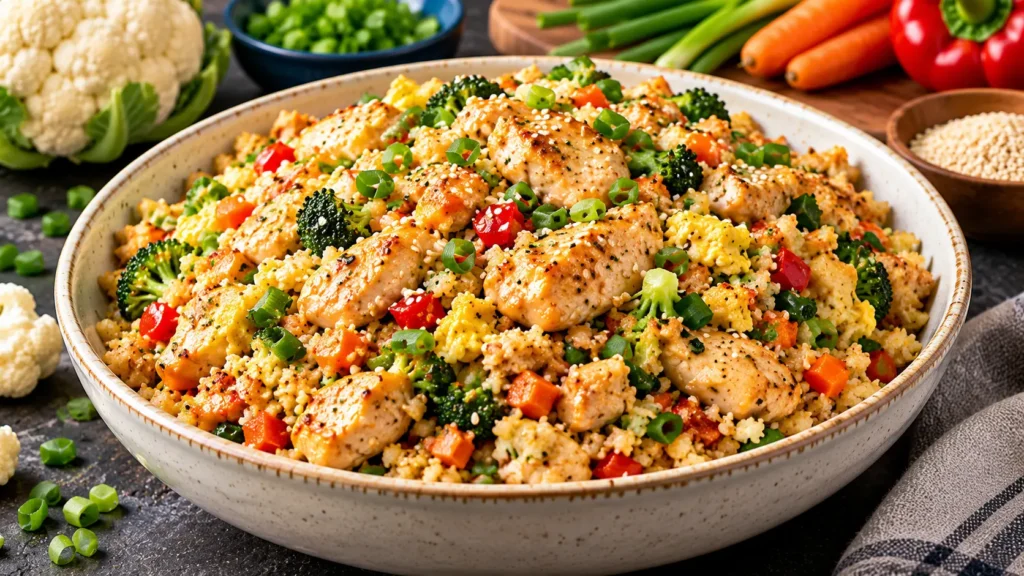
The swap: Riced cauliflower stands in for white rice. It leaves the soy sauce and eggs to do the flavoring.
Riced cauliflower takes the place of the rice in this skillet, and the carb count drops to a fraction of a regular fried rice. Eggs and soy sauce still make it taste like takeout.
Squeeze the cauliflower dry if it's frozen, and don't skip this. Extra water makes the pan steam. Keep the heat high.
The nutrition: About 34 g protein and 7 g net carbs per serving (1 of 4).
Cook the cauliflower only until it's tender with a little bite left, because it turns soft and watery if it sits too long in the pan, and the soy sauce will soak in more evenly when the grains are still firm.
Buy: Fresh riced cauliflower in a bag, or frozen riced cauliflower without sauce. Check that the label lists only cauliflower.
Beef Taco Cauliflower Rice Bowls
A taco bowl keeps the flavor of the taco and drops the shell. Cauliflower rice takes the beans or rice out of the base, and the sour cream cools the spices.
Season the beef in the pan, not at the table. The spices bloom in the hot fat. You'll taste it.
The swap: Riced cauliflower replaces the rice under the beef. Tomatoes and sour cream stay.
The nutrition: Each bowl has about 32 g protein and 6 g net carbs, and the recipe makes 4.
Cook the cauliflower in a separate skillet so it doesn't pick up beef grease, since a clean, lightly browned rice is better beside a rich, spiced topping. I'd also heat the tomatoes for a minute if you prefer them warm.
Skip it if: you don't eat dairy. Leave off the cheddar and sour cream and add sliced avocado.
Sausage and Pepper Cauliflower Skillet
The nutrition: Count on roughly 20 g protein and 12 g net carbs per serving, from 4 equal servings.
Sausage and peppers is usually served in a roll or over pasta. The cauliflower rice soaks up the sausage fat and makes the skillet filling on its own.
The swap: Riced cauliflower replaces the pasta or roll that usually carries sausage and peppers.
Remove the sausage casings so the meat browns in crumbles. Small pieces cook fast. Stir often.
This is one of the higher carb dinners in the guide, at about 12 grams net, since the onion and peppers add up in a single pan. You can cut that by using one pepper in place of two without changing the method.
Reheat: Warm it in a skillet with a spoonful of water. Don't microwave it uncovered.
Garlic Butter Shrimp Over Cauliflower Mash
Cauliflower mash is creamy and mild, and it carries garlic butter as well as mashed potatoes do. Cream cheese gives it the body that cauliflower alone can't.
The swap: Cauliflower mash takes the place of grits or mashed potatoes.
Drain the cauliflower very well after steaming. Wet florets make a thin mash, and it won't recover. Press them in a towel.
The nutrition: One serving comes to about 27 g protein and 7 g net carbs, with 4 in all.
Prep day: Steam and mash the cauliflower a day ahead. Reheat it before the shrimp go in.
Mash it while it's still hot, using a fork or a potato masher for a rustic texture, or blend it for a smooth one. The shrimp cooks in just a few minutes, so it goes into the pan only after the mash is ready.
Pork Chops With Cauliflower Mash
The swap: Cauliflower mash replaces the potatoes beside the chops.
Boneless loin chops are lean, so they cook fast and need a good rest. Cauliflower mash fills the spot where the potatoes would normally go.
The nutrition: Per chop, it's about 43 g protein and 9 g net carbs (4 servings).
Pull the pork at 145°F, not later. It carries on cooking as it rests. Three minutes is enough.
Parmesan in the mash adds salt and a nutty flavor, so you won't need much seasoning beyond what's on the chops. Cooking the green beans in butter after the chops keeps all the browned bits in the pan for them.
Honest note: chops from a thick cut stay juicier than thin ones. I'd ask the butcher for one inch thickness.
Lemon Salmon With Cauliflower Rice
Salmon and asparagus roast together on one pan, and the cauliflower rice cooks in butter in a skillet. That keeps the dishes simple and the carbs low.
Pat the salmon dry with a towel. Dry fish roasts instead of steams. Keep the skin on.
The nutrition: About 39 g protein and 5 g net carbs per fillet (1 of 4).
The swap: Riced cauliflower replaces the rice pilaf. Asparagus takes the second spot on the plate.
Add the lemon juice to the cauliflower at the very end, because the acid brightens the plate, and cooking it for long would dull the flavor. The salmon is done when it flakes at the thickest part and reads 145°F.
Swap: Trout fillets work in place of salmon. They cook in about the same time.
Chicken Broccoli Alfredo Bowls
The swap: Broccoli replaces the fettuccine under the cream sauce.
Alfredo sauce is mostly cream and cheese, so it was never the carb problem. The fettuccine was, and broccoli replaces it and adds some fiber too.
Let the cream simmer, not boil. A hard boil can split it, and you can't fix that. Stay close.
The nutrition: Each bowl has about 35 g protein and 7 g net carbs, and the recipe makes 4.
The sauce thickens fast once the parmesan goes in, so take the pan off the heat the moment it coats the back of a spoon, and add a splash of water if it gets too thick. Heavy cream is the only kind that holds up here.
Buy: Block parmesan that you grate yourself. Pre-grated cheese can leave the sauce grainy.
Don't Miss the Next Recipe
Get fresh recipes, meal prep systems, and high-protein meal ideas delivered to your inbox every week.
No spam. Unsubscribe anytime.
Noodles and Wraps Are the Swap: Zucchini, Cabbage, and Lettuce
Zucchini, cabbage, and lettuce stand in for pasta, wrappers, and tortillas. These 7 dinners use them raw or barely cooked, so they keep a little crunch and don't turn soggy.
For more bowls and wraps without a stove, see our no-cook lunches.
Turkey Bolognese Zucchini Noodles
A meat sauce is easy to keep low in carbs, as long as the tomatoes are crushed and have no added sugar. Zucchini noodles stand in for the spaghetti.
Zucchini gives off water fast. Add it last. Two minutes is plenty.
The swap: Zucchini noodles replace spaghetti under the meat sauce.
The nutrition: Count on roughly 27 g protein and 11 g net carbs per serving, from 4 equal servings.
Spiralize the zucchini or buy it already cut, since it's the same either way, and pat it with a towel before it goes into the sauce so the bolognese doesn't turn thin and watery. At about 11 grams net, it's one of the heavier dinners here, mostly because of the tomatoes.
Skip it if: you don't own a spiralizer. A vegetable peeler makes wide ribbons that work as well.
Pesto Chicken Zucchini Noodles
The nutrition: One serving comes to about 32 g protein and 7 g net carbs, with 4 in all.
Pesto already works without pasta, since the basil, oil, and cheese make a sauce on their own. Zucchini noodles give it a bed to cling to.
The swap: Zucchini noodles replace the pasta in a classic pesto chicken dinner.
Stir the pesto in off the heat. Hot pans dull the basil. Keep it green.
Cook the chicken first and hold it warm, because zucchini noodles need only a quick toss in the pan, and a long cook turns them limp. The cherry tomatoes burst slightly and add a little juice to the sauce.
Buy: Pesto with olive oil, basil, and cheese on the label. Some jars add potato flakes, which add carbs.
Shrimp Scampi Zucchini Noodles
Shrimp scampi is a butter, garlic, and lemon dish by nature. Zucchini noodles in place of linguine make the whole thing lighter and quicker.
The swap: Zucchini noodles replace linguine in the scampi.
Dry the shrimp first. They sear, not steam. Don't crowd the pan. That's the secret.
The nutrition: Per serving, it's about 28 g protein and 6 g net carbs (4 servings).
Swap: Scallops work too. Sear them for two minutes per side.
Shrimp curl into a loose C when they're done, and a tight O means they've cooked too long and turned rubbery, so pull the pan the moment they look pink and opaque. The zucchini only needs two minutes in the butter.
Never Miss a Recipe
Fresh high-protein recipes, meal prep ideas, and kitchen tips, straight to your inbox every week. No spam, just good food.
No spam. Unsubscribe anytime.
Egg Roll in a Bowl
The swap: Shredded cabbage replaces the wrapper and the noodles of an egg roll.
Everything inside an egg roll is cabbage, pork, and seasoning, and the wrapper is the only high carb part. Leave it out and you've got a quick bowl.
The nutrition: About 22 g protein and 5 g net carbs per bowl (1 of 4).
Slice the cabbage thin, since it's quicker. Thin shreds cook fast. A bagged slaw saves time.
Add the soy sauce near the end so it coats the cabbage without making the pan wet, and taste before you add more, since soy sauce is salty and the carbs from it are small but real. I like extra scallions on top.
Freezer note: Freeze it in single portions for up to 3 months. Thaw it overnight in the refrigerator.
Beef Lettuce Wraps
Lettuce cups hold a savory filling the way a taco shell does, with a cool crunch and no starch. Chopped mushrooms stretch the beef and add moisture.
Chop the mushrooms very fine. They almost vanish in the beef, and you won't taste them. Cook off the liquid.
The nutrition: Each serving has about 26 g protein and 3 g net carbs, and the recipe makes 4.
The swap: Butter lettuce leaves replace the rice bowl or the tortilla.
Use butter lettuce, which forms a natural cup, and keep the leaves whole by cutting out the core and peeling them gently under cool water. Fill each one with a spoonful, because overfilled cups tear when you pick them up.
Pack it: Store the filling apart from the lettuce. The leaves stay crisp for 2 days.
Turkey Taco Lettuce Wraps
The swap: Butter lettuce replaces the taco shell.
This is one of the lightest dinners in the guide, at about 3 grams of net carbs. Lettuce replaces the shell, and the avocado supplies the richness a tortilla never did.
Slice the avocado at the last minute. It browns fast. A squeeze of lime helps.
The nutrition: Count on roughly 27 g protein and 3 g net carbs per serving, from 4 equal servings.
Warm the turkey filling before you spoon it in, since cold meat in a cold leaf tastes flat, and the cheddar melts a little against the warm filling. Two small wraps per person is a fair serving for most people.
Swap: Romaine hearts work if you can't find butter lettuce. Use the inner leaves.
Cabbage Roll Skillet
A cabbage roll is meat and rice rolled in a leaf. This skillet keeps the meat and the cabbage and drops the rolling and the rice.
Chop the cabbage into bite-size pieces. They soften evenly. Don't skip the lid.
The swap: Chopped cabbage replaces the rice that goes inside a cabbage roll.
The nutrition: One serving comes to about 26 g protein and 12 g net carbs, with 4 in all.
At about 12 grams net, it's among the higher carb dinners, because cabbage and tomatoes both add up when you eat a large portion. The smoked paprika gives it a stuffed-cabbage flavor without sugar.
Freezer note: It freezes well for 2 to 3 months. The cabbage stays soft but doesn't turn to mush.
No Swap Needed: Protein and Low Starch Vegetables
Some dinners are low in carbs without any trick. These 7 pair a protein with a roasted or sautéed vegetable, and a sauce built from butter, mustard, lemon, or cream.
For more one pan dinners, see our sheet pan dinners.
Lemon Chicken Thighs and Asparagus
The nutrition: Per serving, it's about 36 g protein and 3 g net carbs (4 servings).
This sheet pan needs no swap at all. Chicken thighs and asparagus are already low in carbs, and lemon and butter are the only sauce.
The swap: No swap. The plate is chicken and a low starch vegetable, nothing more.
Add the asparagus later. It cooks fast, and it's done in twelve minutes.
Thighs stay tender at high heat, and the butter and lemon juice run into the pan and season the vegetables as they roast. I'd pick thick spears of asparagus, since thin ones can burn before the chicken reaches 165°F.
Swap: Green beans work in place of asparagus. Roast them the full 25 minutes.
Garlic Butter Steak Bites and Broccoli
Steak bites sear in minutes, and broccoli steams in the same pan. The garlic butter at the end ties it together, and there's no starch anywhere.
The swap: No swap. Broccoli fills the plate where a baked potato would normally sit.
Sear the steak in batches. Crowding steams it. Work fast.
The nutrition: About 39 g protein and 5 g net carbs per serving (1 of 4).
Honest note: sirloin is lean and can turn chewy past medium. I'd pull it at 145°F and no further.
Rest the steak on a plate while the broccoli steams, since the juices settle and stay in the meat instead of running into the pan. Return the steak to the pan only for the final minute with the garlic butter.
Sausage and Brussels Sprouts Sheet Pan
The swap: No swap. The sheet pan holds sausage and a roasted vegetable, so no side starch is needed.
Brussels sprouts roast sweet and crisp at the edges, and sausage supplies the fat and the seasoning. Dijon mustard on the side is all the sauce this pan needs.
The nutrition: Each serving has about 21 g protein and 11 g net carbs, and the recipe makes 4.
Halve the sprouts and set them cut side down on the hot pan, because the flat surface browns deeply and turns sweet while the outer leaves crisp. Don't stir.
This pan lands near 11 grams net, because Brussels sprouts and onion carry more carbs than leafy greens do. The sausage is the main source of protein, and its seasoning means no extra spice jars.
Reheat: Use a hot oven for 10 minutes. The sprouts crisp again.
Dijon Pork Tenderloin and Green Beans
Pork tenderloin is one of the leanest cuts in the store, and a coat of Dijon and garlic gives it a crust. The green beans catch the drippings underneath.
Trim any silver skin. It stays tough. A thin knife slides under it, and you'll feel it release.
The nutrition: Count on roughly 37 g protein and 6 g net carbs per serving, from 4 equal servings.
The swap: No swap. Green beans share the pan, and Dijon mustard is the sauce.
Tenderloin is thin enough to cook in about twenty five minutes, and the rest afterward lets the juices settle so the slices stay moist. USDA guidance for whole pork is 145°F with a three minute rest.
Swap: Chicken thighs work in the same marinade. Roast them to 165°F.
Baked Cod With Zucchini and Tomatoes
The swap: No swap. Zucchini and tomatoes cook beneath the fish and make the sauce.
Cod is mild and flaky, and it takes on the flavor of whatever sits beneath it. Zucchini, tomatoes, olives, and garlic roast into a sauce all on their own.
Roast the vegetables first. They need a head start. Ten minutes is enough.
The nutrition: One fillet comes to about 33 g protein and 5 g net carbs, with 4 in all.
Pat the fish dry and nestle it into the vegetables for the final stretch, since cod cooks quickly and turns dry if it stays in the oven too long. It's done when it flakes and reads 145°F.
Buy: Thick, center-cut fillets. Thin tail pieces overcook before the vegetables are ready.
Creamy Mushroom Chicken and Spinach
Mushrooms and cream make a pan sauce with no flour, which is how this dinner stays low in carbs. Spinach wilts into it at the end.
Don't stir the mushrooms right away. They need to brown. Give them a few minutes.
The swap: No swap. Heavy cream and mushrooms make a sauce that needs no flour.
The nutrition: Per serving, it's about 38 g protein and 4 g net carbs (4 servings).
Cook the chicken first and set it aside, then use the same pan for the mushrooms so you keep all the browned bits that flavor the cream. Add the cream slowly, and keep the heat at a gentle simmer so it doesn't split.
Swap: Chicken breast cutlets work in place of thighs. Check them at 165°F sooner.
Greek Chicken Sheet Pan
The nutrition: About 38 g protein and 6 g net carbs per serving (1 of 4).
Olives and feta carry plenty of salt and richness, so the pan needs nothing else but lemon and oregano. It's a Greek plate with no pita and no rice.
The swap: No swap. Olives and feta supply the salt and richness, so no bread or rice is needed.
Add the feta at the end. It melts. Heat is all it needs.
Cut the chicken, peppers, and onion into similar sizes so they finish together, and spread them in one layer so the edges brown instead of steam. Taste the olives first, because some brands are very salty and you won't need the salt then.
Reheat: Warm it in a 350°F oven for 12 minutes. The feta softens again.
Cheese and Eggs Are the Swap: Bakes, Quiche, and Cups
Cheese and eggs do the work that flour and bread usually do. These 6 dinners set in the oven, so they suit a busy week and they reheat well.
For more make-ahead meals, see our meal prep dinners.
Crustless Spinach Feta Quiche
A quiche is mostly custard, and the crust is the only starch. Leave it out and you've got a high protein slice that sets firm and slices clean.
The swap: Eggs and cream replace the pastry crust.
Cool the spinach before you add the eggs. Hot spinach scrambles them, and you'll get curds. Wait a few minutes.
The nutrition: Each slice has about 13 g protein and 3 g net carbs, and the recipe makes 6.
Prep day: Bake it the day before. It slices cleaner when it's cold.
Squeeze extra water from the cooked spinach with a towel, because it releases liquid in the oven and leaves a wet, weak quiche. It's the lowest protein dinner in the guide, at about 13 grams, so I'd pair a slice with a side of chicken or ham.
Chicken Parmesan Skillet
The swap: Parmesan replaces the breadcrumb coating on the cutlets.
Parmesan on the outside of the cutlet browns into a thin, savory crust, which replaces the usual breadcrumbs. Crushed tomatoes and mozzarella finish the dish.
The nutrition: Count on roughly 47 g protein and 4 g net carbs per serving, from 4 equal servings.
Press the cheese on firmly with a flat hand, because it sticks better to dry chicken, and a loose coating falls off in the pan and burns. It's worth the effort.
Pick unsweetened crushed tomatoes and check the label, because some canned tomatoes add sugar and the carbs climb quickly. The chicken finishes cooking in the sauce, so you can pull it as soon as the thermometer reads 165°F.
Buy: Whole milk shredded mozzarella. It melts smoothly on top.
Cheeseburger Casserole
The best parts of a cheeseburger are the beef and the melted cheddar, and this casserole keeps both. A custard of eggs and cream sets the whole dish.
Drain the fat from the beef. Extra grease pools. Pat the top with a towel.
The nutrition: One serving comes to about 35 g protein and 3 g net carbs, with 6 in all.
The swap: An egg and cheese custard replaces the bun and the potato layer.
Bake until the center is set and a thermometer reads 160°F, since an egg custard needs to reach that temperature to be safe. Let it rest for ten minutes, and the slices will hold their shape on the plate.
Freezer note: Cut it into squares and freeze them in a single layer. Reheat from frozen at 350°F.
Ham and Cheddar Egg Cups
The swap: Eggs replace the English muffin or the toast.
Egg cups are portable, they reheat well, and they hold a whole breakfast sandwich's worth of protein with no bread. Ham and cheddar are the classic filling.
Grease the pan well. Eggs stick, and they won't release cleanly. Silicone cups help too.
The nutrition: Per serving, it's about 31 g protein and 2 g net carbs (4 servings).
Fill each cup about two thirds full, because eggs puff in the oven and then settle as they cool, and an overfull cup spills over the rim. The cups are done when the centers are set and reach 160°F.
Reheat: Microwave two cups for 30 seconds. Don't overheat them.
Pepperoni Pizza Chicken Bake
All of the flavor of a pizza sits on top of the chicken: sauce, mozzarella, pepperoni, and oregano. The chicken breast takes the place of the crust.
Slice the breasts through the side so they cook evenly in the time the cheese needs to melt, and pound them flat if they're still thick. That's the whole trick.
The swap: A chicken breast replaces the pizza crust.
The nutrition: About 45 g protein and 3 g net carbs per serving (1 of 4).
Spoon the tomatoes on thinly, since too much sauce makes the cheese slide off and raises the carbs. The pepperoni crisps at the edges, and the cheese browns where it touches the pan.
Skip it if: you avoid pork. Use turkey pepperoni at the same weight.
Buffalo Chicken Broccoli Bake
The nutrition: Each serving has about 43 g protein and 6 g net carbs, and the recipe makes 4.
Buffalo chicken dip is the model here: chicken, cream cheese, hot sauce, and cheddar. Broccoli turns it from a dip into a full dinner.
The swap: Broccoli replaces the celery and the chips or crackers for scooping.
Whisk the cream cheese and hot sauce smooth. Lumps stay in the oven. Soften the cheese first.
Cut the chicken into small pieces so it cooks through in the time the broccoli needs, and check the center of a large piece with a thermometer. Check the label on your hot sauce, because a few brands add sugar.
Swap: Cauliflower florets replace broccoli with nearly the same carbs.
Low Carb Swap Cheat Sheet
Use these swaps to adapt your own dinners. Each one keeps the dish familiar and cuts the starch.
- Rice becomes riced cauliflower, cooked 5 minutes in a hot skillet.
- Mashed potatoes become cauliflower mash, steamed until very tender and drained well.
- Pasta becomes zucchini noodles, added to the sauce for 2 minutes at the end.
- Tortillas and shells become butter lettuce leaves, filled while the meat is warm.
- Breadcrumbs become grated parmesan, pressed onto the meat before it cooks.
- Crusts become eggs and cream, baked until the center reaches 160°F.
Safety Rules for Low Carb Cooking
The USDA's safe temperature chart lists 165°F for poultry, including ground poultry, and for leftovers, 160°F for ground beef, ground pork, sausage, and egg dishes, and 145°F for fish and for whole cuts of pork and beef, with a 3 minute rest. Shrimp should turn pink and opaque. Cooked leftovers keep 3 to 4 days in the refrigerator, per FoodSafety.gov.
- Use a thermometer, because browning doesn't prove that meat is done.
- Don't rinse raw poultry. The USDA advises against it because the water spreads bacteria.
- Cook egg dishes until the center is set and firm, with no runny egg.
- Refrigerate leftovers within 2 hours, or within 1 hour above 90°F, in shallow containers.
- Reheat every portion to 165°F, and freeze batches in single portions.
Time, Protein, and Net Carbs at a Glance
Use this list to plan the week. Times include prep and cooking, and the numbers are per serving.
- Chicken Cauliflower Fried Rice: 35 min, about 34 g protein and 7 g net carbs per serving
- Beef Taco Cauliflower Rice Bowls: 35 min, about 32 g protein and 6 g net carbs per bowl
- Sausage and Pepper Cauliflower Skillet: 35 min, about 20 g protein and 12 g net carbs per serving
- Garlic Butter Shrimp Over Cauliflower Mash: 35 min, about 27 g protein and 7 g net carbs per serving
- Pork Chops With Cauliflower Mash: 35 min, about 43 g protein and 9 g net carbs per chop
- Lemon Salmon With Cauliflower Rice: 30 min, about 39 g protein and 5 g net carbs per fillet
- Chicken Broccoli Alfredo Bowls: 35 min, about 35 g protein and 7 g net carbs per bowl
- Turkey Bolognese Zucchini Noodles: 45 min, about 27 g protein and 11 g net carbs per serving
- Pesto Chicken Zucchini Noodles: 30 min, about 32 g protein and 7 g net carbs per serving
- Shrimp Scampi Zucchini Noodles: 27 min, about 28 g protein and 6 g net carbs per serving
- Egg Roll in a Bowl: 30 min, about 22 g protein and 5 g net carbs per bowl
- Beef Lettuce Wraps: 30 min, about 26 g protein and 3 g net carbs per serving
- Turkey Taco Lettuce Wraps: 30 min, about 27 g protein and 3 g net carbs per serving
- Cabbage Roll Skillet: 50 min, about 26 g protein and 12 g net carbs per serving
- Lemon Chicken Thighs and Asparagus: 40 min, about 36 g protein and 3 g net carbs per serving
- Garlic Butter Steak Bites and Broccoli: 30 min, about 39 g protein and 5 g net carbs per serving
- Sausage and Brussels Sprouts Sheet Pan: 45 min, about 21 g protein and 11 g net carbs per serving
- Dijon Pork Tenderloin and Green Beans: 40 min, about 37 g protein and 6 g net carbs per serving
- Baked Cod With Zucchini and Tomatoes: 35 min, about 33 g protein and 5 g net carbs per fillet
- Creamy Mushroom Chicken and Spinach: 40 min, about 38 g protein and 4 g net carbs per serving
- Greek Chicken Sheet Pan: 50 min, about 38 g protein and 6 g net carbs per serving
- Crustless Spinach Feta Quiche: 55 min, about 13 g protein and 3 g net carbs per slice
- Chicken Parmesan Skillet: 35 min, about 47 g protein and 4 g net carbs per serving
- Cheeseburger Casserole: 50 min, about 35 g protein and 3 g net carbs per serving
- Ham and Cheddar Egg Cups: 32 min, about 31 g protein and 2 g net carbs per serving
- Pepperoni Pizza Chicken Bake: 35 min, about 45 g protein and 3 g net carbs per serving
- Buffalo Chicken Broccoli Bake: 40 min, about 43 g protein and 6 g net carbs per serving
How I Counted Protein and Carbs
I multiplied typical USDA FoodData Central values by the weights on each card, then divided by the servings. Raw meat and fish are counted raw, and net carbs equal total carbohydrate minus fiber, so the numbers are estimates.
Several inputs rest on assumptions: crushed tomatoes at 5.5 g carbs per 100 g, pesto at 6, soy sauce at 5.6, and Italian sausage at 1.8. Brands of sausage, sauces, and canned tomatoes vary, so check your labels.
Where These Cards Differ From Typical Versions
These cards are my own builds, weighed so the protein and carbs can be counted. A test cook is wise before you serve them to guests. Check your first batch early.
Two common habits don't meet the USDA minimums. Pink pork and runny egg in a bake aren't safe choices, so the cards cook ground meat and egg dishes to 160°F and poultry to 165°F. That matters most for children, older adults, and pregnant guests.
A few dishes resemble cards in our earlier lists, including the taco lettuce wraps and the egg cups, which also appear in our meal prep dinners. Don't cook both in one week.
Questions About Low Carb Dinners
Which dinner has the most protein?
Chicken Parmesan Skillet leads at about 47 grams per serving, followed by Pepperoni Pizza Chicken Bake at about 45 grams and Buffalo Chicken Broccoli Bake at about 43.
Which dinner has the fewest carbs?
Ham and Cheddar Egg Cups comes in lowest at about 2 grams of net carbs per serving.
Can I freeze these dinners?
Fried rice, skillets, bakes, quiche, and egg cups freeze well for 2 to 3 months. Zucchini noodles and lettuce wraps are best fresh. See our family dinners for more batch meals.
How long do leftovers keep?
Cooked leftovers keep 3 to 4 days in the refrigerator, per FoodSafety.gov. Reheat them to 165°F.
Is 12 grams of net carbs low carb?
There's no official cutoff. It's a common target for a single dinner. If you manage blood sugar or a medical condition, ask your doctor what suits you.
1. Chicken Cauliflower Fried Rice
Approx. 34g ProteinIngredients: 1 lb (454 g) boneless chicken breast; 4 cups (600 g) riced cauliflower; 3 large eggs (50 g each, 150 g); 3 tbsp (48 g) soy sauce; 4 scallions, sliced (60 g); 3 garlic cloves, minced (9 g); 2 tbsp olive oil.
Step 1: Cut the chicken into 1/2 inch pieces and cook in 1 tbsp of the olive oil with the garlic for 7 minutes, until browned and a thermometer reads 165°F. Move it to a plate.
Step 2: Scramble the eggs in the same skillet until firm, and a thermometer reads 160°F, then push them to the side.
Step 3: Add the remaining olive oil and the riced cauliflower and cook 5 minutes, until tender but not mushy. Stir in the chicken, soy sauce, and scallions and heat 1 minute. Cool within 2 hours, or within 1 hour above 90°F, and pack in shallow containers. Refrigerate up to 3 to 4 days, or freeze portions up to 2 to 3 months, and reheat to 165°F.
2. Beef Taco Cauliflower Rice Bowls
Approx. 32g ProteinIngredients: 1 lb (454 g) 90 percent lean ground beef; 3 cups (450 g) riced cauliflower; 1 cup (113 g) shredded cheddar cheese; 1 cup (150 g) diced fresh tomatoes; 1/2 cup (120 g) sour cream; 2 tsp chili powder; 1 tsp ground cumin; 1 tbsp olive oil; 1/2 tsp salt.
Step 1: Brown the beef in 1 tbsp of the olive oil with the chili powder, cumin, and salt for 8 minutes, until no pink remains and a thermometer reads 160°F.
Step 2: Cook the riced cauliflower in a separate skillet for 5 minutes, until tender.
Step 3: Divide the cauliflower among 4 bowls and top with the beef, cheddar, tomatoes, and sour cream. Cool within 2 hours, or within 1 hour above 90°F, and pack in shallow containers. Refrigerate up to 3 to 4 days, and reheat to 165°F in the microwave or oven.
3. Sausage and Pepper Cauliflower Skillet
Approx. 20g ProteinIngredients: 1 lb (454 g) Italian sausage, casings removed; 2 bell peppers, sliced (300 g); 1 yellow onion, sliced (150 g); 3 cups (450 g) riced cauliflower; 3 garlic cloves, minced (9 g); 1 tbsp olive oil; 1/2 tsp salt.
Step 1: Crumble the sausage into a large skillet and cook over medium heat for 8 minutes, until no pink remains and a thermometer reads 160°F.
Step 2: Add the bell peppers, onion, and olive oil and cook 6 minutes, until tender.
Step 3: Stir in the riced cauliflower, garlic, and salt and cook 5 minutes. Cool within 2 hours, or within 1 hour above 90°F, and pack in shallow containers. Refrigerate up to 3 to 4 days, or freeze portions up to 2 to 3 months, and reheat to 165°F.
4. Garlic Butter Shrimp Over Cauliflower Mash
Approx. 27g ProteinIngredients: 1 lb (454 g) peeled shrimp; 1 large head cauliflower, cut in florets (700 g); 4 tbsp (57 g) butter; 2 oz (57 g) cream cheese; 4 garlic cloves, minced (12 g); 1 tbsp (15 g) lemon juice; 1 cup water; 1/2 tsp salt.
Step 1: Steam the cauliflower in the water, covered, for 12 minutes, until very tender, and drain well. Mash with the cream cheese, 1 tbsp of the butter, and the salt.
Step 2: Melt the remaining butter in a skillet, add the garlic for 30 seconds, then add the shrimp.
Step 3: Cook the shrimp 2 to 3 minutes per side, until pink and opaque, then add the lemon juice and spoon over the mash. Cool within 2 hours, or within 1 hour above 90°F, and pack in shallow containers. Refrigerate up to 3 to 4 days, and reheat to 165°F in the microwave or oven.
5. Pork Chops With Cauliflower Mash
Approx. 43g ProteinIngredients: 4 boneless pork loin chops, 6 oz each (680 g); 1 large head cauliflower, cut in florets (700 g); 1/4 cup (30 g) grated parmesan cheese; 12 oz (340 g) green beans, trimmed; 2 tbsp (28 g) butter; 1 cup water; 1 tbsp olive oil; 1/2 tsp salt; 1/2 tsp black pepper.
Step 1: Steam the cauliflower in the water for 12 minutes, until tender, and drain. Mash with the parmesan, 1 tbsp of the butter, and the salt.
Step 2: Season the pork chops with the pepper and cook in the olive oil for 4 to 5 minutes per side, until a thermometer reads 145°F. Rest 3 minutes.
Step 3: Cook the green beans in the remaining butter for 6 minutes, until crisp tender, and serve with the chops. Cool within 2 hours, or within 1 hour above 90°F, and pack in shallow containers. Refrigerate up to 3 to 4 days, and reheat to 165°F in the microwave or oven.
6. Lemon Salmon With Cauliflower Rice
Approx. 39g ProteinIngredients: 4 salmon fillets, 6 oz each (680 g); 3 cups (450 g) riced cauliflower; 12 oz (340 g) asparagus, trimmed; 2 tbsp (30 g) lemon juice; 2 tbsp (28 g) butter; 1/2 tsp salt.
Step 1: Heat the oven to 400°F. Set the salmon and asparagus on a rimmed baking sheet, dot with 1 tbsp of the butter, and sprinkle with the salt.
Step 2: Roast 12 to 14 minutes, until the salmon flakes and a thermometer reads 145°F.
Step 3: Cook the riced cauliflower in the remaining butter for 5 minutes, stir in the lemon juice, and serve with the salmon. Cool within 2 hours, or within 1 hour above 90°F, and pack in shallow containers. Refrigerate up to 3 to 4 days, and reheat to 165°F in the microwave or oven.
7. Chicken Broccoli Alfredo Bowls
Approx. 35g ProteinIngredients: 1 lb (454 g) boneless chicken breast; 1 cup (240 g) heavy cream; 1/2 cup (60 g) grated parmesan cheese; 4 cups (400 g) broccoli florets; 3 garlic cloves, minced (9 g); 1 tbsp (14 g) butter; 1/2 tsp salt; 1/2 tsp black pepper.
Step 1: Cut the chicken into 1 inch pieces and cook in the butter with the salt and pepper for 7 to 8 minutes, until browned and a thermometer reads 165°F.
Step 2: Add the garlic for 30 seconds, then pour in the heavy cream and simmer 4 minutes, until it thickens slightly.
Step 3: Stir in the parmesan and broccoli, cover, and cook 4 minutes, until the broccoli is tender. Cool within 2 hours, or within 1 hour above 90°F, and pack in shallow containers. Refrigerate up to 3 to 4 days, and reheat to 165°F in the microwave or oven.
8. Turkey Bolognese Zucchini Noodles
Approx. 27g ProteinIngredients: 1 lb (454 g) ground turkey; 1 can (15 oz) crushed tomatoes (425 g); 4 medium zucchini, spiralized (800 g); 1/2 yellow onion, diced (75 g); 1/4 cup (30 g) grated parmesan cheese; 2 garlic cloves, minced (6 g); 1 tsp dried oregano; 1 tbsp olive oil; 1/2 tsp salt.
Step 1: Cook the onion in the olive oil for 4 minutes. Add the turkey and garlic and cook 8 minutes, until no pink remains and a thermometer reads 165°F.
Step 2: Stir in the crushed tomatoes, oregano, and salt and simmer 15 minutes.
Step 3: Toss the zucchini noodles into the hot sauce for 2 minutes, until barely tender, and top with the parmesan. Cool within 2 hours, or within 1 hour above 90°F, and pack in shallow containers. Refrigerate up to 3 to 4 days, and reheat to 165°F in the microwave or oven.
9. Pesto Chicken Zucchini Noodles
Approx. 32g ProteinIngredients: 1 lb (454 g) boneless chicken breast; 4 medium zucchini, spiralized (800 g); 1/2 cup (120 g) basil pesto; 1 cup (150 g) cherry tomatoes, halved; 1/4 cup (30 g) grated parmesan cheese; 1 tbsp olive oil; 1/2 tsp salt.
Step 1: Cut the chicken into 1 inch pieces and cook in the olive oil with the salt for 7 to 8 minutes, until browned and a thermometer reads 165°F.
Step 2: Add the zucchini noodles and tomatoes and cook 2 minutes, until barely tender.
Step 3: Off the heat, stir in the pesto and top with the parmesan. Cool within 2 hours, or within 1 hour above 90°F, and pack in shallow containers. Refrigerate up to 3 to 4 days, and reheat to 165°F in the microwave or oven.
10. Shrimp Scampi Zucchini Noodles
Approx. 28g ProteinIngredients: 1 lb (454 g) peeled shrimp; 4 medium zucchini, spiralized (800 g); 4 tbsp (57 g) butter; 4 garlic cloves, minced (12 g); 2 tbsp (30 g) lemon juice; 1/4 cup (30 g) grated parmesan cheese; 1/2 tsp salt.
Step 1: Melt the butter in a large skillet and cook the garlic for 30 seconds.
Step 2: Add the shrimp and the salt and cook 2 to 3 minutes per side, until pink and opaque.
Step 3: Add the zucchini noodles and lemon juice and toss 2 minutes, until just tender. Top with the parmesan. Cool within 2 hours, or within 1 hour above 90°F, and pack in shallow containers. Refrigerate up to 3 to 4 days, and reheat to 165°F in the microwave or oven.
11. Egg Roll in a Bowl
Approx. 22g ProteinIngredients: 1 lb (454 g) ground pork; 6 cups (400 g) shredded green cabbage; 3 tbsp (48 g) soy sauce; 3 garlic cloves, minced (9 g); 1 tbsp (10 g) minced fresh ginger; 3 scallions, sliced (40 g); 1 tbsp olive oil.
Step 1: Brown the pork in the olive oil for 8 minutes, until no pink remains and a thermometer reads 160°F.
Step 2: Add the garlic and ginger for 30 seconds, then the cabbage and soy sauce.
Step 3: Cook 6 to 8 minutes, until the cabbage is tender, and top with the scallions. Cool within 2 hours, or within 1 hour above 90°F, and pack in shallow containers. Refrigerate up to 3 to 4 days, or freeze portions up to 2 to 3 months, and reheat to 165°F.
12. Beef Lettuce Wraps
Approx. 26g ProteinIngredients: 1 lb (454 g) 90 percent lean ground beef; 1 head butter lettuce, leaves separated (200 g); 8 oz (225 g) mushrooms, finely chopped; 3 tbsp (48 g) soy sauce; 2 garlic cloves, minced (6 g); 2 scallions, sliced (30 g); 1 tbsp olive oil.
Step 1: Cook the mushrooms in the olive oil for 5 minutes, until the liquid cooks off.
Step 2: Add the beef and garlic and cook 8 minutes, until no pink remains and a thermometer reads 160°F, then stir in the soy sauce.
Step 3: Spoon into the lettuce leaves and top with the scallions. Cool within 2 hours, or within 1 hour above 90°F, and pack in shallow containers. Refrigerate up to 3 to 4 days, and reheat to 165°F in the microwave or oven.
13. Turkey Taco Lettuce Wraps
Approx. 27g ProteinIngredients: 1 lb (454 g) ground turkey; 1 head butter lettuce, leaves separated (200 g); 1 large avocado, sliced (150 g); 3/4 cup (85 g) shredded cheddar cheese; 1 cup (150 g) diced fresh tomatoes; 2 tsp chili powder; 1 tsp ground cumin; 1 tbsp olive oil; 1/2 tsp salt.
Step 1: Brown the turkey in the olive oil with the chili powder, cumin, and salt for 8 minutes, until no pink remains and a thermometer reads 165°F.
Step 2: Spoon the turkey into the lettuce leaves.
Step 3: Top with the avocado, cheddar, and tomatoes. Cool within 2 hours, or within 1 hour above 90°F, and pack in shallow containers. Refrigerate up to 3 to 4 days, and reheat to 165°F in the microwave or oven.
14. Cabbage Roll Skillet
Approx. 26g ProteinIngredients: 1 lb (454 g) 90 percent lean ground beef; 6 cups (600 g) chopped green cabbage; 1 can (14.5 oz) diced tomatoes (411 g); 1 yellow onion, diced (150 g); 3 garlic cloves, minced (9 g); 1 tsp smoked paprika; 1 tbsp olive oil; 1/2 tsp salt; 1/2 tsp black pepper.
Step 1: Cook the onion in the olive oil for 4 minutes. Add the beef and garlic and cook 8 minutes, until no pink remains and a thermometer reads 160°F.
Step 2: Stir in the cabbage, diced tomatoes, smoked paprika, salt, and pepper.
Step 3: Cover and simmer 20 minutes, until the cabbage is tender. Cool within 2 hours, or within 1 hour above 90°F, and pack in shallow containers. Refrigerate up to 3 to 4 days, or freeze portions up to 2 to 3 months, and reheat to 165°F.
15. Lemon Chicken Thighs and Asparagus
Approx. 36g ProteinIngredients: 1 1/2 lb (680 g) boneless chicken thighs; 1 lb (450 g) asparagus, trimmed; 3 tbsp (45 g) lemon juice; 2 tbsp (28 g) butter, melted; 3 garlic cloves, minced (9 g); 1/2 tsp salt; 1/2 tsp black pepper.
Step 1: Heat the oven to 425°F. Toss the chicken with the butter, garlic, lemon juice, salt, and pepper on a rimmed baking sheet.
Step 2: Roast 12 minutes, then add the asparagus around the chicken.
Step 3: Roast 12 to 15 minutes more, until the chicken is browned and a thermometer reads 165°F. Cool within 2 hours, or within 1 hour above 90°F, and pack in shallow containers. Refrigerate up to 3 to 4 days, and reheat to 165°F in the microwave or oven.
16. Garlic Butter Steak Bites and Broccoli
Approx. 39g ProteinIngredients: 1 1/2 lb (680 g) sirloin steak, cut in 1 inch cubes; 4 cups (450 g) broccoli florets; 2 tbsp (28 g) butter; 4 garlic cloves, minced (12 g); 1 tbsp olive oil; 1/2 tsp salt; 1/2 tsp black pepper; 1/4 cup water.
Step 1: Season the steak with the salt and pepper and sear in the olive oil over high heat for 2 to 3 minutes per side, until a thermometer reads 145°F. Rest on a plate for 3 minutes.
Step 2: Add the broccoli and water to the skillet, cover, and steam 4 minutes.
Step 3: Add the butter and garlic for 1 minute and return the steak to the pan. Cool within 2 hours, or within 1 hour above 90°F, and pack in shallow containers. Refrigerate up to 3 to 4 days, and reheat to 165°F in the microwave or oven.
17. Sausage and Brussels Sprouts Sheet Pan
Approx. 21g ProteinIngredients: 1 lb (454 g) Italian sausage links; 1 lb (450 g) Brussels sprouts, halved; 1 yellow onion, cut in wedges (150 g); 2 tbsp (30 g) Dijon mustard; 2 tbsp olive oil; 1/2 tsp salt.
Step 1: Heat the oven to 425°F. Toss the Brussels sprouts and onion with the olive oil and salt on a rimmed baking sheet.
Step 2: Nestle the sausage links among the vegetables and roast 25 to 30 minutes, turning once, until a thermometer in the sausage reads 160°F.
Step 3: Serve with the Dijon mustard. Cool within 2 hours, or within 1 hour above 90°F, and pack in shallow containers. Refrigerate up to 3 to 4 days, or freeze portions up to 2 to 3 months, and reheat to 165°F.
18. Dijon Pork Tenderloin and Green Beans
Approx. 37g ProteinIngredients: 1 1/2 lb (680 g) pork tenderloin; 1 lb (450 g) green beans, trimmed; 3 tbsp (40 g) Dijon mustard; 3 garlic cloves, minced (9 g); 2 tbsp olive oil; 1/2 tsp salt; 1/2 tsp black pepper.
Step 1: Heat the oven to 425°F. Mix the Dijon, garlic, 1 tbsp of the olive oil, the salt, and pepper and rub it over the pork.
Step 2: Toss the green beans with the remaining olive oil on a rimmed baking sheet and set the pork on top.
Step 3: Roast 22 to 25 minutes, until a thermometer reads 145°F, and rest 3 minutes before slicing. Cool within 2 hours, or within 1 hour above 90°F, and pack in shallow containers. Refrigerate up to 3 to 4 days, and reheat to 165°F in the microwave or oven.
19. Baked Cod With Zucchini and Tomatoes
Approx. 33g ProteinIngredients: 1 1/2 lb (680 g) cod fillets; 2 medium zucchini, sliced (500 g); 1 1/2 cups (250 g) cherry tomatoes; 1/2 cup (60 g) pitted olives; 3 garlic cloves, minced (9 g); 2 tbsp olive oil; 1/2 tsp salt.
Step 1: Heat the oven to 400°F. Toss the zucchini, tomatoes, olives, garlic, olive oil, and salt in a 9 by 13 inch baking dish and roast 10 minutes.
Step 2: Nestle the cod into the vegetables.
Step 3: Roast 12 to 15 minutes, until the fish flakes and a thermometer reads 145°F. Cool within 2 hours, or within 1 hour above 90°F, and pack in shallow containers. Refrigerate up to 3 to 4 days, and reheat to 165°F in the microwave or oven.
20. Creamy Mushroom Chicken and Spinach
Approx. 38g ProteinIngredients: 1 1/2 lb (680 g) boneless chicken thighs; 10 oz (300 g) mushrooms, sliced; 7 oz (200 g) baby spinach; 1/2 cup (120 g) heavy cream; 3 garlic cloves, minced (9 g); 1 tbsp olive oil; 1/2 tsp salt; 1/2 tsp black pepper.
Step 1: Season the chicken with the salt and pepper and cook in the olive oil for 6 minutes per side, until browned and a thermometer reads 165°F. Move it to a plate.
Step 2: Cook the mushrooms in the same skillet for 6 minutes, add the garlic for 30 seconds, then pour in the heavy cream and simmer 3 minutes.
Step 3: Stir in the spinach until wilted and return the chicken to the pan. Cool within 2 hours, or within 1 hour above 90°F, and pack in shallow containers. Refrigerate up to 3 to 4 days, and reheat to 165°F in the microwave or oven.
21. Greek Chicken Sheet Pan
Approx. 38g ProteinIngredients: 1 1/2 lb (680 g) boneless chicken thighs; 2 bell peppers, cut in chunks (300 g); 1 red onion, cut in wedges (100 g); 1/2 cup (60 g) kalamata olives; 3/4 cup (85 g) crumbled feta cheese; 2 tbsp (30 g) lemon juice; 1 tsp dried oregano; 2 tbsp olive oil; 1/2 tsp salt.
Step 1: Heat the oven to 425°F. Toss the chicken, bell peppers, red onion, olive oil, lemon juice, oregano, and salt on a rimmed baking sheet.
Step 2: Roast 25 to 30 minutes, until the chicken is browned and a thermometer reads 165°F.
Step 3: Scatter the olives and feta over the pan and roast 3 minutes. Cool within 2 hours, or within 1 hour above 90°F, and pack in shallow containers. Refrigerate up to 3 to 4 days, or freeze portions up to 2 to 3 months, and reheat to 165°F.
22. Crustless Spinach Feta Quiche
Approx. 13g ProteinIngredients: 8 large eggs (50 g each, 400 g); 7 oz (200 g) baby spinach; 1 cup (113 g) crumbled feta cheese; 1/2 cup (120 g) heavy cream; 1/2 yellow onion, diced (75 g); 1 tbsp olive oil; 1/2 tsp salt; 1/2 tsp black pepper.
Step 1: Heat the oven to 375°F. Cook the onion in the olive oil for 4 minutes, add the spinach until wilted, and let it cool slightly.
Step 2: Whisk the eggs, heavy cream, salt, and pepper and pour into a greased 9 inch pie dish. Add the spinach mixture and the feta.
Step 3: Bake 35 minutes, until set and a thermometer in the center reads 160°F. Cool within 2 hours, or within 1 hour above 90°F, and pack in shallow containers. Refrigerate up to 3 to 4 days, or freeze portions up to 2 to 3 months, and reheat to 165°F.
23. Chicken Parmesan Skillet
Approx. 47g ProteinIngredients: 1 1/4 lb (567 g) thin chicken breast cutlets; 1 cup (240 g) crushed tomatoes; 1 1/2 cups (170 g) shredded mozzarella cheese; 1/2 cup (60 g) grated parmesan cheese; 1/4 cup (10 g) fresh basil; 1 tbsp olive oil; 1/2 tsp salt; 1/2 tsp black pepper.
Step 1: Season the chicken with the salt and pepper, press on half the parmesan, and cook in the olive oil for 4 minutes per side.
Step 2: Pour the crushed tomatoes over the chicken, cover, and simmer 6 minutes, until a thermometer reads 165°F.
Step 3: Top with the mozzarella and the remaining parmesan, cover until melted, and finish with the basil. Cool within 2 hours, or within 1 hour above 90°F, and pack in shallow containers. Refrigerate up to 3 to 4 days, and reheat to 165°F in the microwave or oven.
24. Cheeseburger Casserole
Approx. 35g ProteinIngredients: 1 1/2 lb (680 g) 90 percent lean ground beef; 2 cups (227 g) shredded cheddar cheese; 3 large eggs (150 g); 1/2 cup (120 g) heavy cream; 1 yellow onion, diced (150 g); 1 tbsp olive oil; 1/2 tsp salt; 1/2 tsp black pepper.
Step 1: Heat the oven to 375°F. Cook the onion in the olive oil for 4 minutes, add the beef, salt, and pepper, and cook 8 minutes, until no pink remains.
Step 2: Spread the beef in a 9 by 13 inch baking dish and top with 1 cup of the cheddar.
Step 3: Whisk the eggs with the heavy cream, pour over, add the remaining cheddar, and bake 25 minutes, until set and a thermometer reads 160°F. Cool within 2 hours, or within 1 hour above 90°F, and pack in shallow containers. Refrigerate up to 3 to 4 days, or freeze portions up to 2 to 3 months, and reheat to 165°F.
25. Ham and Cheddar Egg Cups
Approx. 31g ProteinIngredients: 10 large eggs (50 g each, 500 g); 6 oz (170 g) diced cooked ham; 1 cup (113 g) shredded cheddar cheese; 3.5 oz (100 g) baby spinach, chopped; 1 tbsp olive oil; 1/2 tsp salt; 1/2 tsp black pepper.
Step 1: Heat the oven to 350°F and brush a 12 cup muffin pan with the olive oil.
Step 2: Divide the ham, spinach, and cheddar among the cups. Whisk the eggs with the salt and pepper and pour them over.
Step 3: Bake 18 to 22 minutes, until set and a thermometer reads 160°F. Cool within 2 hours, or within 1 hour above 90°F, and pack in shallow containers. Refrigerate up to 3 to 4 days, or freeze portions up to 2 to 3 months, and reheat to 165°F.
26. Pepperoni Pizza Chicken Bake
Approx. 45g ProteinIngredients: 1 1/4 lb (567 g) boneless chicken breast; 3/4 cup (180 g) crushed tomatoes; 1 1/2 cups (170 g) shredded mozzarella cheese; 2 oz (57 g) sliced pepperoni; 1 tsp dried oregano; 1 tbsp olive oil; 1/2 tsp salt.
Step 1: Heat the oven to 400°F. Slice the chicken breasts in half through the side, season with the salt, and set in a 9 by 13 inch baking dish brushed with the olive oil.
Step 2: Spoon the crushed tomatoes over, sprinkle with the oregano, and top with the mozzarella and pepperoni.
Step 3: Bake 22 to 25 minutes, until the cheese is bubbling and a thermometer reads 165°F. Cool within 2 hours, or within 1 hour above 90°F, and pack in shallow containers. Refrigerate up to 3 to 4 days, and reheat to 165°F in the microwave or oven.
27. Buffalo Chicken Broccoli Bake
Approx. 43g ProteinIngredients: 1 1/4 lb (567 g) boneless chicken breast; 4 oz (113 g) cream cheese; 1/3 cup (80 g) buffalo hot sauce; 1 cup (113 g) shredded cheddar cheese; 4 cups (450 g) broccoli florets; 1/2 tsp salt.
Step 1: Heat the oven to 375°F. Cut the chicken into 1 inch pieces and spread with the broccoli and salt in a 9 by 13 inch baking dish.
Step 2: Whisk the cream cheese with the buffalo hot sauce until smooth and spoon it over.
Step 3: Top with the cheddar and bake 25 to 30 minutes, until bubbling and a thermometer in the chicken reads 165°F. Cool within 2 hours, or within 1 hour above 90°F, and pack in shallow containers. Refrigerate up to 3 to 4 days, or freeze portions up to 2 to 3 months, and reheat to 165°F.
Get Fresh Recipes Every Week
Join readers getting fresh recipes, meal prep systems, and high-protein meal ideas delivered to your inbox every week.
No spam. Unsubscribe anytime.