
See all 27 recipes
Table of Contents
- Why Rest Time Runs the Day
- Straight to the Table: No Rest Needed
- Rest 10 to 20 Minutes: Short Waits, Quick Sides
- Rest 20 to 30 Minutes: The Big Roasts
- Hold for an Hour or More: Dishes That Wait for You
- A Christmas Day Clock
- Thawing and Food Safety for Big Roasts
- Time and Protein at a Glance
- How I Counted Protein
- Where These Cards Differ From Typical Versions
- FAQ
- Recipe Cards
Christmas dinner usually goes wrong at the oven, not the stove.
One big roast takes the oven for hours, and the sides wait. So this list is sorted by how long each main rests or holds. Every card gives exact weights, USDA temperatures, and protein per serving, from 17 to 61 grams.
If you're feeding a larger group, our holiday main dishes for a crowd has more.
Our Take
Use a thermometer on every roast, and rest it before carving.
Why Rest Time Runs the Day
Meat needs to rest after cooking so the juices settle, and the USDA's minimum for whole cuts of beef, pork, and lamb includes a 3 minute rest. Large roasts rest much longer, and that wait is when the oven is free.
- No rest: fish, seafood, and baked dishes that go straight to the table.
- 10 to 20 minutes: a small roast, a bird, or a layered pasta that needs to set.
- 20 to 30 minutes: a large roast that you carve while the sides bake.
- An hour or more: braises, ham, and stews that hold hot without harm.
Every card ends with a line called Oven plan that says what the oven does next. For a side dish plan, see our Thanksgiving sides you can make ahead, which work for Christmas too.
Straight to the Table: No Rest Needed
These 6 dinners go from the oven or stove to the plate with no rest, so there's no waiting and no carving. They're the right choice for a small table, a seafood meal, or a vegetarian guest.
For more fish ideas, see our salmon dinners.
Honey Mustard Roasted Salmon Side
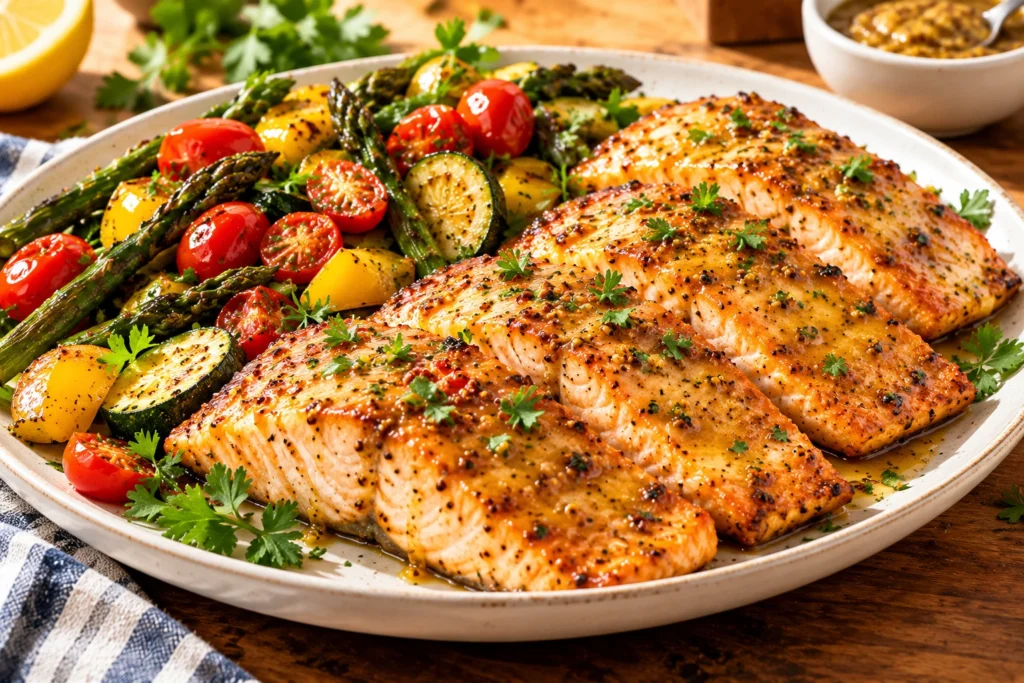
A whole side of salmon is the easiest Christmas centerpiece, because it needs one pan, fifteen minutes, and no resting at all. A honey and Dijon glaze gives the fish a sweet, tangy crust, and the lemon slices on top keep it moist.
Oven plan: It's out in 20 minutes, so you'll have the oven back. Roast vegetables at 425°F for 25 minutes while you glaze and plate.
Keep the skin on. It's a shield.
Salmon is done when a thermometer reads 145°F, per the USDA, and the flesh just flakes, which usually takes 15 to 20 minutes for a 1 inch thick side at 400°F. Pull it a minute early if your fillet is thinner at one end, since the thin edge overcooks first.
The nutrition: About 35 g protein per serving (1 of 8). The salmon carries the most, and the garlic comes next.
Lemon Crumb Baked Cod
The nutrition: Each fillet has about 29 g protein, and the batch makes 6. Most of that comes from the cod, with the Parmesan adding more.
Cod is a mild, flaky fish that suits people who say they don't like seafood. A crust of panko, Parmesan, and butter adds crunch, and the whole dish bakes in about fifteen minutes.
Pat the fillets dry. Wet fish won't brown.
Press the crumbs on firmly so they stay put when you lift a fillet, and bake on the top rack at 425°F so the topping browns before the fish overcooks. I'd check one fillet at 12 minutes, because thin tail pieces finish first.
Oven plan: Serve it straight away. A tray of potatoes can roast at 425°F before and after, since the oven's already hot.
Don't Miss the Next Recipe
Get fresh recipes, meal prep systems, and high-protein meal ideas delivered to your inbox every week.
No spam. Unsubscribe anytime.
Garlic Butter Shrimp Scampi Linguine
Oven plan: Bread or vegetables can use the oven. Toss the pasta at the last second, and serve it hot.
Shrimp scampi cooks entirely on the stove, which makes it the best answer when the oven is booked by a roast. Garlic, butter, and lemon do all the work, and the dish is done in fifteen minutes.
Don't overcook the shrimp. They'll turn rubbery.
The nutrition: Count on roughly 32 g protein per plate, from 6 equal servings. The shrimp leads, followed by the pasta.
Shrimp are done when they turn pink and opaque, usually after two to three minutes a side, and the broth and lemon juice turn the butter into a light sauce. I'd keep the heat at medium so the garlic doesn't scorch and turn bitter.
Chicken Parmesan Bake
Chicken Parmesan baked on a sheet pan gives you the crisp cutlet without frying six pieces one at a time. It's a crowd pleaser for the kids' table and the adults', and jarred marinara keeps it simple.
Pound the cutlets even. Thick ends stay raw.
The nutrition: One cutlet comes to about 50 g protein, with 6 in all. The chicken carries the most, and the mozzarella comes next.
The chicken needs to reach 165°F in the center, and the cheese melts in the last ten minutes, so let the cutlets bake plain first and add the marinara and mozzarella afterward. That's what keeps the crumbs from turning soggy under the sauce.
Oven plan: It's a 425°F dish, so you won't need to reheat anything. Serve it with pasta cooked on the stove, and plate it straight from the pan.
Baked Crab Cakes With Lemon Yogurt Sauce
Crab cakes bound with panko, egg, and a spoon of mayonnaise are an upscale choice that bakes instead of frying. Using lump crabmeat from the refrigerated case keeps them tender, and the yogurt sauce adds a tangy contrast.
The nutrition: Per serving, it's about 18 g protein (6 servings). Most of that comes from the crab, with the eggs adding more.
Oven plan: They bake at 425°F in 18 minutes. Serve them straight from the pan while the rest of the oven finishes sides.
Handle them gently. Lumps won't hold.
Because the mixture contains raw egg, the cakes should reach 160°F in the center, and I'd turn them once halfway so both sides brown. Chilling the shaped cakes for ten minutes before baking helps them hold together if your mixture feels loose.
Lentil and Spinach Stuffed Portobellos
Oven plan: The oven runs at 400°F for 25 minutes. Bake it alongside a tray of roasted vegetables.
The nutrition: About 21 g protein per mushroom (1 of 6). The lentils leads, followed by the mozzarella.
A stuffed portobello gives vegetarian guests a main course that's more than a side dish. Lentils, spinach, and two cheeses fill each cap, and a whole mushroom has about 21 grams of protein.
Wipe, don't soak, the caps. They hold water.
Cook the lentils until they're tender but still hold their shape, since they finish in the oven and a mushy filling would collapse. Brush the caps with oil before filling, which keeps them from drying and gives the edges some color.
Rest 10 to 20 Minutes: Short Waits, Quick Sides
Each of these 6 dinners needs 10 to 20 minutes to settle before it's cut. That's the sweet spot for a smaller roast, because the oven is free for sides without a long delay.
For more pork ideas, see our pork dinners.
Lemon Thyme Roast Chicken
A well roasted chicken is the unfussy Christmas dinner, and it needs only lemon, thyme, and butter. Five pounds feeds six, and the pan drippings make a quick sauce.
Oven plan: Don't turn it off. While the chicken rests, roast potatoes or Brussels sprouts at 425°F for 25 minutes.
Don't rinse the bird. Pat it dry.
The USDA advises against rinsing raw poultry, because the splashing spreads bacteria around the sink, and a dry skin crisps better anyway. Check the thigh, not the breast, with a thermometer that doesn't touch bone, and let the bird rest fifteen minutes so the juices settle.
The nutrition: Each serving has about 38 g protein, and the batch makes 6. The chicken carries the most, and the onion comes next.
Never Miss a Recipe
Fresh high-protein recipes, meal prep ideas, and kitchen tips, straight to your inbox every week. No spam, just good food.
No spam. Unsubscribe anytime.
Herb Butter Cornish Hens
The nutrition: Count on roughly 28 g protein per half hen, from 8 equal servings. Most of that comes from the chicken, with the garlic adding more.
Cornish hens give each guest an individual bird without the work of carving a large one, and the herb butter keeps the small breasts moist. Cut in half, one hen serves two.
Cut them with shears. It's fast.
Hens are small, so they cook faster than a chicken, in about fifty to sixty minutes at 425°F, and the thigh should reach 165°F before they come out. Slide the butter under the skin as well as on top, which flavors the meat itself.
Oven plan: Rest them ten minutes, and use that time to roast vegetables at 425°F, since the oven is already hot.
Herb Crusted Pork Loin With Apples
Oven plan: Raise the heat to 425°F while the pork rests, and roast a pan of potatoes for 25 minutes.
Pork loin is the budget friendly roast on this list, and roasting it over sliced apples makes a built in side that doubles as a pan sauce. A mustard, rosemary, and garlic rub gives the lean meat plenty of flavor.
Don't overcook it. Loin dries fast.
The nutrition: One serving comes to about 36 g protein, with 8 in all. The pork leads, followed by the apples.
Pork is safe at 145°F, per the USDA, with a three minute rest, and a loin is at its best right at that mark, so I'd start checking at an hour. Resting it for fifteen minutes lets the juices settle and the slices come out clean.
Garlic Herb Crusted Rack of Lamb
A crusted rack of lamb looks like a restaurant dish and takes about twenty five minutes in the oven. Dijon helps the garlic and rosemary crumbs stick, and the fat cap keeps the meat tender.
Sear first. It builds color.
The nutrition: Per serving, it's about 32 g protein (6 servings). The lamb carries the most, and the bread comes next.
Lamb is safe at 145°F, per the USDA, but a rack is small, so it can overshoot in a minute or two, and I'd pull it a few degrees early because the temperature keeps rising as it rests. Ten minutes under loose foil is enough before you cut between the bones.
Oven plan: The roast takes only 25 minutes, which leaves the oven open at 425°F for sides while it rests.
Chicken Cordon Bleu
Chicken cordon bleu is the retro dinner party dish, with ham and Swiss rolled inside a breaded cutlet. Baking the rolls instead of frying them means you can make all six at once.
The nutrition: About 50 g protein per roll (1 of 6). Most of that comes from the chicken, with the Swiss cheese adding more.
Oven plan: It bakes at 400°F for 35 minutes. Turn the oven up to 425°F for sides while the rolls rest.
Seal the rolls. Toothpicks help.
Because each roll contains cheese that melts and leaks, set them seam side down and don't crowd the pan, and bake until a thermometer in the chicken reads 165°F. Rest them ten minutes so the cheese stops running when you slice.
Classic Meat Lasagna
Oven plan: It needs 375°F for an hour and ten minutes, then rests. Use the rest time to heat bread at 350°F for ten minutes.
The nutrition: Each square has about 30 g protein, and the batch makes 12. The beef leads, followed by the mozzarella.
Lasagna is the Italian American Christmas classic, and no boil noodles take away the hardest step. Twelve squares from one pan makes it the best value for a big table.
Rest it twenty minutes. Slices hold then.
The center should reach 160°F because the ricotta layer contains a raw egg, and a thermometer is the surest check since the top browns first. Letting the pan stand for twenty minutes lets the layers set so the squares don't slide apart.
Rest 20 to 30 Minutes: The Big Roasts
These 7 big roasts need 20 to 30 minutes of resting, and that window is the most useful time of the day. The oven empties, the sides go in, and the carving happens while everything finishes.
For more steak and beef ideas, see our steak dinners.
Beef Tenderloin With Garlic Herb Butter
Beef tenderloin is the splurge roast, and it cooks in under an hour because it has no bone and no fat. Three pounds feeds eight, and the garlic herb butter melts into the slices as they rest.
Oven plan: Roast potatoes or vegetables on a second rack at 425°F for 30 minutes during the rest, since it's already hot.
Tie it evenly. The roast cooks even.
The USDA minimum for whole cuts of beef is 145°F, which gives a medium roast, while some cooks pull tenderloin at 125°F to 130°F, and that's below the minimum, so I give the safe number. Rest it for twenty minutes before carving.
The nutrition: Count on roughly 35 g protein per serving, from 8 equal servings. The beef carries the most, and the garlic comes next.
Standing Rib Roast With Garlic and Rosemary
The nutrition: One serving comes to about 48 g protein, with 8 in all. Most of that comes from the beef, with the garlic adding more.
A standing rib roast is the centerpiece people remember, and it's easier than it looks, since it's mostly seasoning and a thermometer. The bones act as a rack and add flavor to the pan juices.
Season it early. Salt needs time.
Start at 450°F for fifteen minutes to brown the outside, then lower to 325°F and roast until a thermometer reads 145°F, which takes about two hours for six pounds. Tent the roast with foil for a thirty minute rest, and the temperature will rise a few degrees as it stands.
Oven plan: It's thirty minutes of rest, and you'll want the oven. Raise it to 425°F for Yorkshire pudding, rolls, or potatoes.
Classic Roast Turkey
Oven plan: Don't waste the rest. Raise the oven to 425°F for rolls and potatoes for 25 minutes while you carve.
A roast turkey is still the traditional Christmas bird in many homes, and a twelve pound bird feeds twelve. Butter, thyme, and a few aromatics are all it needs.
Thaw it in the refrigerator. Plan ahead.
The nutrition: Per serving, it's about 61 g protein (12 servings). The turkey leads, followed by the onion.
The USDA says to allow 24 hours of refrigerator thawing for every four to five pounds, so a twelve pound turkey needs about three days. Roast at 325°F until the thigh, the breast, and the wing all read 165°F, and rest it thirty minutes under foil.
Herb Butter Bone-In Turkey Breast
A bone-in turkey breast gives you the Christmas bird without the cooking time of a whole one, and it carves easily. Sage and thyme butter under the skin keeps the white meat from drying out.
Butter under the skin. It bastes inside.
The nutrition: About 46 g protein per serving (1 of 10). The turkey carries the most, and the garlic comes next.
A six pound breast needs two to two and three quarter hours at 325°F, and it's done when a thermometer in the thickest part reads 165°F, which is the only reliable sign for white meat. Rest it twenty minutes before carving across the grain.
Oven plan: Raise the oven to 425°F for potatoes during the rest, and they'll be done when you carve.
Roast Leg of Lamb With Garlic and Dijon
A boneless leg of lamb is a traditional Christmas and Easter roast, and slivers of garlic pushed into slits season it all the way through. Dijon and rosemary make a simple crust.
The nutrition: Each serving has about 45 g protein, and the batch makes 8. Most of that comes from the lamb, with the garlic adding more.
Oven plan: A twenty minute rest gives you the oven back. Roast vegetables at 425°F while the lamb stands.
Tie it up. A neat roast cooks even.
Lamb is safe at 145°F, per the USDA, and a four pound boneless leg takes about an hour and a half at 325°F, though the shape of the roast changes the time. Rest it twenty minutes under loose foil and slice across the grain.
Honey Orange Roast Duck
Oven plan: Save the duck fat. During the rest, roast potatoes in it at 425°F for 30 minutes.
The nutrition: Count on roughly 51 g protein per serving, from 4 equal servings. Nearly all of that comes from the duck.
Roast duck is rich and festive, and a five pound bird feeds four. Pricking the skin lets the fat render out so the skin turns crisp instead of greasy.
Prick the skin only. Skip the meat.
Pour off the fat every 45 minutes, which keeps the pan from smoking and gives you rendered duck fat for roasting potatoes later, and cook until a thermometer in the thigh reads 165°F. The honey goes on only for the last ten minutes, because it burns quickly.
Garlic Herb Sirloin Tip Roast
A sirloin tip roast is the budget cousin of the rib roast, lean and flavorful and about half the price per pound. A Dijon and thyme rub gives it a crust, and slicing it thin keeps it tender.
Oven plan: Raise the oven to 425°F for rolls and vegetables during the rest, and they won't wait for the roast.
Slice thin. Cut across the grain.
Because the cut is lean, it can turn dry if it's cooked past 145°F, so I'd start checking at an hour and forty five minutes. A twenty minute rest and thin slices make a big difference to how tender it eats.
The nutrition: One serving comes to about 48 g protein, with 8 in all. The beef carries the most, and the garlic comes next.
Hold for an Hour or More: Dishes That Wait for You
The 8 dishes here are braises, a ham, and a stew, so they hold hot for an hour or more and leave you free to do everything else. Several taste better when made a day ahead.
For more slow cooked beef, see our braised beef dinners.
Brown Sugar Mustard Glazed Ham
The nutrition: Per serving, it's about 34 g protein (16 servings). Nearly all of that comes from the ham.
A glazed ham feeds sixteen and is almost impossible to ruin, since it's already cooked and only needs to be heated through. Brown sugar, mustard, and cider vinegar make a classic sweet and tangy glaze.
Cover it tightly. Foil keeps moisture in.
The USDA says a fully cooked ham should be reheated to 140°F, so a thermometer reading is the only thing to watch. Add the glaze at the end with the oven turned up, because sugar burns when it's on the ham for an hour.
Oven plan: It holds well for an hour. Bake sides at 400°F while the ham rests, or keep it covered at 200°F.
Braised Beef Short Ribs
Oven plan: Braise it the day before. Reheat it covered at 325°F for 30 minutes, until steaming.
Braised short ribs turn a tough, inexpensive cut into something that falls off the bone. Tomato paste and Worcestershire sauce make a deep sauce without any wine.
Sear them well. Browning builds the sauce.
The nutrition: About 37 g protein per serving (1 of 8). The beef leads, followed by the onion.
The ribs are safe long before they're tender, so the test is a fork sliding in with no resistance, usually after about three hours at 325°F. Chilling the pot overnight lets the fat rise and set, and you can lift it off before reheating.
Oven Braised Brisket With Onions
A brisket braised in the oven with onions is a holiday standard in many families, and it's one of the best make ahead mains. A tight foil cover keeps the beef moist for four hours.
Slice against the grain. It stays tender.
The nutrition: Each serving has about 41 g protein, and the batch makes 10. The beef carries the most, and the onion comes next.
Brisket is a tough cut, so the tenderness test is more useful than the thermometer, though it will be well past 145°F by the time a fork slides in. Resting it twenty minutes and slicing thin makes the difference between tender and chewy.
Oven plan: It tastes better the next day. Slice it cold, then reheat in its juices covered at 325°F until steaming.
Coq au Vin
Coq au vin is chicken braised in red wine with bacon, mushrooms, and pearl onions, and it's the French answer to a holiday stew. Bone-in thighs and drumsticks stay moist and cost less than breasts.
The nutrition: Count on roughly 40 g protein per serving, from 8 equal servings. Most of that comes from the chicken, with the bacon adding more.
Oven plan: Make it Tuesday and reheat on Christmas. It keeps 3 to 4 days, and the flavors deepen.
Brown in batches. A crowded pan steams.
The wine cooks down to a rich sauce, and some alcohol remains after cooking, so I'd make a small batch with broth for guests who avoid it. The chicken is done when a thermometer reads 165°F, though thighs only get better beyond that.
Slow Cooker Cider Pulled Pork
Oven plan: It leaves the oven free all day. Serve it on rolls, or over mashed potatoes.
The nutrition: One serving comes to about 31 g protein, with 10 in all. The pork leads, followed by the onion.
Pork shoulder is among the cheapest roasts in the store, and a slow cooker turns it into tender, shreddable meat while you do something else. Apple cider and cider vinegar give it a sweet and tangy edge.
Don't use frozen pork. Thaw it first.
The USDA and university extension services advise against putting frozen meat into a slow cooker, because it stays too long in the danger zone as it thaws. Keep the finished pork on WARM, which holds it above 140°F, for no more than two hours.
Beef Bourguignon
Beef bourguignon is a Burgundy stew of beef, bacon, mushrooms, and red wine, and it's the kind of dish that rewards slow cooking. It tastes best when made a day ahead.
Oven plan: Make it the day before and reheat it covered at 325°F. It keeps 3 to 4 days in the refrigerator.
Dry the beef. Wet meat won't brown.
Brown the cubes in batches so the pan stays hot, because crowding steams the meat and you lose the flavor that browning builds. The stew is ready when a piece of beef falls apart under a fork, which usually takes about two and a half hours.
The nutrition: Per serving, it's about 38 g protein (8 servings). The beef carries the most, and the bacon comes next.
Lentil and Feta Stuffed Acorn Squash
The nutrition: About 17 g protein per half squash (1 of 6). Most of that comes from the lentils, with the chickpeas adding more.
Stuffed acorn squash makes a handsome vegetarian main for the table, with lentils and chickpeas in the filling and feta on top. At about 17 grams of protein per half, it's a lighter vegetarian main.
Roast it cut side down. It steams.
Roast the squash until a knife slides in easily, then fill and return it to the oven only long enough to heat the filling. The halves can wait in a 200°F oven for up to an hour, which makes them ideal for a long dinner.
Oven plan: Fill it early and keep it warm at 200°F. Leftover halves reheat well in the microwave.
Chicken and Sausage Cassoulet
Oven plan: It improves overnight. Reheat it covered at 325°F with a splash of broth, until steaming.
Cassoulet is a French bean stew traditionally made with duck confit, and this version uses chicken and smoked sausage for a simpler, cheaper pot. White beans soak up the juices and make each spoonful rich.
Drain the beans. Canned liquid is salty.
The nutrition: Each serving has about 32 g protein, and the batch makes 8. The sausage leads, followed by the chicken.
Everything cooks in one Dutch oven, so the work is browning the meats and letting the oven do the rest, and the chicken should read 165°F when you check it. The stew thickens as it stands, so it holds well for an hour or more.
A Christmas Day Clock
Here's one way to run a 3 p.m. dinner with the Standing Rib Roast With Garlic and Rosemary and a side dish tray. Adjust the times to your own roast.
- 10:30 a.m.: take the roast out of the refrigerator, and heat the oven to 450°F.
- 11:00 a.m.: roast 15 minutes at 450°F, then lower the oven to 325°F.
- 1:00 p.m.: check the temperature, and take the roast out at 145°F.
- 1:00 to 1:30 p.m.: rest the roast under foil, and raise the oven to 425°F for the sides.
- 2:30 p.m.: carve and serve, and keep the sides covered.
A big turkey needs more time, so start it at about 9 a.m. for a 3 p.m. meal and use the same pattern. A ham can go in the oven right after.
Thawing and Food Safety for Big Roasts
The USDA's safe temperature chart lists 165°F for poultry, including whole birds, and for leftovers, 160°F for ground beef and egg dishes, 145°F for whole cuts of beef, pork, and lamb and for fish, and 140°F for a fully cooked ham being reheated. Cooked leftovers keep 3 to 4 days in the refrigerator, per FoodSafety.gov.
- Thaw a frozen turkey in the refrigerator, allowing 24 hours for every 4 to 5 pounds.
- Use a thermometer for every roast, and check a bird in the thigh, the breast, and the wing.
- Don't rinse raw poultry, because the water spreads bacteria.
- Keep hot food at 140°F or above, and cold food at 40°F or below.
- Refrigerate leftovers within 2 hours, and reheat them to 165°F.
- Slice a large roast and pack it in shallow containers so it cools quickly.
Time and Protein at a Glance
Use this list to plan the day. Times include prep, cooking, and resting, and protein's per serving.
- Honey Mustard Roasted Salmon Side: 28 min, about 35 g protein per serving
- Lemon Crumb Baked Cod: 30 min, about 29 g protein per fillet
- Garlic Butter Shrimp Scampi Linguine: 30 min, about 32 g protein per plate
- Chicken Parmesan Bake: 55 min, about 50 g protein per cutlet
- Baked Crab Cakes With Lemon Yogurt Sauce: 43 min, about 18 g protein per serving
- Lentil and Spinach Stuffed Portobellos: 1 hr 15 min, about 21 g protein per mushroom
- Lemon Thyme Roast Chicken: 1 hr 50 min, about 38 g protein per serving
- Herb Butter Cornish Hens: 1 hr 25 min, about 28 g protein per half hen
- Herb Crusted Pork Loin With Apples: 1 hr 40 min, about 36 g protein per serving
- Garlic Herb Crusted Rack of Lamb: 55 min, about 32 g protein per serving
- Chicken Cordon Bleu: 1 hr 20 min, about 50 g protein per roll
- Classic Meat Lasagna: 2 hr 10 min, about 30 g protein per square
- Beef Tenderloin With Garlic Herb Butter: 1 hr 30 min, about 35 g protein per serving
- Standing Rib Roast With Garlic and Rosemary: 3 hr 20 min, about 48 g protein per serving
- Classic Roast Turkey: 4 hr 45 min, about 61 g protein per serving
- Herb Butter Bone-In Turkey Breast: 3 hr 10 min, about 46 g protein per serving
- Roast Leg of Lamb With Garlic and Dijon: 2 hr 20 min, about 45 g protein per serving
- Honey Orange Roast Duck: 3 hr 15 min, about 51 g protein per serving
- Garlic Herb Sirloin Tip Roast: 2 hr 35 min, about 48 g protein per serving
- Brown Sugar Mustard Glazed Ham: 2 hr 20 min, about 34 g protein per serving
- Braised Beef Short Ribs: 3 hr 35 min, about 37 g protein per serving
- Oven Braised Brisket With Onions: 4 hr 40 min, about 41 g protein per serving
- Coq au Vin: 1 hr 45 min, about 40 g protein per serving
- Slow Cooker Cider Pulled Pork: 9 hr 15 min, about 31 g protein per serving
- Beef Bourguignon: 3 hr 45 min, about 38 g protein per serving
- Lentil and Feta Stuffed Acorn Squash: 1 hr 35 min, about 17 g protein per half squash
- Chicken and Sausage Cassoulet: 1 hr 50 min, about 32 g protein per serving
How I Counted Protein
I multiplied typical USDA FoodData Central values by the weights on each card, then divided by the servings. Raw meat is counted raw, bone-in cuts are counted with the bone, and canned beans are counted drained, so the numbers are estimates.
Some inputs rest on assumptions: whole turkey at 13.5 g per 100 g with the bone, bone-in rib roast at 14, rack of lamb at 14, whole duck at 9, bone-in ham at 15, and short ribs at 13. Bone and fat vary a lot, so treat those cards as rough, and portions for large roasts are generous.
Where These Cards Differ From Typical Versions
These cards are my own builds, weighed so the protein can be counted. A test cook is wise before you serve them to guests, and an oven that runs hot can change the times for a large roast.
One common habit doesn't meet USDA advice. Many cooks pull beef at 125°F to 130°F for medium rare, but the USDA minimum for whole cuts of beef is 145°F, so the cards give 145°F. That matters most for children, older adults, and pregnant guests.
A few dishes echo cards in our earlier lists, including the braises in our Dutch oven dinners. Don't cook both in one week.
Questions About Christmas Day Dinner
Which dinner has the most protein?
Classic Roast Turkey leads at about 61 grams per serving, followed by Honey Orange Roast Duck at about 51 grams and Chicken Parmesan Bake at about 50. The lowest's the Lentil and Feta Stuffed Acorn Squash at about 17 grams.
How much meat should I buy per guest?
The USDA suggests about one pound of whole turkey per person. For boneless roasts, plan 6 to 8 ounces raw per adult, and for bone-in roasts, 10 to 12 ounces.
Which dinners can I make the day before?
The braises, the stew, the cassoulet, and the lasagna all reheat well, and brisket is better after a night in the refrigerator. For starters to go with them, see our Friendsgiving appetizers.
How long do leftovers keep?
Cooked leftovers keep 3 to 4 days in the refrigerator, per FoodSafety.gov. Reheat them to 165°F.
Are these protein numbers exact?
No. They're estimates based on typical USDA values, and bone-in cuts are the least precise.
1. Honey Mustard Roasted Salmon Side
Approx. 35g ProteinIngredients: 3 lb (1360 g) skin-on salmon fillet; 3 tbsp (45 g) Dijon mustard; 2 tbsp honey; 1 lemon, sliced; 4 garlic cloves, minced (12 g); 2 tbsp olive oil; 1 tsp salt; 1/2 tsp black pepper.
Step 1: Heat the oven to 400°F. Set the salmon skin side down on a lined baking sheet.
Step 2: Whisk the Dijon mustard, honey, garlic, olive oil, salt, and pepper and spread it over the fish. Lay the lemon slices on top.
Step 3: Roast 15 to 20 minutes, until a thermometer reads 145°F and the flesh flakes. Cool within 2 hours, or within 1 hour above 90°F, and pack in shallow containers. Refrigerate up to 3 to 4 days, and reheat to 165°F in the microwave or oven.
2. Lemon Crumb Baked Cod
Approx. 29g ProteinIngredients: 2 lb (900 g) cod fillets; 1/2 cup (40 g) panko bread crumbs; 1/4 cup (25 g) grated Parmesan; 3 tbsp butter, melted; 2 tbsp lemon juice; 2 garlic cloves, minced (6 g); 2 tbsp chopped parsley; 1 tsp salt.
Step 1: Heat the oven to 425°F. Pat the cod dry and set the fillets in a 9 by 13 inch baking dish.
Step 2: Mix the panko, Parmesan, butter, garlic, parsley, and salt and press it over the fish. Spoon the lemon juice around the fillets.
Step 3: Bake 12 to 15 minutes, until golden and a thermometer reads 145°F. Cool within 2 hours, or within 1 hour above 90°F, and pack in shallow containers. Refrigerate up to 3 to 4 days, and reheat to 165°F in the microwave or oven.
3. Garlic Butter Shrimp Scampi Linguine
Approx. 32g ProteinIngredients: 12 oz (340 g) linguine; 1 1/2 lb (680 g) large peeled shrimp; 4 tbsp butter; 6 garlic cloves, minced (18 g); 1/2 cup chicken broth; 3 tbsp lemon juice; 1/4 cup (25 g) grated Parmesan; 1/4 cup chopped parsley; 1/2 tsp red pepper flakes; Water for boiling the pasta; 1 tsp salt.
Step 1: Boil the linguine in salted water until al dente and drain.
Step 2: Melt the butter in a large skillet, cook the garlic and pepper flakes for 1 minute, then add the shrimp and cook 2 to 3 minutes per side, until pink and opaque.
Step 3: Add the broth and lemon juice, simmer 2 minutes, and toss with the linguine, Parmesan, and parsley. Cool within 2 hours, or within 1 hour above 90°F, and pack in shallow containers. Refrigerate up to 3 to 4 days, and reheat to 165°F in the microwave or oven.
4. Chicken Parmesan Bake
Approx. 50g ProteinIngredients: 2 lb (900 g) boneless skinless chicken breasts, sliced into 6 cutlets; 1 cup (80 g) panko bread crumbs; 2 large eggs (50 g each, 100 g); 1/2 cup (50 g) grated Parmesan; 2 cups (225 g) shredded mozzarella; 1 jar (24 oz) marinara sauce (680 g); 1 tsp Italian seasoning; 2 tbsp olive oil; 1 tsp salt.
Step 1: Heat the oven to 425°F and oil a rimmed baking sheet. Pound the cutlets to 1/2 inch thick.
Step 2: Dip each cutlet in the beaten eggs, then in the panko mixed with the Parmesan, Italian seasoning, and salt, and set them on the baking sheet. Bake 15 minutes.
Step 3: Spoon the marinara over the chicken, top with the mozzarella, and bake 10 to 12 minutes more, until melted and a thermometer reads 165°F. Cool within 2 hours, or within 1 hour above 90°F, and pack in shallow containers. Refrigerate up to 3 to 4 days, and reheat to 165°F in the microwave or oven.
5. Baked Crab Cakes With Lemon Yogurt Sauce
Approx. 18g ProteinIngredients: 1 lb (450 g) lump crabmeat, drained; 1/2 cup (40 g) panko bread crumbs; 2 large eggs (50 g each, 100 g); 1/4 cup (56 g) mayonnaise; 1/2 cup (120 g) plain Greek yogurt; 2 scallions, sliced (30 g); 1 tbsp Dijon mustard; 2 tbsp lemon juice; 1 tbsp olive oil; 1 tsp salt.
Step 1: Heat the oven to 425°F. Mix the crabmeat, panko, eggs, mayonnaise, scallions, Dijon mustard, 1 tablespoon of the lemon juice, and salt and shape into 12 cakes.
Step 2: Set the cakes on an oiled baking sheet and bake 15 to 18 minutes, turning once, until golden and a thermometer reads 160°F.
Step 3: Stir the remaining lemon juice into the Greek yogurt and serve it alongside. Cool within 2 hours, or within 1 hour above 90°F, and pack in shallow containers. Refrigerate up to 3 to 4 days, and reheat to 165°F in the microwave or oven.
6. Lentil and Spinach Stuffed Portobellos
Approx. 21g ProteinIngredients: 6 large portobello mushroom caps (about 80 g each, 480 g); 1 cup (200 g) dry brown lentils, rinsed; 3 cups vegetable broth; 5 oz (140 g) baby spinach; 1 1/2 cups (170 g) shredded mozzarella; 1/2 cup (50 g) grated Parmesan; 1 yellow onion, diced (150 g); 3 garlic cloves, minced (9 g); 1 tsp dried thyme; 3 tbsp olive oil; 1 tsp salt.
Step 1: Simmer the lentils in the broth for 25 minutes, until tender, and drain. Heat the oven to 400°F.
Step 2: Cook the onion and garlic in 1 tablespoon of the olive oil for 5 minutes, add the spinach until wilted, and stir in the lentils, thyme, salt, Parmesan, and half the mozzarella.
Step 3: Brush the mushrooms with the remaining olive oil, fill them, and bake 20 minutes. Top with the remaining mozzarella and bake 5 minutes more, until tender and golden. Cool within 2 hours, or within 1 hour above 90°F, and pack in shallow containers. Refrigerate up to 3 to 4 days, and reheat to 165°F in the microwave or oven.
7. Lemon Thyme Roast Chicken
Approx. 38g ProteinIngredients: 1 whole chicken (5 lb, 2270 g); 3 tbsp butter, softened; 1 lemon, halved; 4 garlic cloves, smashed (12 g); 6 sprigs fresh thyme; 1 yellow onion, quartered (150 g); 1 tsp salt; 1/2 tsp black pepper.
Step 1: Heat the oven to 425°F. Pat the chicken dry, and don't rinse it. Rub it with the butter, salt, and pepper.
Step 2: Put the lemon, garlic, and thyme in the cavity, set the chicken on the onion in a roasting pan, and roast 70 to 80 minutes, until a thermometer in the thickest part of the thigh reads 165°F.
Step 3: Rest 15 minutes before carving. Cool within 2 hours, or within 1 hour above 90°F, and pack in shallow containers. Refrigerate up to 3 to 4 days, and reheat to 165°F in the microwave or oven.
8. Herb Butter Cornish Hens
Approx. 28g ProteinIngredients: 4 Cornish hens (about 1 1/4 lb each, 2270 g); 4 tbsp butter, softened; 2 tsp dried thyme; 4 garlic cloves, minced (12 g); 1 lemon, halved; 1 tsp salt; 1/2 tsp black pepper.
Step 1: Heat the oven to 425°F. Pat the hens dry and mix the butter, thyme, garlic, salt, and pepper.
Step 2: Rub the butter under and over the skin, put a lemon half in each cavity, and set the hens on a rack in a roasting pan. Roast 50 to 60 minutes, until a thermometer in the thigh reads 165°F.
Step 3: Rest 10 minutes, then halve with kitchen shears. Cool within 2 hours, or within 1 hour above 90°F, and pack in shallow containers. Refrigerate up to 3 to 4 days, and reheat to 165°F in the microwave or oven.
9. Herb Crusted Pork Loin With Apples
Approx. 36g ProteinIngredients: 3 lb (1360 g) boneless pork loin roast; 3 apples, sliced (450 g); 2 tbsp Dijon mustard; 4 garlic cloves, minced (12 g); 2 tbsp chopped fresh rosemary; 1 tbsp fresh thyme leaves; 2 tbsp olive oil; 1 tsp salt; 1/2 tsp black pepper.
Step 1: Heat the oven to 375°F. Mix the Dijon mustard, garlic, rosemary, thyme, olive oil, salt, and pepper and rub it over the pork.
Step 2: Set the pork on the apples in a roasting pan and roast 60 to 75 minutes, until a thermometer reads 145°F.
Step 3: Rest 15 minutes before slicing. Cool within 2 hours, or within 1 hour above 90°F, and pack in shallow containers. Refrigerate up to 3 to 4 days, and reheat to 165°F in the microwave or oven.
10. Garlic Herb Crusted Rack of Lamb
Approx. 32g ProteinIngredients: 2 racks of lamb (about 1 1/2 lb each, 1360 g); 3 tbsp Dijon mustard; 1/2 cup (30 g) panko bread crumbs; 4 garlic cloves, minced (12 g); 2 tbsp chopped fresh rosemary; 2 tbsp olive oil; 1 tsp salt; 1/2 tsp black pepper.
Step 1: Heat the oven to 425°F. Season the lamb with the salt and pepper and sear it in 1 tablespoon of the olive oil in a hot skillet for 2 minutes per side.
Step 2: Brush the racks with the Dijon mustard and press on the panko mixed with the garlic, rosemary, and remaining olive oil.
Step 3: Roast 18 to 25 minutes, until a thermometer reads 145°F, and rest 10 minutes before cutting. Cool within 2 hours, or within 1 hour above 90°F, and pack in shallow containers. Refrigerate up to 3 to 4 days, and reheat to 165°F in the microwave or oven.
11. Chicken Cordon Bleu
Approx. 50g ProteinIngredients: 2 lb (900 g) boneless skinless chicken breasts, sliced into 6 cutlets; 6 oz (170 g) thinly sliced ham; 6 slices Swiss cheese (6 oz, 170 g); 1/4 cup (30 g) all purpose flour; 2 large eggs (50 g each, 100 g); 1 cup (80 g) panko bread crumbs; 2 tbsp Dijon mustard; 2 tbsp butter, melted; 1 tsp salt; 1/2 tsp black pepper.
Step 1: Heat the oven to 400°F. Pound the chicken cutlets to 1/2 inch thick, spread each with the Dijon mustard, top with the ham and Swiss, roll up, and secure with toothpicks.
Step 2: Dredge the rolls in the flour, then the beaten eggs, then the panko seasoned with the salt and pepper, and set them seam side down on a baking sheet.
Step 3: Drizzle with the butter and bake 30 to 35 minutes, until golden and a thermometer reads 165°F. Cool within 2 hours, or within 1 hour above 90°F, and pack in shallow containers. Refrigerate up to 3 to 4 days, and reheat to 165°F in the microwave or oven.
12. Classic Meat Lasagna
Approx. 30g ProteinIngredients: 1 1/2 lb (680 g) 85 percent lean ground beef; 1 yellow onion, diced (150 g); 3 garlic cloves, minced (9 g); 2 jars (24 oz each) marinara sauce (1360 g); 1 cup water; 12 oz (340 g) no boil lasagna noodles; 15 oz (425 g) ricotta cheese; 1 large egg (50 g); 4 cups (450 g) shredded mozzarella; 1/2 cup (50 g) grated Parmesan; 1 tsp Italian seasoning; Aluminum foil; 1 tsp salt.
Step 1: Heat the oven to 375°F. Brown the beef, onion, and garlic for 8 minutes, until no pink remains and a thermometer reads 160°F, then stir in the marinara, water, and Italian seasoning.
Step 2: Mix the ricotta, egg, half the mozzarella, and the salt. Spread sauce in a 9 by 13 inch baking dish, then layer noodles, ricotta, and sauce three times, ending with sauce, the remaining mozzarella, and the Parmesan.
Step 3: Cover with foil and bake 45 minutes, uncover, and bake 15 to 20 minutes more, until bubbling and a thermometer in the center reads 160°F. Rest 20 minutes. Cool within 2 hours, or within 1 hour above 90°F, and pack in shallow containers. Refrigerate up to 3 to 4 days, or freeze portions up to 2 to 3 months, and reheat to 165°F.
13. Beef Tenderloin With Garlic Herb Butter
Approx. 35g ProteinIngredients: 3 lb (1360 g) center cut beef tenderloin, trimmed and tied; 3 tbsp butter, softened; 4 garlic cloves, minced (12 g); 2 tbsp chopped fresh rosemary; 2 tbsp olive oil; 1 1/2 tsp salt; 1 tsp black pepper.
Step 1: Heat the oven to 425°F. Pat the beef dry and rub it with the olive oil, salt, and pepper. Mix the butter, garlic, and rosemary.
Step 2: Roast 35 to 45 minutes, until a thermometer reads 145°F, the USDA minimum for whole cuts of beef.
Step 3: Rest 20 minutes, then spread the garlic herb butter over the top and slice. Cool within 2 hours, or within 1 hour above 90°F, and pack in shallow containers. Refrigerate up to 3 to 4 days, and reheat to 165°F in the microwave or oven.
14. Standing Rib Roast With Garlic and Rosemary
Approx. 48g ProteinIngredients: 6 lb (2720 g) bone-in rib roast; 1 1/2 tbsp salt; 1 tbsp black pepper; 4 garlic cloves, minced (12 g); 2 tbsp chopped fresh rosemary; 2 tbsp olive oil; Aluminum foil.
Step 1: Heat the oven to 450°F. Rub the roast with the olive oil, salt, pepper, garlic, and rosemary and set it bone side down in a roasting pan.
Step 2: Roast 15 minutes, lower the oven to 325°F, and roast 1 3/4 to 2 hours more, until a thermometer reads 145°F.
Step 3: Tent with foil and rest 30 minutes before carving. Cool within 2 hours, or within 1 hour above 90°F, and pack in shallow containers. Refrigerate up to 3 to 4 days, and reheat to 165°F in the microwave or oven.
15. Classic Roast Turkey
Approx. 61g ProteinIngredients: 1 whole turkey (12 lb, 5440 g), thawed; 4 tbsp butter, softened; 1 tbsp salt; 1 tsp black pepper; 1 tbsp fresh thyme leaves; 1 yellow onion, quartered (150 g); 2 celery ribs, cut in chunks (80 g); 2 cups chicken broth; Aluminum foil.
Step 1: Thaw the turkey in the refrigerator, allowing 24 hours for every 4 to 5 pounds. Heat the oven to 325°F and pat the turkey dry.
Step 2: Rub it with the butter, thyme, salt, and pepper, put the onion and celery in the cavity, and set it breast side up on a rack in a roasting pan with the broth.
Step 3: Roast 3 to 3 3/4 hours, until a thermometer in the thigh, the breast, and the wing reads 165°F, and rest 30 minutes under foil. Cool within 2 hours, or within 1 hour above 90°F, and pack in shallow containers. Refrigerate up to 3 to 4 days, and reheat to 165°F in the microwave or oven.
16. Herb Butter Bone-In Turkey Breast
Approx. 46g ProteinIngredients: 6 lb (2720 g) bone-in turkey breast; 3 tbsp butter, softened; 4 garlic cloves, minced (12 g); 1 tbsp chopped fresh sage; 1 tbsp fresh thyme leaves; 1 tsp salt; 1/2 tsp black pepper.
Step 1: Heat the oven to 325°F. Mix the butter, garlic, sage, thyme, salt, and pepper.
Step 2: Rub the butter under and over the skin and set the turkey breast on a rack in a roasting pan.
Step 3: Roast 2 to 2 3/4 hours, until a thermometer in the thickest part reads 165°F, and rest 20 minutes. Cool within 2 hours, or within 1 hour above 90°F, and pack in shallow containers. Refrigerate up to 3 to 4 days, and reheat to 165°F in the microwave or oven.
17. Roast Leg of Lamb With Garlic and Dijon
Approx. 45g ProteinIngredients: 4 lb (1814 g) boneless leg of lamb, tied; 6 garlic cloves, cut in slivers (18 g); 2 tbsp Dijon mustard; 2 tbsp chopped fresh rosemary; 2 tbsp lemon juice; 2 tbsp olive oil; 1 tsp salt; 1/2 tsp black pepper.
Step 1: Heat the oven to 325°F. Cut slits in the lamb and push in the garlic slivers.
Step 2: Rub it with the Dijon mustard, rosemary, lemon juice, olive oil, salt, and pepper and set it in a roasting pan.
Step 3: Roast 1 hour 20 minutes to 1 hour 45 minutes, until a thermometer reads 145°F, and rest 20 minutes before slicing. Cool within 2 hours, or within 1 hour above 90°F, and pack in shallow containers. Refrigerate up to 3 to 4 days, and reheat to 165°F in the microwave or oven.
18. Honey Orange Roast Duck
Approx. 51g ProteinIngredients: 1 whole duck (5 lb, 2270 g), thawed; 1 orange, quartered; 4 sprigs fresh thyme; 1 tbsp honey; 1 tbsp salt; 1/2 tsp black pepper.
Step 1: Heat the oven to 350°F. Pat the duck dry, prick the skin all over without piercing the meat, and rub it with the salt and pepper.
Step 2: Put the orange and thyme in the cavity, set the duck breast side up on a rack in a roasting pan, and roast 2 to 2 1/2 hours, pouring off the fat every 45 minutes.
Step 3: Brush with the honey for the last 10 minutes, until a thermometer in the thigh reads 165°F and the skin is crisp, and rest 20 minutes. Cool within 2 hours, or within 1 hour above 90°F, and pack in shallow containers. Refrigerate up to 3 to 4 days, and reheat to 165°F in the microwave or oven.
19. Garlic Herb Sirloin Tip Roast
Approx. 48g ProteinIngredients: 4 lb (1814 g) boneless sirloin tip roast; 2 tbsp Dijon mustard; 4 garlic cloves, minced (12 g); 1 tbsp fresh thyme leaves; 2 tbsp olive oil; 1 1/2 tsp salt; 1/2 tsp black pepper.
Step 1: Heat the oven to 325°F. Mix the Dijon mustard, garlic, thyme, olive oil, salt, and pepper and rub it over the beef.
Step 2: Set the beef on a rack in a roasting pan and roast 1 hour 45 minutes to 2 hours 15 minutes, until a thermometer reads 145°F.
Step 3: Rest 20 minutes and slice thin across the grain. Cool within 2 hours, or within 1 hour above 90°F, and pack in shallow containers. Refrigerate up to 3 to 4 days, and reheat to 165°F in the microwave or oven.
20. Brown Sugar Mustard Glazed Ham
Approx. 34g ProteinIngredients: 8 lb (3630 g) fully cooked bone-in spiral ham; 3/4 cup (150 g) brown sugar; 1/4 cup (60 g) yellow mustard; 2 tbsp apple cider vinegar; 1/2 cup water; Aluminum foil.
Step 1: Heat the oven to 325°F. Set the ham cut side down in a roasting pan with the water and cover it tightly with foil.
Step 2: Heat 10 to 12 minutes per pound, about 1 hour 30 minutes, until a thermometer reads 140°F, the USDA reheating temperature for a fully cooked ham.
Step 3: Raise the oven to 400°F, brush on the brown sugar, mustard, and cider vinegar mixed together, and bake 10 to 15 minutes, until glazed. Rest 20 minutes. Cool within 2 hours, or within 1 hour above 90°F, and pack in shallow containers. Refrigerate up to 3 to 4 days, or freeze portions up to 2 to 3 months, and reheat to 165°F.
21. Braised Beef Short Ribs
Approx. 37g ProteinIngredients: 5 lb (2270 g) bone-in beef short ribs; 1 yellow onion, diced (150 g); 3 carrots, diced (180 g); 4 garlic cloves, minced (12 g); 2 tbsp tomato paste; 2 cups beef broth; 1 tbsp Worcestershire sauce; 1 tsp dried thyme; 2 tbsp olive oil; 1 tsp salt; 1/2 tsp black pepper.
Step 1: Heat the oven to 325°F. Season the ribs with the salt and pepper and sear them in the olive oil in a Dutch oven, 3 minutes per side, then remove them.
Step 2: Cook the onion, carrots, and garlic for 5 minutes, stir in the tomato paste, then add the broth, Worcestershire sauce, and thyme and return the ribs.
Step 3: Cover and braise 2 1/2 to 3 hours, until the meat is fork tender and well past 145°F, and skim off the fat. Cool within 2 hours, or within 1 hour above 90°F, and pack in shallow containers. Refrigerate up to 3 to 4 days, or freeze portions up to 2 to 3 months, and reheat to 165°F.
22. Oven Braised Brisket With Onions
Approx. 41g ProteinIngredients: 5 lb (2270 g) beef brisket, flat cut; 2 yellow onions, sliced (300 g); 4 garlic cloves, minced (12 g); 1 cup beef broth; 1/4 cup (65 g) ketchup; 2 tbsp Worcestershire sauce; 1 tbsp smoked paprika; 1 1/2 tsp salt; 1/2 tsp black pepper; Aluminum foil.
Step 1: Heat the oven to 300°F. Rub the brisket with the paprika, salt, and pepper and set it on the onions and garlic in a roasting pan.
Step 2: Pour in the broth, ketchup, and Worcestershire sauce, cover tightly with foil, and braise 3 1/2 to 4 hours, until fork tender.
Step 3: Rest 20 minutes and slice across the grain. Cool within 2 hours, or within 1 hour above 90°F, and pack in shallow containers. Refrigerate up to 3 to 4 days, or freeze portions up to 2 to 3 months, and reheat to 165°F.
23. Coq au Vin
Approx. 40g ProteinIngredients: 4 lb (1814 g) bone-in skin-on chicken thighs and drumsticks; 6 oz (170 g) bacon, chopped; 8 oz (227 g) mushrooms, quartered; 1 cup frozen pearl onions (150 g); 3 carrots, sliced (180 g); 3 garlic cloves, minced (9 g); 2 tbsp tomato paste; 2 tbsp all purpose flour (16 g); 2 cups dry red wine; 1 cup chicken broth; 4 sprigs fresh thyme; 2 bay leaves; 1 tsp salt; 1/2 tsp black pepper.
Step 1: Heat the oven to 350°F. Cook the bacon in a Dutch oven until crisp, remove it, and brown the chicken, seasoned with the salt and pepper, in the fat, 4 minutes per side, in batches.
Step 2: Cook the mushrooms, pearl onions, carrots, and garlic for 6 minutes, then stir in the tomato paste and flour for 1 minute. Add the wine, broth, thyme, bay leaves, and the bacon and chicken.
Step 3: Cover and bake 45 to 55 minutes, until a thermometer in the thickest piece reads 165°F and the sauce is thickened. Cool within 2 hours, or within 1 hour above 90°F, and pack in shallow containers. Refrigerate up to 3 to 4 days, or freeze portions up to 2 to 3 months, and reheat to 165°F.
24. Slow Cooker Cider Pulled Pork
Approx. 31g ProteinIngredients: 4 lb (1814 g) boneless pork shoulder, cut in 3 chunks; 1 cup (240 g) apple cider; 2 yellow onions, sliced (300 g); 4 garlic cloves, smashed (12 g); 1 tbsp smoked paprika; 1 tbsp cider vinegar; 1 tsp dried thyme; 1 tsp salt; 1/2 tsp black pepper.
Step 1: Rub the pork with the paprika, thyme, salt, and pepper. Put the onions and garlic in the slow cooker, set the pork on top, and pour in the cider.
Step 2: Cook covered on LOW 8 to 10 hours, until very tender and a thermometer reads about 195°F, well past the 145°F safe minimum.
Step 3: Shred the pork, stir in the cider vinegar, and keep it on WARM up to 2 hours, at 140°F or above. Cool within 2 hours, or within 1 hour above 90°F, and pack in shallow containers. Refrigerate up to 3 to 4 days, or freeze portions up to 2 to 3 months, and reheat to 165°F.
25. Beef Bourguignon
Approx. 38g ProteinIngredients: 3 lb (1360 g) beef chuck, cut in 1 1/2 inch cubes; 6 oz (170 g) bacon, chopped; 8 oz (227 g) mushrooms, quartered; 4 carrots, sliced (240 g); 1 cup frozen pearl onions (150 g); 3 garlic cloves, minced (9 g); 2 tbsp tomato paste; 3 tbsp all purpose flour (23 g); 2 cups dry red wine; 1 cup beef broth; 1 tsp dried thyme; 2 bay leaves; 1 tsp salt; 1/2 tsp black pepper.
Step 1: Heat the oven to 325°F. Cook the bacon in a Dutch oven until crisp, remove it, and brown the beef, seasoned with the salt and pepper, in the fat in batches.
Step 2: Cook the mushrooms, carrots, pearl onions, and garlic for 6 minutes, stir in the tomato paste and flour, then add the wine, broth, thyme, bay leaves, bacon, and beef.
Step 3: Cover and bake 2 1/2 to 3 hours, until the beef is fork tender and the sauce is thickened. Cool within 2 hours, or within 1 hour above 90°F, and pack in shallow containers. Refrigerate up to 3 to 4 days, or freeze portions up to 2 to 3 months, and reheat to 165°F.
26. Lentil and Feta Stuffed Acorn Squash
Approx. 17g ProteinIngredients: 3 acorn squash, halved and seeded (about 1800 g); 1 cup (200 g) dry brown lentils, rinsed; 1 can (15 oz) chickpeas, drained (255 g); 3/4 cup (110 g) crumbled feta; 1 yellow onion, diced (150 g); 3 garlic cloves, minced (9 g); 2 cups vegetable broth; 1 tsp ground cumin; 3 tbsp olive oil; 1 tsp salt.
Step 1: Heat the oven to 400°F. Brush the squash with 2 tablespoons of the olive oil, sprinkle with the salt, and roast cut side down 35 to 40 minutes, until tender. Simmer the lentils in the broth for 25 minutes and drain.
Step 2: Cook the onion and garlic in the remaining olive oil for 5 minutes, then stir in the lentils, chickpeas, cumin, and half the feta.
Step 3: Turn the squash cut side up, fill, top with the remaining feta, and bake 10 minutes. Cool within 2 hours, or within 1 hour above 90°F, and pack in shallow containers. Refrigerate up to 3 to 4 days, or freeze portions up to 2 to 3 months, and reheat to 165°F.
27. Chicken and Sausage Cassoulet
Approx. 32g ProteinIngredients: 1 lb (450 g) boneless skinless chicken thighs, cubed; 1 1/2 lb (680 g) smoked sausage, sliced; 3 cans (15 oz each) white beans, drained (765 g); 4 oz (113 g) bacon, chopped; 1 yellow onion, diced (150 g); 3 carrots, diced (180 g); 4 garlic cloves, minced (12 g); 1 can (14.5 oz) diced tomatoes (411 g); 2 cups chicken broth; 1 tsp dried thyme; 2 bay leaves; 1 tsp salt; 1/2 tsp black pepper.
Step 1: Heat the oven to 350°F. Cook the bacon and sausage in a Dutch oven for 6 minutes, then add the chicken and cook until browned.
Step 2: Add the onion, carrots, and garlic for 5 minutes, then stir in the tomatoes, broth, beans, thyme, bay leaves, salt, and pepper.
Step 3: Cover and bake 1 hour, until bubbling and a thermometer in the chicken reads 165°F. Cool within 2 hours, or within 1 hour above 90°F, and pack in shallow containers. Refrigerate up to 3 to 4 days, or freeze portions up to 2 to 3 months, and reheat to 165°F.
Get Fresh Recipes Every Week
Join readers getting fresh recipes, meal prep systems, and high-protein meal ideas delivered to your inbox every week.
No spam. Unsubscribe anytime.