
See all 22 recipes
Table of Contents
The hardest part of steak night usually isn't the steak. It's figuring out what you actually have time for.
Some evenings you've got 25 minutes and a hot skillet. Other nights you've got a whole Sunday afternoon and a Dutch oven that's begging for a job. So instead of grouping these 22 dinners by cut, we sorted them by the clock: 7 dinners you can finish in about 40 minutes, 6 grill-night recipes where the marinade does the waiting for you, 5 roasts and showpieces, and 4 slow braises and smokes for the days when the oven is the whole plan.
Every recipe below has the same four things a good steak dinner needs: a cut that suits the method, a time you can trust, a safe temperature, and a protein number you can plan around. Cooking times come from the Beef Checkoff's published cooking guidelines and the USDA Food Safety and Inspection Service roasting chart. Protein is calculated from USDA nutrient data for the exact quantities on each recipe card. If you want even bigger plates, our 50g protein dinners pick up where these leave off.
Our Take
USDA data puts a 3-ounce cooked portion of beef at roughly 19 to 27 grams of protein depending on the cut, so a 6-ounce steak lands around 38 to 54 grams. Slow-cooked cuts like brisket and chuck sit near the top because long cooking drives out water.
Video :
The Steak Dinner Clock
All 22 at a glance. Total time includes resting, and "plus marinade" means the active time is short but the meat needs hours in the fridge first.
Don't Miss the Next Recipe
Get fresh recipes, meal prep systems, and high-protein meal ideas delivered to your inbox every week.
No spam. Unsubscribe anytime.
| # | Dinner | Cut | Total time | Cook to | Protein per serving |
|---|---|---|---|---|---|
| 1 | Seared Ribeye | Boneless ribeye | 25 min | 145°F | 44g |
| 2 | Filet Mignon | Tenderloin steak | 25 min | 145°F | 32g |
| 3 | Pepper-Crusted Steak | Top sirloin | 30 min | 145°F | 45g |
| 4 | Sliced Sirloin Steak | Top sirloin | 30 min | 145°F | 34g |
| 5 | Chopped Steak | 90% lean ground beef | 35 min | 160°F | 33g |
| 6 | Surf and Turf | Ribeye and shrimp | 30 min | 145°F | 56g |
| 7 | Steak with Saffron Rice | Tri-tip steak | 40 min | 145°F | 36g |
| 8 | Grilled Flank Steak | Flank | 30 min plus marinade | 145°F | 34g |
| 9 | Grilled Skirt Steak | Skirt | 25 min plus marinade | 145°F | 37g |
| 10 | Grilled Tri-Tip | Tri-tip roast | 1 hr 10 min | 145°F | 43g |
| 11 | Steak Fajitas | Sirloin tip side steak | 40 min plus marinade | 145°F | 42g |
| 12 | Carne Asada | Flank | 30 min plus marinade | 145°F | 38g |
| 13 | Seared Short Ribs | Boneless short rib | 20 min plus marinade | 145°F | 31g |
| 14 | Prime Rib | Bone-in rib roast | 2 hr 30 min to 3 hr 15 min | 145°F | 38g |
| 15 | Roast Beef | Eye round roast | 1 hr 30 min | 145°F | 37g |
| 16 | Beef Tenderloin | Half tenderloin roast | 1 hr 15 min | 145°F | 43g |
| 17 | Steak Frites | Top sirloin | 1 hr 5 min | 145°F | 50g |
| 18 | Steak Tartare | Top sirloin | 1 hr | 145°F | 28g |
| 19 | Braised Short Ribs | Boneless short rib | 3 hr 15 min | Fork-tender | 41g |
| 20 | Smoked Brisket | Brisket flat | 7 to 10 hr | 195 to 205°F | 45g |
| 21 | Beef Bourguignon | Chuck | 3 hr 45 min | Fork-tender | 51g |
| 22 | Classic Pot Roast | Chuck roast | 3 hr to 4 hr 15 min | Fork-tender | 54g |
Doneness: What USDA Says, and Where Cooks Disagree
Before the recipes, one thing worth settling, because it changes every number in the table.
The USDA's safe minimum internal temperature chart puts beef steaks and roasts at 145°F, followed by a rest of at least 3 minutes. Ground meats need 160°F. Fish and shellfish, including shrimp, need 145°F. Those are the numbers we use in every recipe.
You'll see other advice, and it's fair to know where the sources part ways:
- The Beef Checkoff's grilling guidance often has you take steaks off the heat around 135°F and let the temperature climb to 145°F during the rest, while many chefs pull steaks closer to 130 to 135°F for medium-rare. USDA's wording is that 145°F should be reached before the meat comes off the heat. We follow USDA, and you can decide how you want to use the others.
- For ground beef, there's no gray area. Color isn't a reliable sign of doneness, so use a thermometer.
- Marinate in the refrigerator, never on the counter, and boil any marinade that touched raw meat before using it as a sauce. USDA says steaks can safely marinate for up to five days, though a day or less is plenty for flavor and keeps the texture better.
Don't Miss the Next Recipe
Get fresh recipes, meal prep systems, and high-protein meal ideas delivered to your inbox every week.
No spam. Unsubscribe anytime.
Protein by Cut, From USDA Data
Protein per cooked ounce changes a lot from cut to cut, and it climbs with long cooking because braising and smoking drive out water. This table uses USDA values for a 3-ounce cooked portion, lean and fat together, as you'd actually eat it.
| Cut (how it's cooked) | Protein in 3 oz cooked | Where it shows up here |
|---|---|---|
| Boneless ribeye (broiled) | 21g | Seared Ribeye, Surf and Turf |
| Prime rib, small end (roasted) | 19g | Prime Rib |
| Tenderloin steak (grilled) | 26g | Filet Mignon, Beef Tenderloin |
| Top sirloin (broiled) | 23g | Pepper-Crusted Steak, Sliced Sirloin, Steak Frites, Tartare |
| Flank steak (broiled) | 23g | Grilled Flank Steak, Carne Asada |
| Skirt steak (grilled) | 25g | Grilled Skirt Steak |
| Tri-tip (roasted) | 22g | Grilled Tri-Tip, Steak with Saffron Rice |
| Eye of round (grilled) | 25g | Roast Beef |
| Tip round (roasted) | 23g | Steak Fajitas |
| Boneless short rib (braised) | 21g | Braised Short Ribs, Seared Short Ribs |
| Brisket flat (braised) | 27g | Smoked Brisket |
| Chuck pot roast (braised) | 26g | Beef Bourguignon, Classic Pot Roast |
| 90% lean ground beef (broiled patty) | 22g | Chopped Steak |
A few notes on how we counted. Each recipe's number covers the beef, plus the shrimp, eggs, rice, potatoes, bread, or tortillas listed on its card. Vegetables, bacon, and sauces add a little more and aren't included. Cooked weight comes from USDA's own convention that 4 ounces of raw beef becomes about 3 ounces cooked. Real results shift with your stove, your cut, and how long it cooks, so treat the numbers as a planning guide, not a lab result.
Dinner in 40 Minutes or Less
These seven are built for weeknights: a hot pan or a broiler, a thermometer, and a short list of ingredients.
Seared Ribeye
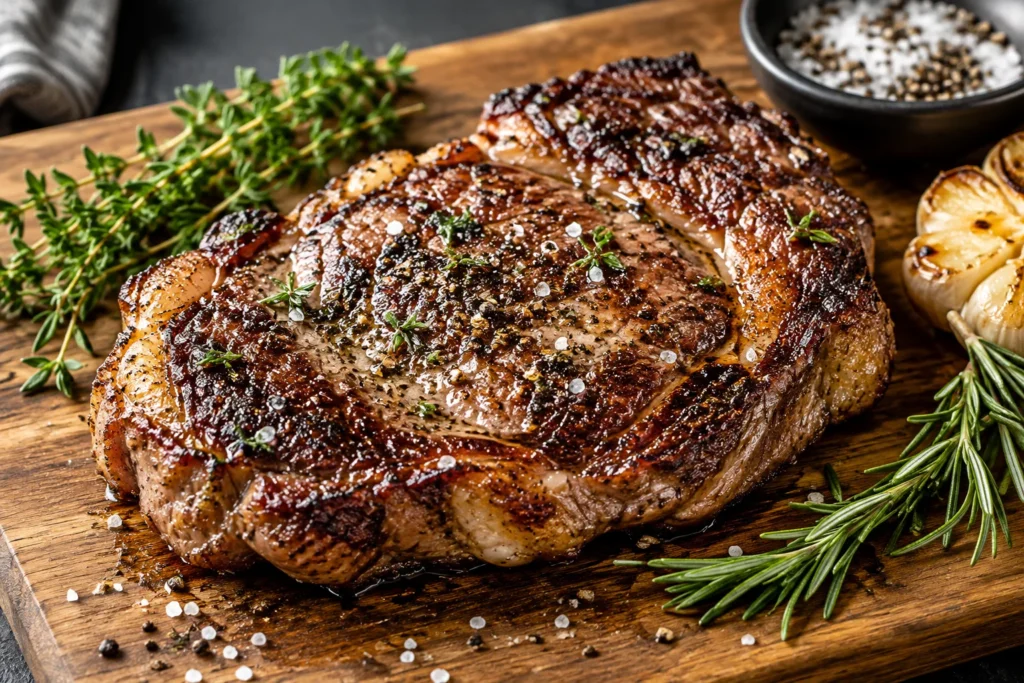
Ribeye is the forgiving one. The marbling that makes it rich also keeps it juicy if you run a minute or two long, which is why it's the cut most people start with.
Here's what matters, in order:
- Use a steak about 1 inch thick. The Beef Checkoff's skillet guidelines give boneless ribeye of that thickness 12 to 15 minutes total, which covers 145°F (medium rare by USDA's numbers) up to medium.
- Pat the steak dry. A wet surface steams instead of sears.
- Get the skillet hot before the steak goes in, and turn the steak every few minutes instead of leaving it alone.
- Spoon butter, smashed garlic, and thyme over it in the last two minutes.
- Check for 145°F in the thickest part, then rest it at least 3 minutes before you cut.
If skillets are your thing, our high-protein skillet dinners have plenty more where this came from.
Why this works: Drying the surface and starting with a hot pan builds a crust fast, so the center doesn't overshoot before the outside browns.
The nutrition: About 44g of protein per steak, from roughly 6.4 ounces of cooked meat. Ribeye has less protein per ounce than leaner cuts like filet or sirloin, and it makes up for it with flavor.
Filet Mignon
Is filet worth the price? For protein, it's one of the best cuts you can buy: about 26g in a 3-ounce cooked portion by USDA data, with very little fat.
The trade-off is that filet has less flavor of its own, so it likes company. Butter, garlic, and thyme do a lot of the work here, and a pile of roasted broccolini on the side keeps the plate from feeling heavy.
Keep the steaks to about 1 inch. Per the Beef Checkoff skillet guide, a 1-inch tenderloin steak takes 10 to 13 minutes total, and a thicker steak takes noticeably longer, so don't be surprised if a 1.5-inch filet needs the oven. Rest the steaks 3 minutes, and don't skip it, because a lean cut dries out faster than a marbled one.
Season generously with salt right before cooking. Filet is the cut that most needs it.
The nutrition: About 32g of protein per 5-ounce raw filet, which cooks down to roughly 3.7 ounces. If you want a bigger serving, buy 6-ounce filets and the number goes up proportionally.
Pepper-Crusted Steak
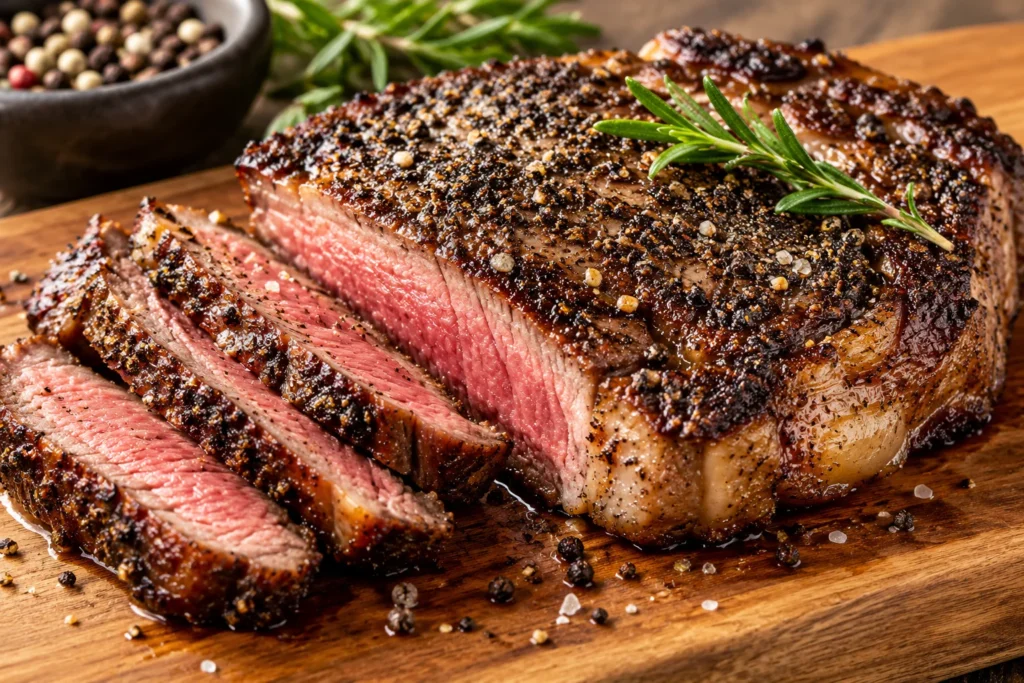
A thick crust of cracked peppercorns gives a simple sirloin real heat and crunch. The only trick is cracking the peppercorns yourself.
- Crush 2 tablespoons of whole black peppercorns coarsely with the bottom of a heavy pan. Pre-ground pepper turns bitter and dusty when it hits a hot skillet.
- Salt four 1-inch top sirloin steaks, then press the pepper firmly into both sides.
- Sear in a hot skillet with a little oil for 15 to 18 minutes total, which is the Beef Checkoff's range for a 1-inch top sirloin.
- Add butter at the end for a quick pan sauce, and rest the steaks for 3 minutes.
Top sirloin is lean, so it rewards a thermometer. Pull it at 145°F, not a degree later.
Why this works: Coarsely cracked pepper stays in distinct pieces that toast on the surface, while fine pepper tends to scorch and turn bitter.
The nutrition: About 45g of protein per 8-ounce raw steak (roughly 5.9 ounces cooked).
Sliced Sirloin Steak
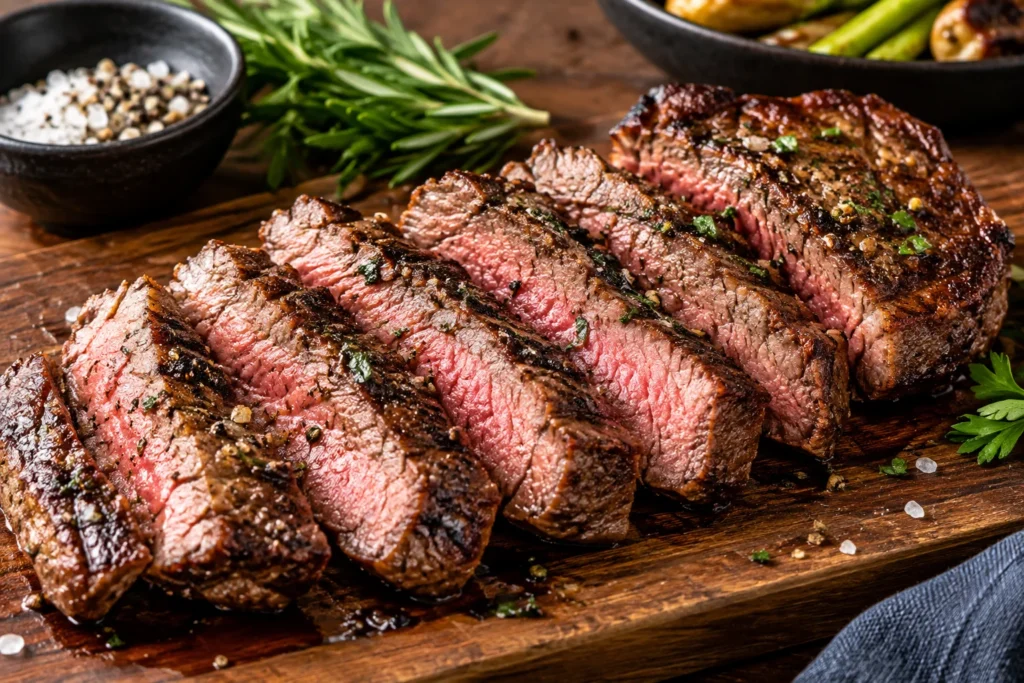
This is the only recipe in the opening group that uses the broiler, and it's a good one for a weeknight because you don't have to babysit it.
Top sirloin broils well, and the Beef Checkoff publishes timing by thickness, so you can plan before you start:
| Thickness | Distance from heat | Total time (145 to 160°F) |
|---|---|---|
| 0.75 inch | 2 to 3 inches | 9 to 12 min |
| 1 inch | 3 to 4 inches | 16 to 21 min |
| 1.5 inches | 3 to 4 inches | 26 to 31 min |
| 2 inches | 3 to 4 inches | 34 to 39 min |
Use a 1-inch steak, rest it, then cut thin slices across the grain, lay them over greens, and spoon on a quick parsley, garlic, and red wine vinegar sauce. For a lighter dinner on a busy night, it's hard to beat, and it pairs nicely with the ideas in our quick high-protein dinners for busy school nights.
The nutrition: About 34g of protein per serving when 1.5 pounds of steak feeds four.
Chopped Steak
Chopped steak is a seasoned ground beef patty with steakhouse manners: a good sear, a pile of browned onions, and a gravy.
Ground beef plays by different rules than steak. The USDA's number is 160°F in the center, and color isn't a reliable guide, so don't skip the thermometer. Time varies a lot with thickness and heat (sources say anywhere from 8 to 12 minutes total for a three-quarter-inch patty over medium heat), which is exactly why the thermometer matters more than the clock.
Form four 6-ounce patties about three-quarters of an inch thick, press a shallow dimple in the middle so they stay flat, and brown them well. Cook sliced onions and mushrooms in the same pan, then build a quick gravy from butter, flour, beef broth, and a spoonful of Dijon.
It's also the most budget-friendly dinner in the group, which makes it a natural fit with our high-protein meal prep ideas on a budget.
The nutrition: About 33g of protein per patty using USDA data for 90% lean ground beef. We assumed about 25 percent shrink during cooking.
Surf and Turf
When dinner needs to feel like an occasion, a steak and shrimp on one plate covers two lean proteins in about half an hour.
Cook the steak first. A boneless ribeye about three-quarters of an inch thick takes 8 to 11 minutes in a skillet by the Beef Checkoff's guide. Move it to a plate to rest, wipe the pan, and cook the shrimp in the same skillet with butter and garlic.
Shrimp go fast. Plan on 2 to 3 minutes per side for large shrimp, until they turn opaque and curl into a loose C. USDA lists 145°F as the safe minimum for shellfish, and anything tighter than a C has gone too far. Finish with lemon and parsley.
Seafood nights like this one fit nicely alongside the ideas in our omega-3 rich dinners.
The nutrition: About 56g of protein per plate, from roughly 4.8 ounces of cooked ribeye plus 4 ounces of raw shrimp (peeled).
Steak with Saffron Rice
This one earns its place on the list because the rice isn't an afterthought.
- Steep about a quarter teaspoon of saffron threads in 2 tablespoons of warm water for 10 minutes. Warm, not boiling, water pulls out the color without scorching the flavor.
- Cook 1 cup of long-grain white rice with 2 cups of broth, the saffron water, and a pinch of salt. Bring it to a boil, cover, and simmer on low for about 18 minutes, then rest it covered for 5 minutes and fluff.
- While the rice rests, grill or pan-sear 1-inch tri-tip steaks. The Beef Checkoff gives that thickness 10 to 14 minutes total on the grill.
Serve the steak over the rice so it soaks up the juices, with a quick mash of peas and butter on the side if you want some green.
The nutrition: About 36g of protein per serving, counting roughly 4.4 ounces of cooked tri-tip and about a cup of the rice. The pea mash isn't counted.
Marinate Now, Grill Later
These six are the most hands-off dinners in the article. The marinade works while you're doing something else, and the cooking itself takes less than half an hour.
A quick safety rule for all of them: marinate in the refrigerator, in a covered container or a zip-top bag, and set aside a little extra marinade before it touches raw meat if you want a sauce. Anything that has touched raw beef has to be boiled before it goes near cooked food.
Grilled Flank Steak
Flank ranks among the leanest, most protein-dense steaks you can put on a grill, and it loves a marinade. The catch is that it has a long, obvious grain, and cutting it wrong makes even a perfect steak chewy.
Whisk together olive oil, balsamic vinegar, soy sauce, garlic, black pepper, and a little dried oregano. Marinate the steak in the fridge for 2 to 24 hours.
Then:
- Grill over direct medium heat, about 350 to 450°F, for 8 to 10 minutes for a three-quarter-inch steak, turning once. (The Beef Checkoff's broiling guide allows 13 to 18 minutes for a larger 1.5 to 2 pound flank.)
- Check for 145°F and rest the steak 5 minutes.
- Slice thin across the grain, which means cutting perpendicular to the lines you can see running along the steak.
The nutrition: About 34g of protein per serving when 1.5 pounds of flank feeds four.
Grilled Skirt Steak
Skirt is all about heat. It's thin, loose-grained, and rich with beefy flavor, and it needs to hit a very hot grill and come off quickly.
The Beef Checkoff's grilling guide for skirt steak (marinated, in 4 to 6 inch portions, 1 to 1.5 pounds) lists 7 to 12 minutes total on charcoal and 8 to 12 on gas. That's the whole cook. Keep the grill lid up, turn it once, and don't wander off.
A lime, garlic, chili powder, and cumin marinade works well here, but go easy on the time. Acidic marinades like lime juice can make thin cuts mushy if they sit too long, so 2 to 8 hours is plenty.
Slice it thin against the grain, then pile it into tacos, over rice, or straight off the board.
Why this works: Skirt is thin enough that a very hot grill cooks it through before it has time to toughen.
The nutrition: About 37g of protein per serving. USDA lists skirt at around 25g in a 3-ounce cooked portion, which is among the highest for steaks.
Grilled Tri-Tip
Tri-tip is leaner than ribeye and packed with beefy flavor, and a single roast feeds a table without a steakhouse bill. It's also a little different from a regular steak because you cook it as a small roast.
Rub a 2-pound tri-tip with salt, black pepper, garlic powder, smoked paprika, and thyme. The Beef Checkoff's indirect-grilling guide gives a 1.5 to 2 pound tri-tip 35 to 45 minutes. A common approach is to sear it for about 10 minutes over direct medium heat first, then move it to the cooler side with the lid closed until a thermometer reads 145°F.
Rest it. Sources range from 10 to 25 minutes, and a roast this size does better with at least 10 or 15. Then slice thin against the grain. Tri-tip has two grain directions that meet near the middle, so you may need to cut the roast in half first.
Cold slices also work well on a salad the following day.
The nutrition: About 43g of protein per serving when 2 pounds of tri-tip feeds four, roughly 5.9 ounces cooked each.
Steak Fajitas
Fajitas make a modest piece of lean beef go a long way, because the peppers, onions, and tortillas turn it into a full plate.
Use sirloin tip side steak, which the Beef Checkoff lists in its skillet guidelines for marinated cuts. A three-quarter-inch steak takes 10 to 12 minutes in a skillet, and a 1-inch steak takes 13 to 15. After a lime, garlic, chili powder, and cumin marinade, cook the steak hot, rest it, and slice it thin against the grain.
Use the same pan for the peppers and onions so they pick up the browned bits. Then build your own tortillas at the table.
Cooking for a crowd? Fajitas scale easily, and our cheap high-protein dinners to feed six have more big-batch ideas.
The nutrition: About 42g of protein per serving, which includes roughly 4.4 ounces of cooked steak and two 7-inch flour tortillas.
Carne Asada
Carne asada gets its charred, smoky flavor from a hot grill and a bright, citrusy marinade. Here's the version we'd make for a backyard dinner.
The marinade: orange juice, lime juice, olive oil, garlic, cilantro, cumin, and a little salt, with a minced jalapeño if you want heat.
The timing: 2 to 4 hours in the fridge is plenty. Citrus is acidic, and acid breaks down the surface of the meat, so overnight is too long for a thin cut.
The cook: flank steak, grilled over direct medium heat for 8 to 10 minutes, turning once, until a thermometer reads 145°F. Rest 5 minutes, then slice thin against the grain.
Serve it in warm corn tortillas with onion, cilantro, and lime. It's lean, high in protein, and it makes a good party food because everyone assembles their own.
The nutrition: About 38g of protein per serving, from roughly 4.4 ounces of cooked flank and three 6-inch corn tortillas.
Seared Short Ribs
When there's no time for a braise, you can still get short rib flavor in minutes if you slice the meat thin and marinate it Korean-style.
Ask for thin boneless short rib slices (kalbi style), or cut a boneless short rib into strips about a quarter to a half inch thick. Marinate them for at least 4 hours, and up to overnight, in soy sauce, brown sugar, sesame oil, garlic, ginger, and a little grated pear.
Then cook fast. Published kalbi recipes grill the ribs 3 to 4 minutes per side over medium-hot heat, and a very hot cast iron skillet needs about 2 to 3 minutes per side. Cook the slices until the thickest piece reaches 145°F, checking with a quick-read thermometer. Because the slices are thin, they rest in a couple of minutes and need little more than scallions and rice.
The nutrition: About 31g of protein per serving, from roughly 6 ounces of raw meat per person. The marinade that drips off isn't counted.
Roasts and Showpieces
Bigger cuts, longer timelines, and a thermometer you shouldn't cook without. The payoff is a dinner that looks like a holiday and slices into leftovers for days.
Prime Rib
Prime rib is the roast you make when the whole table is full. The method is simpler than it looks, because there's really only one decision to make: how big the roast is.
The USDA roasting chart gives a bone-in rib roast of 4 to 8 pounds 23 to 30 minutes per pound at 325°F. For a 5-pound roast, that's roughly 1 hour 55 minutes to 2 hours 30 minutes. USDA also advises against roasting below 325°F, because meat held at lower temperatures can linger too long in the danger zone.
- Pat the roast dry and rub it with salt, black pepper, minced garlic, chopped rosemary, and olive oil.
- Roast it on a rack in a shallow pan, fat side up, with a thermometer in the center of the thickest part, away from bone.
- Take it out at 145°F and rest it 15 to 20 minutes under loose foil before carving. Larger roasts hold their heat and keep climbing a little as they rest.
Serve with a horseradish cream made from sour cream, prepared horseradish, lemon juice, and a pinch of salt.
The nutrition: About 38g of protein in a 6-ounce cooked slice, using USDA data for roasted rib, small end.
Roast Beef
Roast beef is the classic Sunday dinner: a lean roast, cooked gently and carved thin, with slices left over for sandwiches the next day.
Eye of round is the cut for it, and the USDA chart gives a 2 to 3 pound eye round 20 to 22 minutes per pound at 325°F. That makes a 3-pound roast about 1 hour to 1 hour 6 minutes, until a thermometer reads 145°F. Rest it 15 minutes.
Eye of round is very lean, which means two things. First, it's high in protein for the calories. Second, it dries out if you push it past 145°F, so use the thermometer instead of a timer. Slice it as thin as you can, against the grain.
Leftover slices are the whole reason to make this on a Sunday. Pile them on bread with mustard, or add them to the lunches in our healthy meal prep dinner ideas.
Why this works: A moderate 325°F oven, the temperature USDA recommends for roasting, cooks a lean cut evenly and limits shrinkage.
The nutrition: About 37g of protein per 6-ounce raw portion (about 4.4 ounces cooked), when a 3-pound roast feeds eight.
Beef Tenderloin
Tenderloin is buttery, lean, and sliced into medallions it makes a table look like a celebration. It's also the roast with the shortest cook time, which surprises people.
Per the USDA chart, a half tenderloin of 2 to 3 pounds roasts at a much higher 425°F for 35 to 45 minutes total, until it reaches 145°F. A whole tenderloin of 4 to 6 pounds takes 45 to 60 minutes. Rest the roast 15 minutes before slicing.
Because tenderloin is narrow at one end, it can cook unevenly. Fold the thin tail under and tie the roast with kitchen string at regular intervals so it's the same thickness all the way down. Then keep the seasoning simple with salt, pepper, and a little oil.
A sharp horseradish sauce, made with Greek yogurt, prepared horseradish, and lemon, cuts the richness.
Why this works: Tying the roast to an even thickness lets the whole length reach 145°F at about the same time.
The nutrition: About 43g of protein per serving when a 2.5-pound trimmed roast feeds six, which works out to roughly 4.9 ounces cooked each.
Steak Frites
The bistro classic is a seared steak, a pile of crisp fries, and a pat of herb butter that melts into both. The trick for a home cook is making the fries in the oven so you aren't managing a pot of hot oil.
For the fries: this follows a published university recipe for baked fries.
- Cut 2 pounds of unpeeled Idaho or russet potatoes into sticks about 3 to 4 inches long and just under half an inch wide.
- Toss with 2 teaspoons of salt and let them stand for 10 minutes. Rinse in cold water and dry them very well.
- Coat with oil, spread on two sheet pans in a single layer, and bake at 350°F for 40 to 45 minutes, turning halfway, until golden and crisp. Allow a few extra minutes if the pans are crowded.
For the steak: four 1-inch top sirloin steaks, pan-seared for 15 to 18 minutes total, which is the Beef Checkoff's range for that thickness. Finish with a slice of compound butter made from butter, parsley, minced shallot, and garlic.
Fries can be held in a 200°F oven for up to an hour, so start them first and cook the steak when everyone sits down.
Why this works: Salting the potato sticks, then rinsing and drying them, pulls moisture off the surface, and that helps them crisp in the oven.
The nutrition: About 50g of protein per plate, including roughly 5.9 ounces of cooked sirloin and the potatoes.
Never Miss a Recipe
Fresh high-protein recipes, meal prep ideas, and kitchen tips, straight to your inbox every week. No spam, just good food.
No spam. Unsubscribe anytime.
Steak Tartare
This is the one recipe in the list where we changed the classic, and we want to explain why.
Traditional steak tartare is raw beef, and raw beef is something the USDA advises against. Its food safety service warns that raw ground beef and raw egg dishes like tartare have been tied to outbreaks of E. coli and Salmonella, and the risk is highest for young children, older adults, pregnant women, and anyone with a weakened immune system. Chopping a steak doesn't remove the problem, because bacteria that sit on the surface get mixed into the middle.
So this version keeps everything people love about tartare, the sharp, savory flavors and the fine texture, but starts with a fully cooked steak.
- Sear a top sirloin steak until a thermometer reads 145°F, then rest it and chill it until it's cold.
- Dice it finely with a sharp knife.
- Fold in minced shallot, chopped capers and cornichons, Dijon mustard, Worcestershire, a little olive oil, hot sauce, and parsley.
- Top each serving with grated hard-cooked egg yolk and serve with toast points.
Keep it cold, serve it within 2 hours, and refrigerate leftovers right away.
The nutrition: About 28g of protein per serving, from roughly 3 ounces of cooked steak plus the egg yolk and a slice of toast.
Low and Slow
These four trade time for tenderness. The work is mostly waiting, and they all get better when you make them a day ahead.
Braised Short Ribs
Short ribs are what you make when it's cold out and you want the house to smell like dinner for three hours. A long braise turns a tough, collagen-rich cut into meat that falls apart under a fork.
The method has four parts:
- Sear two pounds of boneless short ribs in a hot Dutch oven until deeply browned on every side, then set them aside.
- Build the base with onion, carrot, and celery, a spoonful of tomato paste, and a cup of red wine cooked down by half.
- Braise: return the ribs, add a cup of beef stock, thyme, and a bay leaf, cover, and cook in a 325°F oven.
- Finish by skimming the fat and reducing the liquid into a glossy sauce.
The Beef Checkoff's braising guide gives boneless short ribs 1.75 to 2.5 hours covered, and other recipes run closer to 3 hours for bone-in ribs. Start checking at about 1.75 hours and stop when a fork slides in without resistance. Serve over mashed potatoes so none of the sauce goes to waste.
Why this works: Slow, moist heat melts the collagen in the meat into gelatin, which is what makes the ribs fall apart and the sauce glossy.
The nutrition: About 41g of protein per serving, from roughly 5.9 ounces of cooked meat. The mashed potatoes aren't counted.
Smoked Brisket
Brisket takes most of a day and rewards the effort. It's also the cut where the clock lies the most, so this recipe asks you to cook to temperature and feel.
- The smoker: hold it steady between 225 and 250°F.
- The rub: equal parts coarse black pepper and kosher salt, and nothing else.
- The timing: plan on roughly 1 to 1.5 hours per pound at 225°F, though sources range from about 30 minutes to 90 minutes per pound, so treat the clock as a rough guide only.
- The finish: brisket is done when a probe slides into the thickest part of the flat with almost no resistance, usually between 195 and 205°F. That's well past the USDA's 145°F minimum, because collagen needs the extra heat to melt.
- The rest: hold it wrapped for 1 to 2 hours, then slice against the grain.
Plan your day around the rest, not the smoke. A brisket that's done early can sit happily wrapped in a towel, but one that's rushed comes out tough.
The nutrition: About 45g of protein per 5-ounce cooked slice, using USDA data for brisket flat. A 5-pound flat serves roughly eight.
Beef Bourguignon
Bourguignon is beef stew with a French education. Chuck simmers in red wine with bacon, mushrooms, and pearl onions until the sauce coats a spoon.
The classic ratios, taken from Julia Child's recipe as adapted by many cooks, are straightforward: 3 pounds of lean chuck cut into 2-inch cubes, 6 ounces of bacon, 3 cups of red wine, and 2 to 3 cups of beef stock, along with a tablespoon of tomato paste, garlic, thyme, and bay. Brown the beef in batches, don't crowd the pot, and bring everything to a simmer on the stove before it goes into a 325°F oven for 2.5 to 3 hours.
Sauté the mushrooms and pearl onions separately in butter and add them near the end so they keep their shape.
Make it the day before. Overnight in the fridge, the sauce deepens and the fat rises to the top where it's easy to lift off. Reheat gently to 165°F.
Why this works: Adding the mushrooms and pearl onions near the end keeps them intact and distinct instead of dissolving into the stew.
The nutrition: About 51g of protein per serving when 3 pounds of chuck feeds six, at roughly 5.9 ounces of cooked beef each. Bacon, vegetables, and the noodles or potatoes underneath aren't counted.
Classic Pot Roast
Pot roast is mostly patience. A chuck roast simmers slowly alongside its vegetables until a fork pulls it apart, and a single pot serves the whole table.
Brown a 3-pound boneless chuck roast on every side, then nestle it in a Dutch oven with onions, garlic, tomato paste, wine, and beef broth. Cover and cook at 325°F. The Beef Checkoff lists a 7-bone chuck roast of around 2.25 pounds at about 2.25 to 2.5 hours, so a 3-pound boneless roast realistically needs 2.5 to 3.5 hours. Check for fork-tenderness rather than trusting the clock.
Add the carrots and baby potatoes after the first hour and a half so they finish tender, not mushy.
Pot roast is the original one-pot meal, and if you like that style, our one-pot dinners with real protein are worth a look. The leftovers make great sandwiches.
The nutrition: About 54g of protein per serving, including about 5.9 ounces of cooked chuck and the potatoes.
Leftovers Without the Risk
Steak dinners often make more than people eat, so a few rules keep the leftovers safe and tasty.
- Get cooked beef into the refrigerator within 2 hours of cooking (1 hour if it's hotter than 90°F).
- Eat leftovers within 3 to 4 days, per the USDA.
- Reheat to 165°F. For sliced roast beef and tri-tip, a splash of broth in a covered pan keeps it from drying out.
- Cool braises in shallow containers so the middle chills quickly, and freeze what you won't eat in time.
Questions About Cooking Steak at Home
What temperature should steak be cooked to?
The USDA's safe minimum for steaks and roasts is 145°F, followed by a rest of at least 3 minutes. Ground beef needs 160°F.
Is medium-rare steak safe to eat?
By the USDA's numbers, 145°F is the minimum safe temperature for whole cuts of beef. Many chefs and some industry guides take steaks off the heat closer to 130 to 135°F for medium-rare, which is below that minimum. It's a personal choice, and it's riskier for young children, older adults, pregnant women, and anyone with a weakened immune system.
How long should I rest steak?
At least 3 minutes, according to the USDA. Thin steaks are fine with 3 to 5 minutes, and larger roasts do better with 15 to 20, because the juices need time to settle and the temperature keeps climbing slightly as they rest.
Which cut has the most protein?
Per cooked ounce, slow-cooked cuts lead because long cooking drives out water. USDA data shows about 27g in a 3-ounce portion of braised brisket flat and 26g for chuck pot roast and tenderloin, compared with about 21g for ribeye and 19g for roasted prime rib.
How much protein is in a typical steak?
Roughly 19 to 27 grams in a 3-ounce cooked portion, depending on the cut. A 6-ounce cooked steak lands around 38 to 54 grams. If you're building bigger plates, take a look at our high-protein dinners with 30g of protein.
Can I marinate steak overnight?
Yes, as long as it's in the refrigerator. USDA says steaks can safely marinate for up to five days, but acidic marinades with citrus or vinegar can turn thin cuts mushy if they sit too long. For flank and skirt, 2 to 8 hours is a safer window.
Why is my steak tough?
Usually one of three things: overcooking a lean cut, skipping the rest, or slicing a flank or skirt steak with the grain instead of across it. Braised cuts have the opposite problem and get tender only when they're cooked long enough, so give them more time instead of more heat.
Is steak tartare safe?
Raw tartare isn't something the USDA recommends. It warns that raw beef and raw eggs have been tied to E. coli and Salmonella outbreaks. The version in this article is made with a steak cooked to 145°F and then chilled.
Do I really need a meat thermometer?
For steaks, roasts, and ground beef, yes. Color isn't a reliable sign of safety, and an instant-read thermometer takes the guesswork out of every cut in this article.
Can I swap one cut for another?
Often, but match the thickness and the cooking method rather than the name. A 1-inch top sirloin and a 1-inch ribeye can trade places with only a few minutes of difference, while a roast or a braise needs the same style of cut to work.
Related Articles
- Healthy Meal Prep Dinner Ideas
- High-Protein Meal Prep Ideas on a Budget
- Cheap High-Protein Dinners to Feed 6
- One-Pot Dinners with Real Protein
- 50g Protein Dinners
1. Seared Ribeye
Approx. 44g ProteinIngredients: 4 boneless ribeye steaks, 1 inch thick (about 8 oz each), 1 tbsp avocado or canola oil, 1 1/2 tsp kosher salt, 1 tsp black pepper, 2 tbsp butter, 2 cloves garlic (smashed), 4 sprigs fresh thyme.
Step 1: Pat the steaks dry and season both sides with the salt and pepper.
Step 2: Heat a 12-inch cast iron skillet over medium-high heat for 3 minutes, then add the oil.
Step 3: Cook the steaks 12 to 15 minutes total, turning every few minutes, until a thermometer reads 145°F in the thickest part.
Step 4: In the last 2 minutes, add the butter, garlic, and thyme and spoon the melted butter over the steaks.
Step 5: Rest the steaks at least 3 minutes before slicing.
2. Filet Mignon
Approx. 32g ProteinIngredients: 4 filet mignon steaks, 1 inch thick (about 5 oz each), 1 tbsp oil, 1 tsp kosher salt, 1/2 tsp black pepper, 2 tbsp butter, 3 cloves garlic (smashed), 4 sprigs fresh thyme, 1 lb broccolini, 1 tbsp olive oil, 1 lemon.
Step 1: Season the filets generously with salt and pepper.
Step 2: Toss the broccolini with the olive oil and a pinch of salt and roast at 425°F until tender and browned at the tips, about 12 minutes.
Step 3: Heat the oil in a skillet over medium-high heat. Cook the filets 10 to 13 minutes total, turning once or twice, until a thermometer reads 145°F.
Step 4: In the last 2 minutes, add the butter, garlic, and thyme and spoon the butter over the steaks.
Step 5: Rest the filets 3 minutes. Squeeze lemon over the broccolini and serve.
3. Pepper-Crusted Steak
Approx. 45g ProteinIngredients: 4 top sirloin steaks, 1 inch thick (about 8 oz each), 2 tbsp whole black peppercorns (coarsely cracked), 1 1/2 tsp kosher salt, 1 tbsp oil, 2 tbsp butter.
Step 1: Crush the peppercorns coarsely with the bottom of a heavy pan.
Step 2: Pat the steaks dry, salt both sides, and press the pepper firmly into both sides.
Step 3: Heat the oil in a skillet over medium-high heat. Sear the steaks 15 to 18 minutes total, turning once or twice, until a thermometer reads 145°F.
Step 4: Add the butter to the pan in the last minute and spoon it over the steaks.
Step 5: Rest the steaks 3 minutes before serving.
4. Sliced Sirloin Steak
Approx. 34g ProteinIngredients: 1 1/2 lb top sirloin steak (1 inch thick), 1 tsp kosher salt, 1/2 tsp black pepper, 1 tbsp oil, 5 oz mixed greens. Sauce: 1 cup chopped parsley, 3 cloves garlic (minced), 3 tbsp red wine vinegar, 1/2 cup olive oil, 1/4 tsp red pepper flakes, 1/2 tsp salt.
Step 1: Set an oven rack so the steak will sit 3 to 4 inches from the broiler and preheat the broiler.
Step 2: Season the steak with the oil, salt, and pepper and place it on a broiler pan.
Step 3: Broil 16 to 21 minutes total, turning once, until a thermometer reads 145°F.
Step 4: Meanwhile, stir the sauce ingredients together.
Step 5: Rest the steak 3 minutes, slice thinly across the grain, lay the slices over the greens, and spoon on the sauce.
5. Chopped Steak
Approx. 33g ProteinIngredients: 1 1/2 lb 90 percent lean ground beef, 1 tbsp Worcestershire sauce, 1 tsp kosher salt, 1/2 tsp black pepper, 1 tbsp oil, 1 large onion (sliced), 8 oz mushrooms (sliced), 2 tbsp butter, 2 tbsp all-purpose flour, 1 1/2 cups beef broth, 1 tsp Dijon mustard.
Step 1: Gently mix the beef with the Worcestershire, salt, and pepper. Form four patties about 3/4 inch thick and press a shallow dimple into each.
Step 2: Heat the oil in a large skillet over medium heat. Cook the patties 4 to 6 minutes per side, until a thermometer reads 160°F. Move them to a plate.
Step 3: Melt the butter in the same pan and cook the onions and mushrooms about 8 minutes, until browned.
Step 4: Stir in the flour for 1 minute, then add the broth and Dijon and simmer about 5 minutes until thickened.
Step 5: Return the patties to the gravy to warm through and serve.
6. Surf and Turf
Approx. 56g ProteinIngredients: 4 boneless ribeye steaks, 3/4 inch thick (about 6 oz each), 1 lb large raw shrimp (peeled and deveined, 21 to 25 count), 1 tbsp oil, 1 tsp kosher salt, 1/2 tsp black pepper, 4 tbsp butter, 4 cloves garlic (minced), juice of 1 lemon, 2 tbsp chopped parsley.
Step 1: Season the steaks with salt and pepper. Heat the oil in a skillet over medium-high heat.
Step 2: Cook the steaks 8 to 11 minutes total, until a thermometer reads 145°F. Move to a plate and rest 3 minutes.
Step 3: Wipe out the skillet, melt the butter over medium-high heat, and cook the garlic for 30 seconds.
Step 4: Add the shrimp and cook 2 to 3 minutes per side, until opaque and curled into a loose C (145°F).
Step 5: Finish with the lemon juice and parsley and serve beside the steaks.
7. Steak with Saffron Rice
Approx. 36g ProteinIngredients: Rice: 1 cup long-grain white rice, 2 cups chicken or vegetable broth, 1/4 tsp saffron threads, 2 tbsp warm water, 1 tbsp olive oil, 1/2 tsp salt. Steak: 4 tri-tip steaks, 1 inch thick (about 6 oz each), 1 tsp kosher salt, 1/2 tsp black pepper, 1 tbsp oil. Optional: 1 cup frozen peas and 1 tbsp butter for a quick pea mash.
Step 1: Steep the saffron in the warm water for 10 minutes.
Step 2: Rinse the rice. Warm the olive oil in a saucepan, stir in the rice for 2 minutes, then add the broth, saffron water, and salt.
Step 3: Bring to a boil, cover, and simmer on low about 18 minutes. Rest covered 5 minutes, then fluff.
Step 4: Season the steaks and grill or sear them 10 to 14 minutes total, until a thermometer reads 145°F. Rest 3 minutes.
Step 5: Serve the steak over the rice. Simmer and mash the peas with the butter if using.
8. Grilled Flank Steak
Approx. 34g ProteinIngredients: 1 1/2 lb flank steak, 1/4 cup olive oil, 1/4 cup balsamic vinegar, 2 tbsp soy sauce, 3 cloves garlic (minced), 1 tsp black pepper, 1 tsp dried oregano.
Step 1: Whisk the marinade ingredients, add the steak, and refrigerate 2 to 24 hours.
Step 2: Heat a grill to direct medium heat (350 to 450°F). Remove the steak from the marinade and discard the marinade.
Step 3: Grill 8 to 10 minutes for a 3/4-inch steak, turning once, until a thermometer reads 145°F.
Step 4: Rest the steak 5 minutes.
Step 5: Slice thinly across the grain.
9. Grilled Skirt Steak
Approx. 37g ProteinIngredients: 1 1/2 lb skirt steak (cut into 4 to 6 inch portions), 1/4 cup lime juice, 3 tbsp olive oil, 4 cloves garlic (minced), 1 tbsp chili powder, 1 tsp cumin, 1 tsp kosher salt, 1/4 cup chopped cilantro.
Step 1: Combine the marinade ingredients, add the steak, and refrigerate 2 to 8 hours.
Step 2: Heat a grill to high. Remove the steak and discard the marinade.
Step 3: Grill 7 to 12 minutes total, turning once, until a thermometer reads 145°F.
Step 4: Rest 5 minutes.
Step 5: Slice thinly across the grain and serve.
10. Grilled Tri-Tip
Approx. 43g ProteinIngredients: 2 lb tri-tip roast, 1 tbsp kosher salt, 2 tsp black pepper, 2 tsp garlic powder, 1 tsp smoked paprika, 1 tsp dried thyme, 1 tbsp oil.
Step 1: Rub the tri-tip with the oil, then the salt, pepper, garlic powder, paprika, and thyme.
Step 2: Set up a two-zone grill. Sear the roast over direct medium heat for about 10 minutes, turning once.
Step 3: Move to the cooler side, close the lid, and grill until a thermometer reads 145°F (35 to 45 minutes total).
Step 4: Rest 10 to 15 minutes.
Step 5: Slice thinly across the grain, cutting the roast in half first where the grain changes direction.
11. Steak Fajitas
Approx. 42g ProteinIngredients: 1 1/2 lb sirloin tip side steak (3/4 to 1 inch thick), 3 tbsp lime juice, 3 tbsp olive oil, 3 cloves garlic (minced), 2 tsp chili powder, 1 tsp cumin, 1 tsp kosher salt, 1/2 tsp smoked paprika, 2 bell peppers (sliced), 1 large onion (sliced), 8 flour tortillas (7 to 8 inch), lime wedges and salsa for serving.
Step 1: Combine the lime juice, 2 tbsp of the oil, garlic, chili powder, cumin, salt, and paprika. Marinate the steak in the refrigerator 2 to 8 hours.
Step 2: Heat a skillet over medium-high heat. Cook the steak 10 to 12 minutes (3/4 inch) or 13 to 15 minutes (1 inch), until a thermometer reads 145°F. Rest 5 minutes.
Step 3: In the same skillet, cook the peppers and onion in the remaining oil 6 to 8 minutes until browned at the edges.
Step 4: Slice the steak thinly across the grain.
Step 5: Warm the tortillas and serve with the steak, vegetables, lime, and salsa.
12. Carne Asada
Approx. 38g ProteinIngredients: 1 1/2 lb flank steak, 1/3 cup orange juice, 1/4 cup lime juice, 1/4 cup olive oil, 5 cloves garlic (minced), 1/2 cup chopped cilantro, 1 tsp cumin, 1 tsp kosher salt, 1 jalapeno (minced, optional), 12 corn tortillas (6 inch), chopped onion, cilantro, and lime wedges for serving.
Step 1: Combine the marinade ingredients, add the steak, and refrigerate 2 to 4 hours.
Step 2: Heat a grill to direct medium heat. Remove the steak and discard the marinade.
Step 3: Grill 8 to 10 minutes, turning once, until a thermometer reads 145°F.
Step 4: Rest 5 minutes, then slice thinly across the grain.
Step 5: Serve in warm corn tortillas with onion, cilantro, and lime.
13. Seared Short Ribs
Approx. 31g ProteinIngredients: 1 1/2 lb boneless beef short rib, sliced 1/4 to 1/2 inch thick (kalbi style). Marinade: 1/3 cup soy sauce, 3 tbsp packed brown sugar, 1 tbsp toasted sesame oil, 4 cloves garlic (minced), 1 tbsp grated ginger, 1/4 Asian pear (grated). To serve: 2 sliced scallions, 1 tbsp toasted sesame seeds, steamed rice.
Step 1: Whisk the marinade ingredients, add the beef, and refrigerate at least 4 hours or overnight.
Step 2: Heat a grill to medium-hot or a cast iron skillet to very hot. Drain the beef.
Step 3: Cook 3 to 4 minutes per side on the grill, or 2 to 3 minutes per side in the skillet, until the thickest piece reaches 145°F.
Step 4: Rest 2 minutes.
Step 5: Top with scallions and sesame seeds and serve with rice.
14. Prime Rib
Approx. 38g ProteinIngredients: 5 lb bone-in rib roast (2 ribs), 2 tbsp kosher salt, 1 tbsp black pepper, 6 cloves garlic (minced), 2 tbsp chopped fresh rosemary, 2 tbsp olive oil. Horseradish cream: 1/2 cup sour cream, 2 tbsp prepared horseradish, 1 tbsp lemon juice, pinch of salt.
Step 1: Preheat the oven to 325°F. Pat the roast dry and rub it with the oil, salt, pepper, garlic, and rosemary.
Step 2: Set the roast fat side up on a rack in a shallow pan. Insert a thermometer into the center of the thickest part, away from bone.
Step 3: Roast 23 to 30 minutes per pound (about 1 hr 55 min to 2 hr 30 min for 5 lb), until the thermometer reads 145°F.
Step 4: Rest under loose foil 15 to 20 minutes.
Step 5: Stir the horseradish cream together, carve, and serve.
15. Roast Beef
Approx. 37g ProteinIngredients: 3 lb eye of round roast, 1 tbsp kosher salt, 2 tsp black pepper, 2 tsp garlic powder, 1 tsp dried thyme, 2 tbsp olive oil.
Step 1: Preheat the oven to 325°F. Pat the roast dry and rub with the oil and seasonings.
Step 2: Place on a rack in a shallow pan with a thermometer in the center.
Step 3: Roast 20 to 22 minutes per pound (1 hr to 1 hr 6 min for 3 lb), until the thermometer reads 145°F.
Step 4: Rest 15 minutes.
Step 5: Slice as thinly as you can across the grain.
16. Beef Tenderloin
Approx. 43g ProteinIngredients: 2 1/2 lb half beef tenderloin roast (trimmed), 2 tbsp olive oil, 2 tsp kosher salt, 1 tsp black pepper, kitchen string. Horseradish sauce: 1/2 cup plain Greek yogurt, 3 tbsp prepared horseradish, 1 tbsp lemon juice, 1/4 tsp salt.
Step 1: Preheat the oven to 425°F. Fold the thin tail end under and tie the roast with string every 1 1/2 inches so it is an even thickness.
Step 2: Rub with the oil, salt, and pepper and set on a rack in a roasting pan.
Step 3: Roast 35 to 45 minutes, until a thermometer in the center reads 145°F.
Step 4: Rest 15 minutes, then remove the string.
Step 5: Stir together the horseradish sauce, slice the roast into medallions, and serve.
17. Steak Frites
Approx. 50g ProteinIngredients: Fries: 2 lb unpeeled Idaho or russet potatoes, 2 tsp kosher salt, 2 tbsp oil. Steak: 4 top sirloin steaks, 1 inch thick (about 8 oz each), 1 tsp kosher salt, 1/2 tsp black pepper, 1 tbsp oil. Herb butter: 4 tbsp softened butter, 1 tbsp chopped parsley, 1 small shallot (minced), 1 clove garlic (minced).
Step 1: Cut the potatoes into sticks about 3 to 4 inches long and just under 1/2 inch wide. Toss with the 2 tsp salt and let stand 10 minutes. Rinse in cold water and dry very well.
Step 2: Preheat the oven to 350°F. Toss the potatoes with the oil, spread on two sheet pans in a single layer, and bake 40 to 45 minutes, turning halfway (a few extra minutes if crowded).
Step 3: Mash the butter with the parsley, shallot, and garlic.
Step 4: Season the steaks and sear in the oil 15 to 18 minutes total, until a thermometer reads 145°F. Rest 3 minutes.
Step 5: Top the steaks with the herb butter and serve with the fries.
18. Steak Tartare
Approx. 28g ProteinIngredients: 1 lb top sirloin steak (two 1-inch steaks), 1 tsp kosher salt, 1/2 tsp black pepper, 1 tbsp oil, 1 small shallot (minced), 2 tbsp capers (chopped), 3 cornichons (chopped), 1 tbsp Dijon mustard, 2 tsp Worcestershire sauce, 1 tbsp olive oil, 1 tsp hot sauce, 2 tbsp chopped parsley, 2 hard-cooked egg yolks (grated), 4 slices baguette (about 1 oz each, toasted).
Step 1: Season the steaks and sear in the oil over medium-high heat 15 to 18 minutes total, until a thermometer reads 145°F.
Step 2: Rest 3 minutes, then chill in the refrigerator until cold, about 30 minutes.
Step 3: Dice the cold steak very finely with a sharp knife.
Step 4: Fold in the shallot, capers, cornichons, Dijon, Worcestershire, olive oil, hot sauce, and parsley.
Step 5: Top with the grated egg yolk and serve right away with the toast. Keep cold and refrigerate leftovers within 2 hours.
19. Braised Short Ribs
Approx. 41g ProteinIngredients: 2 lb boneless beef short ribs (in large pieces), 1 1/2 tsp kosher salt, 1/2 tsp black pepper, 2 tbsp oil, 1 onion (diced), 2 carrots (diced), 2 celery ribs (diced), 2 tbsp tomato paste, 1 cup dry red wine, 1 cup beef stock, 4 sprigs fresh thyme, 1 bay leaf. Serve over mashed potatoes.
Step 1: Preheat the oven to 325°F. Season the ribs and sear in the oil in a Dutch oven until deeply browned. Set aside.
Step 2: Cook the onion, carrot, and celery in the pot until softened. Stir in the tomato paste, then the wine, and simmer until reduced by half.
Step 3: Return the ribs, add the stock, thyme, and bay leaf, cover, and braise in the oven 2 to 2 1/2 hours, checking from 1 3/4 hours, until a fork slides in easily.
Step 4: Skim the fat from the liquid and simmer the sauce on the stove until glossy.
Step 5: Serve the ribs over mashed potatoes with the sauce.
20. Smoked Brisket
Approx. 45g ProteinIngredients: 5 lb trimmed beef brisket flat, 3 tbsp kosher salt, 3 tbsp coarse black pepper, wood chunks for smoking.
Step 1: Heat a smoker to 225 to 250°F. Mix the salt and pepper and coat the brisket on all sides.
Step 2: Smoke the brisket, planning roughly 1 to 1 1/2 hours per pound at 225°F (sources vary widely), and hold the smoker steady.
Step 3: If the temperature stalls, you may wrap the brisket in butcher paper or foil around 165°F.
Step 4: Cook until a probe slides into the thickest part with almost no resistance, usually 195 to 205°F.
Step 5: Rest wrapped 1 to 2 hours, then slice against the grain.
21. Beef Bourguignon
Approx. 51g ProteinIngredients: 3 lb lean beef chuck (cut into 2-inch cubes), 6 oz bacon (cut into pieces), 1 tbsp olive oil, 1 carrot (sliced), 1 onion (sliced), 2 tbsp all-purpose flour, 3 cups dry red wine, 2 to 3 cups beef stock, 1 tbsp tomato paste, 2 cloves garlic (minced), 4 sprigs thyme, 2 bay leaves, 18 to 24 pearl onions, 1 lb mushrooms (quartered), 3 tbsp butter (divided), salt and pepper.
Step 1: Preheat the oven to 325°F. Cook the bacon in a Dutch oven until crisp and remove it. Brown the beef in batches in the fat and set aside.
Step 2: Cook the carrot and onion until soft. Return the beef and bacon, season, and sprinkle with the flour.
Step 3: Add the wine and enough stock to barely cover the meat, then stir in the tomato paste, garlic, thyme, and bay. Bring to a simmer on the stove.
Step 4: Cover and braise in the oven 2 1/2 to 3 hours, until the beef is fork-tender.
Step 5: Meanwhile, brown the pearl onions in 1 tbsp butter, then cook the mushrooms in the remaining butter. Stir both into the stew near the end and serve.
22. Classic Pot Roast
Approx. 54g ProteinIngredients: 3 lb boneless beef chuck roast, 2 tsp kosher salt, 1 tsp black pepper, 2 tbsp oil, 2 onions (quartered), 4 cloves garlic, 2 tbsp tomato paste, 1 cup dry red wine or beef broth, 2 cups beef broth, 4 sprigs thyme, 2 bay leaves, 4 carrots (cut into chunks), 1 1/2 lb baby potatoes.
Step 1: Preheat the oven to 325°F. Season the roast and brown it on all sides in the oil in a Dutch oven. Set aside.
Step 2: Cook the onions and garlic briefly, stir in the tomato paste, then the wine, and scrape up the browned bits.
Step 3: Return the roast, add the broth, thyme, and bay, cover, and cook at 325°F.
Step 4: After about 1 1/2 hours, add the carrots and potatoes. Continue until the roast is fork-tender, 2 1/2 to 3 1/2 hours in total.
Step 5: Rest 10 minutes, then shred or slice and serve with the vegetables and pan juices.
Get Fresh Recipes Every Week
Join readers getting fresh recipes, meal prep systems, and high-protein meal ideas delivered to your inbox every week.
No spam. Unsubscribe anytime.