
See all 20 recipes
Table of Contents
Every holiday host runs into the same quiet problem: the menu is easy to write, but the oven only has one door.
Turkey wants 325°F for the better part of an afternoon. A beef tenderloin wants 425°F for under an hour. The casserole wants 375°F, the sides want whatever is left, and somewhere in the middle of all that, twelve people are asking when dinner is. So instead of sorting these 20 mains by protein, we sorted them by where they cook and when you can make them: 7 that use the oven, 4 that move outside to the grill or smoker, 4 braises that are better made the day before, and 5 casseroles that wait patiently in the fridge until you need them.
Every recipe comes with a temperature, a time, and a serving size that actually feeds a crowd. Cooking times come from the USDA's roasting charts and the Beef Checkoff's published guidelines wherever they exist, and protein is calculated from USDA nutrient data for the exact quantities on each recipe card. If you're cooking for a big table on a tight budget, our cheap high-protein dinners that feed six are a good place to borrow ideas for the sides and the second-night leftovers.
Our Take
The USDA's Food Safety and Inspection Service advises allowing 1 pound of turkey per person when buying a whole bird, so a 14-pound turkey feeds about 14 guests.
Start With the Oven Math
Before you pick a main, count your ovens and your oven temperatures. Here's what the mains in this article ask for, straight from the USDA charts and the recipe sources we used:
- 325°F: whole turkey, bone-in prime rib, pork loin roast, braises, and oven kalua pork. This is the temperature the USDA recommends for most roasting, and it says to avoid going lower for roasts, because food can sit in the danger zone too long.
- 350°F: whole roast chicken and meatloaf.
- 375°F: baked ziti and the chicken enchilada casserole.
- 400°F: sheet pan salmon, chicken pot pie, and shepherd's pie.
- 425°F: beef tenderloin and pork tenderloin, which cook fast and finish in under an hour.
Two things follow from that list. First, a turkey and a tenderloin can't share an oven at the same time, but a turkey can rest for 20 minutes (the USDA's recommendation for quality) while the tenderloin takes its turn. Second, anything that doesn't need the oven, like the smoker and grill mains, is a gift to the host. A smoked turkey or a grilled tri-tip leaves the oven free for every side dish on the table.
Don't Miss the Next Recipe
Get fresh recipes, meal prep systems, and high-protein meal ideas delivered to your inbox every week.
No spam. Unsubscribe anytime.
Safe Temperatures and Holding Rules for a Crowd
Crowd cooking leans on a few rules more than regular dinners do, and the USDA's numbers are the ones we use throughout.
- Poultry, including turkey, needs 165°F, checked in the innermost part of the thigh, the innermost part of the wing, and the thickest part of the breast.
- Beef, pork, and lamb roasts and steaks need 145°F, followed by a rest of at least 3 minutes. Ground meats need 160°F. Fish and shellfish need 145°F.
- Keep hot food at 140°F or above, because 40°F to 140°F is the danger zone where bacteria multiply fastest.
- Get perishable food into the refrigerator within 2 hours of cooking (1 hour when it's above 90°F outside), and reheat leftovers to 165°F.
One place where sources disagree is worth flagging. Some recipes pull beef tenderloin at 125°F and many cooks prefer it that way, and America's Test Kitchen reports its tasters preferred salmon cooked well below 145°F. Both are below the USDA's minimum, so every recipe here follows the USDA number. If you cook a lower temperature, keep in mind that the risk is higher for young children, older adults, pregnant guests, and anyone with a weakened immune system, which describes plenty of holiday tables.
How Much Protein to Plan For
A main only counts as a crowd-pleaser if the plate comes out satisfying, so each recipe lists protein per serving. A few anchors help you plan.
According to USDA data, roasted turkey meat runs about 29g of protein per 100 grams, which makes a 6-ounce serving land near 50g. Chicken is almost identical at about 29g per 100 grams. Braised beef cuts run higher per ounce than steaks, because long cooking drives out water, with about 26g in a 3-ounce serving of chuck and 27g in braised brisket. Pork tenderloin comes in around 26g per 100 grams, while pork shoulder, the cut for kalua pork, is closer to 23g.
How we counted: each number covers the main protein plus the other protein-rich ingredients on the card, such as beans, cheese, pasta, and tortillas. Vegetables, sauces, and pie crust add a little more and aren't included. Where a cut has bones or skin, the number is based on the cooked, edible meat per serving, so real results vary with the bird, the roast, and how you carve. Treat the numbers as a planning guide, not a lab result.
Mains for the Oven
Seven roasts and bakes that earn their oven time. If you only have one oven, pick no more than two of these, and put them at different temperatures with a rest in between.
Classic Roast Turkey
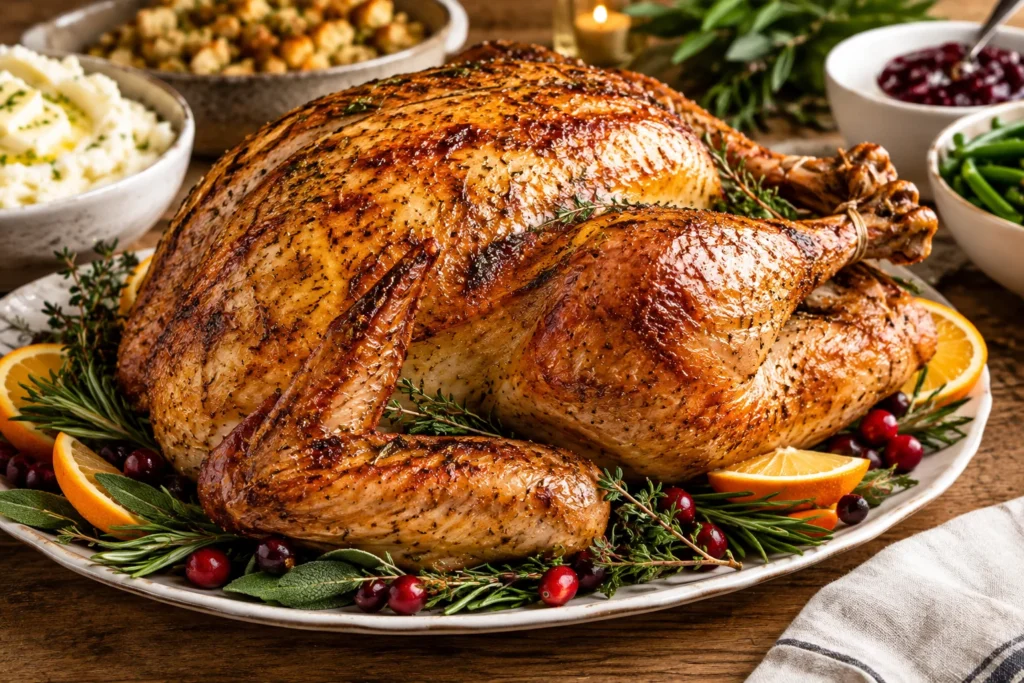
Start counting days before you cook, because the schedule for a turkey is mostly waiting.
- Buying: the USDA's Food Safety and Inspection Service advises allowing 1 pound of turkey per person, so a 14-pound bird serves 14. The agency's roasting guide covers the rest.
- Thawing: in the refrigerator, plan about 24 hours for every 4 to 5 pounds, which means roughly three days for a 14-pound bird.
- Salting: rub the turkey with kosher salt, black pepper, and chopped thyme and rosemary a day or two ahead, and leave it uncovered on a tray in the refrigerator, kept at 40°F or below.
- Roasting: set the oven to 325°F, tuck the wing tips under, and put the bird on a rack. The USDA lists 3 to 3.75 hours for 12 to 14 pounds and 3.75 to 4.25 hours for 14 to 18 pounds, so a 14-pound turkey sits at the edge of both. Start checking at the 3-hour mark.
- Doneness: 165°F in the innermost part of the thigh, the innermost part of the wing, and the thickest part of the breast.
- Resting: 20 minutes before carving. Cook any stuffing in a separate dish, which the USDA recommends.
Why this works: Salting ahead and leaving the bird uncovered in the refrigerator dries the skin, which is what lets it brown without constant basting.
The nutrition: About 49g of protein per 6-ounce serving of cooked turkey meat, using USDA data for roasted turkey meat.
Prime Rib Roast
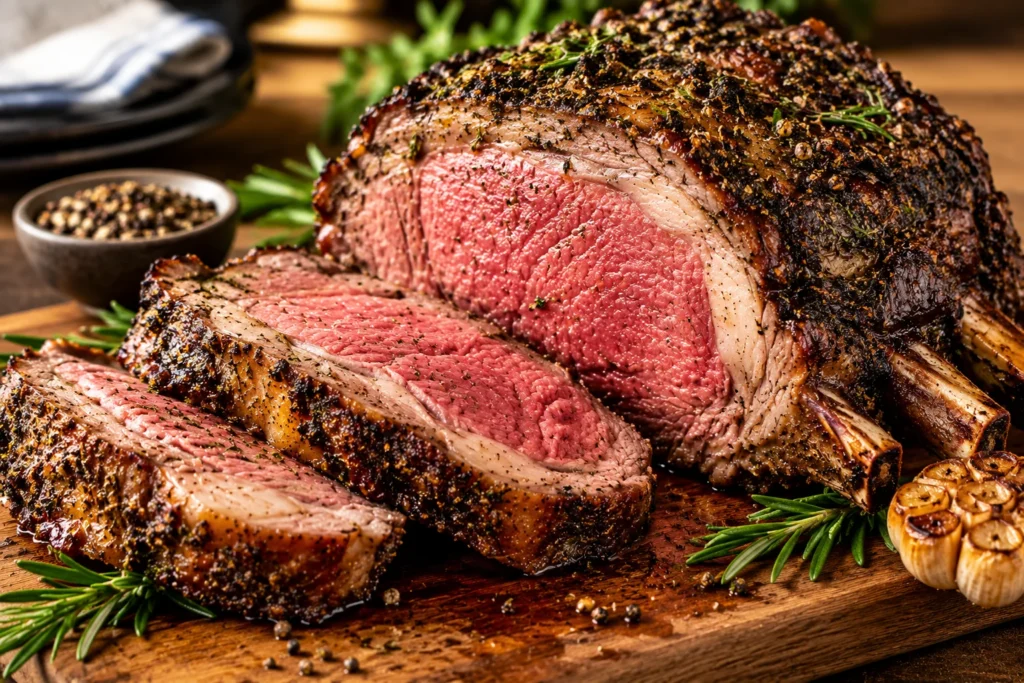
A prime rib is the one dish where the arithmetic matters more than the recipe.
The USDA roasting chart lists a bone-in rib roast of 4 to 8 pounds at 23 to 30 minutes per pound at 325°F. For an 8-pound roast, that's about 3 hours 5 minutes to 4 hours. A common planning rule is about a pound of bone-in roast per person, so 8 pounds serves 8 with a little left for sandwiches.
Rub the roast with salt, pepper, minced garlic, rosemary, and olive oil, set it fat side up on a rack, and put a thermometer in the center of the thickest part, away from the bone. Take it out at 145°F, the USDA's minimum for beef roasts, then rest it 20 minutes under loose foil. That rest is also your window to use the oven for something else.
Serve with horseradish cream made from sour cream, prepared horseradish, and lemon.
Why this works: A rack lets hot air reach the whole roast, and the long rest lets the juices settle so the slices stay moist.
The nutrition: About 38g of protein in a 6-ounce cooked slice, based on USDA data for roasted rib, small end.
Never Miss a Recipe
Fresh high-protein recipes, meal prep ideas, and kitchen tips, straight to your inbox every week. No spam, just good food.
No spam. Unsubscribe anytime.
Pepper-Crusted Beef Tenderloin
Tenderloin is the shortest cook time on this list, and the only one that wants a screaming hot oven.
What to do:
- Tie a trimmed 5-pound whole tenderloin at regular intervals so it's one even thickness.
- Press 3 tablespoons of coarsely cracked black peppercorns into the surface and brown the roast on all sides in a hot pan.
- Roast at 425°F. The USDA lists 45 to 60 minutes total for a whole tenderloin of 4 to 6 pounds, until a thermometer reads 145°F.
- Rest 15 minutes and slice into medallions.
What to skip: taking it out at 125°F because a recipe says so. That's below the USDA's 145°F minimum, and tenderloin is lean enough that a few extra degrees won't make it dry if you rest it properly.
Why this works: Tying the roast gives it one even thickness, so the whole length reaches 145°F at about the same time.
The nutrition: About 43g of protein per serving when a 5-pound tenderloin feeds 12, roughly 4.9 ounces of cooked beef each.
Herb Stuffed Porchetta
Porchetta looks like days of work and takes an afternoon. This version uses a boneless pork loin, which is easier to find than a skin-on belly and gives you a leaner slice.
Butterfly a 4-pound boneless pork loin, spread the inside with a paste of parsley, rosemary, sage, minced garlic, toasted crushed fennel seed, lemon zest, and olive oil, then roll it and tie it tightly.
The USDA chart gives a boneless pork loin roast of 2 to 4 pounds 23 to 33 minutes per pound at 325°F, and it notes that boned and rolled roasts need more time per pound than bone-in cuts. Plan for roughly 1.5 to 2.25 hours, and let the thermometer decide: 145°F, then a rest of at least 3 minutes (10 to 15 is kinder to the slices).
The best part comes the next day. Slices crisped in a skillet are wonderful next to eggs, and if you like that kind of cooking, our high-protein skillet dinners are full of ideas.
Why this works: Rolling the herb paste inside the loin seasons every slice, not just the outside.
The nutrition: About 38g of protein per 5-ounce cooked slice, using USDA data for roasted pork loin. A 4-pound roast serves about 8.
Lemon Herb Roast Chicken
How many chickens do you need for 8 people? Two, and they should go in side by side.
Per the USDA chart, a whole chicken of 3 to 4 pounds takes 1.25 to 1.5 hours at 350°F, which is why two birds fit comfortably into one oven and one meal. Stuff each cavity with lemon halves, garlic, and thyme, rub the skin with olive oil and salt, and leave a little space between the birds so the hot air can move.
Check for 165°F in the innermost part of the thigh and wing and the thickest part of the breast. Rest the chickens 15 minutes, then whisk a little flour and broth into the pan juices for a quick gravy.
It's a good dark-meat-and-white-meat spread for a mixed table. On regular weeknights, the same method scales down nicely, and our quick high-protein dinners for busy school nights show how to get a similar result in less time.
Why this works: Space between the birds lets hot air circulate, which helps the skin brown and the thighs cook through on schedule.
The nutrition: About 41g of protein per serving, using about 5 ounces of cooked chicken meat each. Two 4-pound birds serve 8.
Herb-Crusted Pork Tenderloin
Pork tenderloin is the budget main that holds its own on a platter, and it's fast. The USDA chart lists a tenderloin of half a pound to 1.5 pounds at 425°F for 20 to 30 minutes total, until it reaches 145°F.
For a crowd, roast three tenderloins of about 1.25 pounds each on a single sheet pan, leaving space between them. Brush each with Dijon mustard, then press on a mix of chopped parsley, rosemary, thyme, and minced garlic with a little olive oil. No heavy sauce is needed.
Rest the roasts at least 3 minutes (10 is better), then slice thickly on the bias. Pork tenderloin is one of the leanest cuts you can serve, so don't push it past 145°F.
The nutrition: About 36g of protein per serving when three tenderloins feed 9, using USDA data for roasted pork tenderloin and an assumed cooking yield of 74 percent.
Sheet Pan Salmon with Tapenade
The easiest main here is a whole side of salmon. Lay a 3-pound skin-on side on a lined sheet pan, rub it with olive oil and salt, and spread a quick tapenade over the top: pitted olives, capers, garlic, lemon zest and juice, parsley, and olive oil, pulsed or chopped together.
The Alaska Seafood Marketing Institute's guideline is to bake salmon at 400°F for 10 minutes per inch of thickness, measured at the thickest part. For a side that's 1 to 1.5 inches thick, that's 10 to 15 minutes. The USDA's minimum for fish is 145°F, though America's Test Kitchen found tasters preferred farmed Atlantic salmon at about 125°F. The recipe here follows the USDA number, and you can use a lower one only if you're comfortable with the added risk.
This is also the right main for anyone at the table who passes on red meat, and the leftovers flake into a salad. For more ideas like this one, see our omega-3 rich dinners.
The nutrition: About 31g of protein per 5-ounce cooked serving, using USDA data for farmed Atlantic salmon. A 3-pound side serves 8.
Mains for the Smoker and Grill
Cooking outside is the cleanest way to solve the one-oven problem. These four give the oven back to the sides.
Smoked Turkey
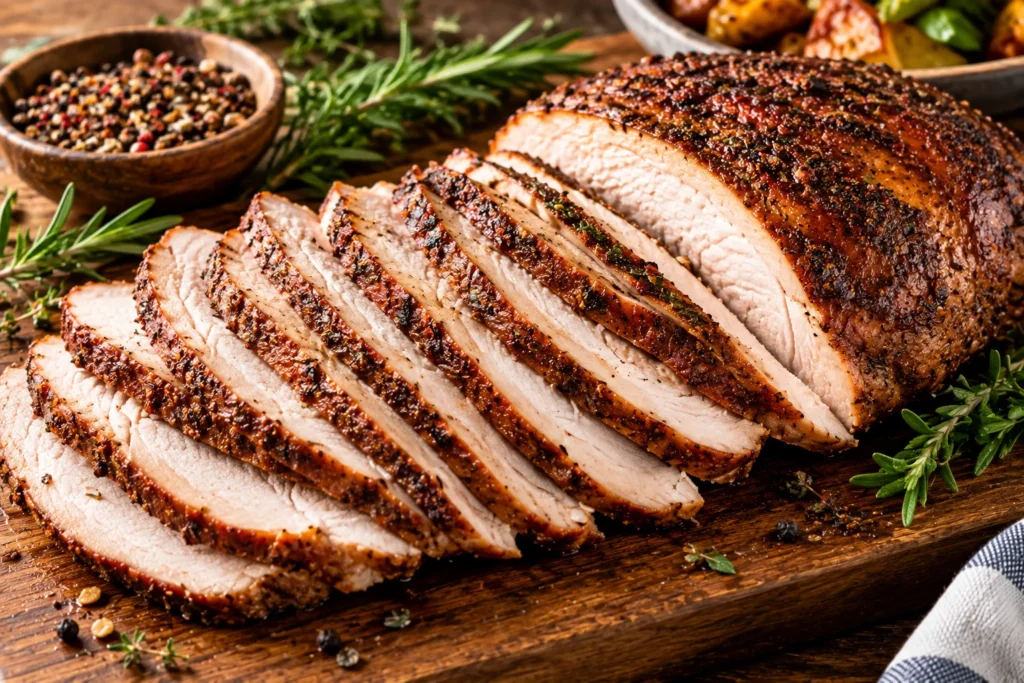
A smoker turns the oven from a bottleneck into a free appliance. It also changes the rules a little, because smoked poultry is held to the same 165°F as roasted poultry but cooks at a lower, steadier heat.
The USDA's smoking guidance has three points worth following to the letter. Keep the smoker's air temperature between 225 and 300°F the whole time, which is why a 275°F setting works well. Use two thermometers, one for the smoker and one for the bird. And plan for time, since the agency says smoking meat or poultry can take anywhere from 4 to 8 hours.
For a 12-pound turkey, completely thaw it first, rub it with oil, salt, pepper, smoked paprika, and garlic powder, and put it on the smoker. Check the innermost thigh, innermost wing, and thickest breast for 165°F, rest the bird 20 minutes, and refrigerate leftovers within 2 hours of taking it off.
The leftovers make serious sandwiches, and they slot right into the plans in our high-protein meal prep ideas on a budget.
The nutrition: About 49g of protein per 6-ounce serving of cooked turkey meat. A 12-pound bird serves 12 at 1 pound per person.
Surf and Turf Platter
Put steak and lobster on one board and nobody has to choose.
Grill four 1-inch boneless strip steaks over medium heat. The Beef Checkoff lists 11 to 14 minutes total for a 1-inch top loin steak to reach 145°F, and recipes from the same source run 11 to 15 minutes. Rest them at least 3 minutes, then slice.
For the lobster, split four-ounce tails down the back, spoon on melted butter with garlic and lemon, and broil them 4 to 6 inches from the element. Here sources disagree. One tested recipe gives 6 to 8 minutes for 3 to 4 ounce tails and 10 to 11 minutes for 5 to 6 ounce tails, while others use about a minute per ounce. Because the spread is so wide, trust a thermometer: the meat should be opaque and reach 145°F, the USDA's number for shellfish (some seafood sources stop at 140°F).
Slice the steak, line up the tails, and let people build their own plates.
The nutrition: About 52g of protein per serving, from roughly 4.4 ounces of cooked strip steak and about 3 ounces of lobster meat. We assumed a 4-ounce tail yields about 3 ounces of cooked meat. Four steaks and eight tails serve 8.
Never Miss a Recipe
Fresh high-protein recipes, meal prep ideas, and kitchen tips, straight to your inbox every week. No spam, just good food.
No spam. Unsubscribe anytime.
Smoked Brisket
Brisket gets its own warning label: it's the only main here you can't schedule precisely. A whole packer brisket of 12 pounds takes about 12 to 18 hours at 225°F or 10 to 14 hours at 250°F, according to smoking guides, and both ranges move with the weather, the smoker, and the individual cut.
Use that as a rough plan, then cook to the probe:
- Hold the smoker steady at 225 to 250°F, inside the USDA's range of 225 to 300°F.
- Coat the brisket with equal parts coarse salt and coarse black pepper.
- Cook until a probe slides into the thickest part of the flat with almost no resistance, usually 195 to 205°F. That's far past the 145°F safety minimum, because the connective tissue needs the extra heat to melt.
- Wrap it and rest it in a cooler for 2 to 4 hours, then slice against the grain.
Because it needs that long rest, brisket is perfect for a host who wants to be done with the main by mid-morning.
Why this works: A long, steady rest in a cooler lets the collagen finish melting and the juices redistribute before slicing.
The nutrition: About 45g of protein per 5-ounce cooked slice, using USDA data for brisket flat. Slices from the fattier point have slightly less. A 12-pound packer serves about 12.
Grilled Tri-Tip
When the guest list is long and the budget isn't, tri-tip is the cut to reach for. Rub two 2-pound roasts with salt, pepper, garlic powder, smoked paprika, and thyme, and set up a two-zone grill.
The Beef Checkoff lists 35 to 45 minutes of indirect grilling for a 1.5 to 2 pound tri-tip. Sear it first over direct medium heat for about 10 minutes, then move it to the cooler side with the lid closed until a thermometer reads 145°F. Rest for 10 to 15 minutes, then slice thin against the grain. Tri-tip has two grain directions that meet near the middle, so cutting the roast in half first keeps every slice tender.
It's among the leanest roasts you can serve, and the protein-per-dollar math is hard to beat. If you want to build even bigger plates around it, our 50g protein dinners show how.
The nutrition: About 43g of protein per serving when two 2-pound roasts feed 8, at roughly 5.9 ounces of cooked beef each.
Braises You Make Ahead
If the holiday has a secret weapon, it's a pot that does its work on Tuesday. These four get better after a night in the refrigerator.
Braised Short Ribs
Of all the make-ahead mains, short ribs repay the effort best. Braise them a day early, refrigerate them overnight, and the fat firms into a layer you can lift off in one piece.
The method is a classic. Sear 4 pounds of boneless short ribs until deeply browned, soften onion, carrot, and celery in the same pot, stir in tomato paste, and reduce 2 cups of red wine by about half. Return the ribs with 2 cups of beef stock, thyme, and bay, cover, and cook at 325°F. The Beef Checkoff's braising guide gives smaller portions of boneless short ribs 1.75 to 2.5 hours; larger pieces and bigger batches take longer, so check from the 2.5 hour mark for fork-tenderness.
Refrigerate overnight, lift off the fat, and reheat covered at 325°F until the ribs reach 165°F. This is exactly the type of cook-once, serve-later dinner that fills our healthy meal prep dinner ideas.
Why this works: Slow, moist heat melts the collagen in short ribs into gelatin, which gives the meat its tenderness and the sauce its body.
The nutrition: About 41g of protein per serving when 4 pounds of boneless ribs feed 8, at roughly 5.9 ounces of cooked beef each. Mashed potatoes underneath aren't counted.
Beef Bourguignon
Bourguignon is the cold-weather crowd-pleaser: chuck simmered in red wine until the sauce coats a spoon. It doubles easily, but only if you do it right.
The classic ratios come from Julia Child's recipe as many cooks have adapted it. For 6 servings that's 3 pounds of lean chuck cut into 2-inch cubes, 6 ounces of bacon, 3 cups of red wine, 2 to 3 cups of beef stock, tomato paste, garlic, thyme, and bay. For a crowd of 12, double all of it and use a very large Dutch oven or two pots, since a crowded pot braises unevenly. The oven goes to 325°F for 2.5 to 3 hours, until the beef is fork-tender.
Sauté the pearl onions and mushrooms separately in butter and stir them in at the end. Then hold the stew on the stove at a bare simmer, or reheat it gently to 165°F, and it stays ready as long as you need.
The nutrition: About 51g of protein per serving when 6 pounds of chuck feed 12, at roughly 5.9 ounces of cooked beef each. Bacon, vegetables, and the noodles or potatoes underneath aren't counted.
Classic Pot Roast
Pot roast is low-effort and generous, and a single 5-pound chuck roast feeds 10 without much fuss.
Brown the roast in a Dutch oven, build a base of onions, garlic, tomato paste, and red wine, add 3 cups of beef broth with thyme and bay, cover, and cook at 325°F. Published braising guides run from about 2.25 hours for smaller bone-in chuck roasts (the Beef Checkoff's figure for roughly 2.25 pounds) to 3 or 4 hours for 3 to 5 pound roasts, so start checking at 3 hours and stop when a fork twists easily in the thickest part.
Add the carrots and baby potatoes for the last 90 minutes so they stay whole. Because the roast does all its work covered in the oven, it's a natural fit with our one-pot dinners with real protein.
The nutrition: About 53g of protein per serving, including roughly 5.9 ounces of cooked chuck plus the potatoes. A 5-pound roast serves 10.
Oven Kalua Pork
Kalua pork is three ingredients and patience: pork shoulder, coarse salt, and liquid smoke.
Rub a 5-pound boneless pork shoulder with 2 tablespoons of Hawaiian or coarse sea salt and about 1.5 tablespoons of liquid smoke, wrap it tightly in foil, and set it in a roasting pan with a little water in the bottom, covered. Published oven versions use 300 to 325°F and about 5 hours for a roast this size. We use 325°F, which keeps the oven at the USDA's recommended floor for roasting.
The pork is done when it falls apart under a fork. One chef's version tells you to expect about 170°F, while grill-based shoulder recipes cook to 195 to 200°F, so go by texture. Shred, toss with the juices, and serve over rice or on slider rolls.
The nutrition: About 33g of protein per 5-ounce cooked serving, using USDA data for roasted pork shoulder. We assumed about half the raw weight ends up as shredded meat, so a 5-pound roast serves about 8.
Casseroles That Wait in the Fridge
When the main course can be assembled on Monday and baked on the day, the holiday gets calmer. These five all travel well to a buffet table. One rule applies to all of them: a casserole that goes into the oven cold needs more time than one that goes in warm, so judge doneness by the center reaching 165°F, not by the clock.
Baked Ziti
Every crowd has one guest who wants pasta, and baked ziti keeps that person happy without a second main.
For one 9 by 13-inch pan, cook 1 pound of ziti until just shy of al dente. Brown 1 pound of lean ground beef with an onion and garlic until it reaches 160°F, then stir it into two 24-ounce jars of marinara. Mix a 15-ounce container of ricotta with an egg and half a cup of Parmesan. Layer pasta and sauce with dollops of the ricotta mixture, finish with 2 cups of shredded mozzarella, and cover with foil.
Bake at 375°F, covered, for about 20 minutes, then uncovered for another 10 to 15 minutes until bubbling and golden. Published versions say the assembled pan can be refrigerated for up to 2 days before baking (take it out about 30 minutes ahead) and frozen for up to 3 months. A single pan serves 8, so for 16 people, make two.
The nutrition: About 31g of protein per serving when one pan serves 8, from the pasta, beef, ricotta, mozzarella, Parmesan, and egg.
Chicken Pot Pie
Pot pie is comfort food that scales neatly in a 9 by 13-inch dish, and the shredded chicken is where the protein lives.
Sauté onion, carrots, and celery in butter, stir in flour, then whisk in chicken broth and milk until thick. Fold in 1.5 pounds of cooked, shredded chicken, frozen peas, thyme, salt, and pepper. Pour the filling into the dish and top with a rolled refrigerated pie crust, cutting a few vents.
A published 9 by 13-inch version bakes at 400°F for 30 to 40 minutes, until the crust is golden and the filling bubbles. You can make the filling ahead and refrigerate it, then reheat it before adding the crust. If you do assemble the whole pie the day before, expect to need more oven time, and check that the center reaches 165°F.
The nutrition: About 27g of protein per serving when one dish serves 8, from the chicken, milk, and peas. Flour, butter, and crust aren't counted.
Cracker Barrel Style Meatloaf
Meatloaf belongs at a holiday table, especially one with children, and a diner-style loaf with a tangy ketchup glaze is the one most guests recognize.
For each loaf, combine 2 pounds of 90% lean ground beef with 2 eggs, three-quarters of a cup of minced onion, half a cup of milk, a cup and a quarter of breadcrumbs, Worcestershire, salt, and pepper, and mix just until combined. Shape each loaf on a rimmed baking sheet.
Published recipes bake a 2-pound loaf at 350°F for 45 minutes, brush on a glaze of ketchup, brown sugar, and mustard, then finish for 15 more minutes at 400°F, or bake the whole hour at 350°F. Either way, the USDA's number for ground beef is 160°F in the center. Two loaves on one pan may need extra time, so rely on the thermometer. Rest 10 minutes before slicing.
It slices cleanly for a buffet, and it's proof that a high-protein plate can be simple. For a lighter weeknight version of the idea, see our high-protein dinners with 30g of protein.
Why this works: Mixing the beef just until combined keeps the loaf tender instead of dense.
The nutrition: About 27g of protein per slice when two loaves serve 16, from the beef, eggs, breadcrumbs, and milk. Each loaf slices into 8.
Shepherd's Pie
For a smaller table that still wants something hearty, shepherd's pie puts the meat, vegetables, and potatoes all in one dish.
Cook 2 pounds of ground lamb with diced carrots and onion until it reaches 160°F, stir in tomato paste, Worcestershire, and a cup of frozen peas, and spread it in a 9 by 13-inch dish. Boil 3 pounds of russet potatoes, mash them with butter and cream, and spread them over the top, dragging a fork through the surface for peaks that brown.
Bake at 400°F for 20 to 25 minutes, until the top is golden and the filling bubbles around the edges. If you build the pie the day before, bake it until the middle reaches 165°F, which will take a little longer than from fresh. Ground beef works too, but then it's technically a cottage pie.
The nutrition: About 26g of protein per serving when one dish serves 8, from the lamb, potatoes, peas, and cream.
Chicken Enchilada Casserole
This is the casserole for the guests who want something a little different, and it builds up in layers the night before.
Mix 1 pound of cooked, shredded chicken with a drained 15-ounce can of black beans, a minced onion, cumin, and chili powder. Spread a thin layer of enchilada sauce in a 9 by 13-inch dish, then layer corn tortillas, the chicken mixture, enchilada sauce, and shredded cheddar, repeating until everything is used and ending with cheese.
Bake at 375°F, covered with foil, for about 20 minutes, then uncovered for another 20, until bubbling and melted. Let it stand 5 to 10 minutes before cutting into squares. The chicken and the beans each carry real protein, and the cheese puts it over the top.
The nutrition: About 31g of protein per serving when one pan serves 8, from the chicken, black beans, cheddar, and corn tortillas.
Leftovers and Reheating
Holiday mains tend to produce leftovers, and a few USDA rules make them safe and easy.
- Refrigerate cooked food within 2 hours.
- Eat leftovers within 3 to 4 days.
- Reheat everything to 165°F, whether it's sliced turkey, braised beef, or casserole.
- Cool large pots of stew or braise in shallow containers so the center chills quickly.
- Freeze what you won't finish in time.
Questions About Holiday Mains
How much turkey should I buy per person?
The USDA advises 1 pound of turkey per person. If you want leftovers, extension guidance suggests up to 1.5 pounds per person.
How long should a turkey rest before carving?
The USDA recommends 20 minutes, which lets the juices settle and makes carving cleaner.
What is the safest way to thaw a turkey?
In the refrigerator, allowing about 24 hours for every 4 to 5 pounds. A 14-pound turkey needs roughly three days.
What if I only have one oven?
Choose mains that cook at the same temperature, or cook one outside. A smoked turkey, grilled tri-tip, or smoked brisket frees the oven completely, and any braise can be made a day ahead and simply reheated.
Can I cook beef tenderloin to 125°F?
Many recipes do, but that's below the USDA's minimum of 145°F with a 3-minute rest for beef roasts. The lower temperature is a personal choice that carries more risk, especially for children, older adults, pregnant guests, and anyone with a weakened immune system.
How do I keep food warm for a buffet?
Hold hot food at 140°F or above, using warming trays or a low oven. Perishable food shouldn't sit out longer than 2 hours, or 1 hour if it's above 90°F.
Which main has the most protein per serving?
Among these recipes, pot roast leads at about 53g per serving, followed by surf and turf at 52g, bourguignon at 51g, and both turkeys at 49g. Serving sizes differ, so compare the numbers with how big a portion you'll actually serve.
Can I make these mains ahead?
The braises, the casseroles, and the make-ahead roasts are the best candidates. Published baked ziti recipes keep an assembled pan in the refrigerator for up to 2 days, and the USDA says to eat leftovers within 3 to 4 days.
How do I reheat leftovers safely?
Bring them to 165°F in the center. Cover roasts and braises with a splash of broth so they don't dry out.
1. Classic Roast Turkey
Approx. 49g ProteinIngredients: 14 lb thawed whole turkey (unstuffed), 3 tbsp kosher salt, 1 tbsp black pepper, 2 tbsp chopped fresh thyme, 2 tbsp chopped fresh rosemary, 1 lemon (halved), 1 onion (quartered), 1/2 cup water for the pan.
Step 1: One to two days ahead, pat the turkey dry and rub it with the salt, pepper, thyme, and rosemary. Refrigerate uncovered on a tray at 40°F or below.
Step 2: Preheat the oven to 325°F. Set the turkey on a rack in a shallow roasting pan, tuck the wing tips under, put the lemon and onion in the cavity, and add the water to the pan.
Step 3: Roast until a thermometer reads 165°F in the innermost part of the thigh, the innermost part of the wing, and the thickest part of the breast. USDA lists 3 to 3 3/4 hours for 12 to 14 lb and 3 3/4 to 4 1/4 hours for 14 to 18 lb. Start checking at 3 hours.
Step 4: Rest the turkey 20 minutes before carving.
Step 5: Cook any stuffing in a separate dish.
2. Smoked Turkey
Approx. 49g ProteinIngredients: 12 lb thawed whole turkey, 2 tbsp oil, 2 tbsp kosher salt, 1 tbsp black pepper, 1 tbsp smoked paprika, 1 tbsp garlic powder, wood chunks for smoking.
Step 1: Heat a smoker to 275°F and keep it between 225 and 300°F. Use one thermometer for the smoker and one for the turkey.
Step 2: Pat the turkey dry and rub it with the oil, salt, pepper, paprika, and garlic powder.
Step 3: Smoke until a thermometer reads 165°F in the innermost thigh, the innermost wing, and the thickest breast. USDA says smoking can take 4 to 8 hours, so start checking at 4 hours.
Step 4: Rest 20 minutes before carving.
Step 5: Refrigerate leftovers within 2 hours.
3. Prime Rib Roast
Approx. 38g ProteinIngredients: 8 lb bone-in rib roast (4 ribs), 3 tbsp kosher salt, 1 tbsp black pepper, 8 cloves garlic (minced), 3 tbsp chopped fresh rosemary, 3 tbsp olive oil. Horseradish cream: 3/4 cup sour cream, 3 tbsp prepared horseradish, 1 tbsp lemon juice, pinch of salt.
Step 1: Preheat the oven to 325°F. Pat the roast dry and rub with the oil, salt, pepper, garlic, and rosemary.
Step 2: Set the roast fat side up on a rack in a shallow pan with a thermometer in the center of the thickest part, away from bone.
Step 3: Roast 23 to 30 minutes per pound (about 3 hr 5 min to 4 hr for 8 lb), until the thermometer reads 145°F.
Step 4: Rest under loose foil 20 minutes.
Step 5: Stir the horseradish cream together, carve, and serve.
4. Pepper-Crusted Beef Tenderloin
Approx. 43g ProteinIngredients: 5 lb whole beef tenderloin (trimmed), 3 tbsp coarsely cracked black peppercorns, 1 tbsp kosher salt, 3 tbsp oil, kitchen string. Horseradish cream: 1 cup sour cream, 1/4 cup prepared horseradish, 1 tbsp lemon juice, pinch of salt.
Step 1: Preheat the oven to 425°F. Tie the tenderloin with string at regular intervals so it is an even thickness.
Step 2: Season with the salt, then press the cracked pepper into the surface. Brown the roast on all sides in the oil in a hot skillet.
Step 3: Roast on a rack until a thermometer in the center reads 145°F. USDA lists 45 to 60 minutes total for a whole tenderloin of 4 to 6 lb.
Step 4: Rest 15 minutes, then remove the string.
Step 5: Stir together the horseradish cream and serve with the sliced medallions.
5. Herb Stuffed Porchetta
Approx. 38g ProteinIngredients: 4 lb boneless pork loin roast, 1/4 cup chopped parsley, 2 tbsp chopped fresh rosemary, 2 tbsp chopped fresh sage, 8 cloves garlic (minced), 2 tbsp fennel seeds (toasted and crushed), zest of 2 lemons, 2 tsp kosher salt, 1 tsp black pepper, 3 tbsp olive oil, kitchen string.
Step 1: Preheat the oven to 325°F. Butterfly the pork loin so it lays flat.
Step 2: Mix the herbs, garlic, fennel, zest, salt, pepper, and oil into a paste and spread it over the cut surface.
Step 3: Roll the loin up and tie it with string every 1 1/2 inches. Rub the outside with a little oil and salt.
Step 4: Roast 23 to 33 minutes per pound (about 1 hr 30 min to 2 hr 15 min for 4 lb) until a thermometer reads 145°F.
Step 5: Rest at least 3 minutes (10 to 15 is better), remove the string, and slice.
6. Braised Short Ribs
Approx. 41g ProteinIngredients: 4 lb boneless beef short ribs, 2 tsp kosher salt, 1 tsp black pepper, 3 tbsp oil, 2 onions (diced), 3 carrots (diced), 3 celery ribs (diced), 3 tbsp tomato paste, 2 cups dry red wine, 2 cups beef stock, 6 sprigs fresh thyme, 2 bay leaves. Serve over mashed potatoes.
Step 1: Preheat the oven to 325°F. Season the ribs and sear in the oil in a Dutch oven until deeply browned. Set aside.
Step 2: Cook the onion, carrot, and celery until softened. Stir in the tomato paste, add the wine, and simmer until reduced by half.
Step 3: Return the ribs, add the stock, thyme, and bay, cover, and braise 2 1/2 to 3 hours, checking from 2 1/2 hours, until fork-tender.
Step 4: For make-ahead, refrigerate overnight, lift off the solid fat, and reheat covered at 325°F until the ribs reach 165°F.
Step 5: Reduce the sauce on the stove until glossy and serve over mashed potatoes.
7. Beef Bourguignon
Approx. 51g ProteinIngredients: 6 lb lean beef chuck (cut into 2-inch cubes), 12 oz bacon (cut into pieces), 2 tbsp olive oil, 2 carrots (sliced), 2 onions (sliced), 1/4 cup all-purpose flour, 6 cups dry red wine, 4 to 6 cups beef stock, 2 tbsp tomato paste, 4 cloves garlic (minced), 8 sprigs thyme, 4 bay leaves, 36 to 48 pearl onions, 2 lb mushrooms (quartered), 6 tbsp butter (divided), salt and pepper.
Step 1: Preheat the oven to 325°F. Cook the bacon in a very large Dutch oven (or two pots) until crisp and remove it. Brown the beef in batches in the fat and set aside.
Step 2: Cook the carrots and onions until soft. Return the beef and bacon, season, and sprinkle with the flour.
Step 3: Add the wine and enough stock to barely cover the meat, then the tomato paste, garlic, thyme, and bay. Bring to a simmer on the stove.
Step 4: Cover and braise in the oven 2 1/2 to 3 hours, until the beef is fork-tender.
Step 5: Brown the pearl onions in 2 tbsp butter, then cook the mushrooms in the remaining butter. Stir both in near the end. Keep hot or reheat to 165°F.
8. Classic Pot Roast
Approx. 53g ProteinIngredients: 5 lb boneless beef chuck roast, 1 tbsp kosher salt, 2 tsp black pepper, 3 tbsp oil, 3 onions (quartered), 6 cloves garlic, 3 tbsp tomato paste, 1 cup dry red wine, 3 cups beef broth, 6 sprigs thyme, 2 bay leaves, 6 carrots (cut into chunks), 2 lb baby potatoes.
Step 1: Preheat the oven to 325°F. Season the roast and brown it on all sides in the oil in a Dutch oven. Set aside.
Step 2: Cook the onions and garlic briefly, stir in the tomato paste, then add the wine and scrape up the browned bits.
Step 3: Return the roast, add the broth, thyme, and bay, cover, and cook at 325°F.
Step 4: After about 1 1/2 hours, add the carrots and potatoes. Continue until the roast is fork-tender, 3 to 4 hours in total.
Step 5: Rest 10 minutes, then slice or shred and serve with the vegetables and pan juices.
9. Lemon Herb Roast Chicken
Approx. 41g ProteinIngredients: Two 4 lb whole chickens, 2 lemons (halved), 8 cloves garlic (smashed), 8 sprigs fresh thyme, 3 tbsp olive oil, 2 tsp kosher salt, 1 tsp black pepper. Gravy: 2 tbsp all-purpose flour, 2 cups chicken broth.
Step 1: Preheat the oven to 350°F. Pat the chickens dry and rub with the oil, salt, and pepper.
Step 2: Put lemon halves, garlic, and thyme inside each cavity.
Step 3: Set the chickens side by side in a roasting pan with space between them. Roast 1 1/4 to 1 1/2 hours until a thermometer reads 165°F in the innermost thigh and wing and the thickest breast.
Step 4: Rest 15 minutes, then carve.
Step 5: Whisk the flour into the pan juices on the stove, add the broth, and simmer until thickened.
10. Surf and Turf Platter
Approx. 52g ProteinIngredients: 4 boneless beef strip steaks, 1 inch thick (about 12 oz each), 1 tbsp oil, 2 tsp kosher salt, 1 tsp black pepper, 8 lobster tails (about 4 oz each), 1/2 cup butter (melted), 4 cloves garlic (minced), juice of 1 lemon, 2 tbsp chopped parsley.
Step 1: Season the steaks and grill over medium heat 11 to 14 minutes total, turning occasionally, until a thermometer reads 145°F. Rest at least 3 minutes, then slice.
Step 2: Split the lobster tails down the back and set them on a baking sheet.
Step 3: Mix the butter, garlic, lemon juice, and parsley and spoon it over the tails.
Step 4: Broil 4 to 6 inches from the element until the meat is opaque and reads 145°F (times vary from about 6 to 11 minutes by tail size).
Step 5: Arrange the sliced steak and lobster on a platter.
11. Smoked Brisket
Approx. 45g ProteinIngredients: 12 lb whole packer brisket, 1/4 cup kosher salt, 1/4 cup coarse black pepper, wood chunks for smoking.
Step 1: Heat a smoker to 225 to 250°F. Mix the salt and pepper and coat the brisket on all sides.
Step 2: Smoke the brisket, planning about 12 to 18 hours at 225°F or 10 to 14 hours at 250°F, and hold the smoker steady.
Step 3: If the temperature stalls, you may wrap the brisket in butcher paper or foil.
Step 4: Cook until a probe slides into the thickest part with almost no resistance, usually 195 to 205°F.
Step 5: Rest wrapped in a cooler 2 to 4 hours, then slice against the grain.
12. Baked Ziti
Approx. 31g ProteinIngredients: 1 lb ziti, 1 lb 90 percent lean ground beef, 1 tbsp olive oil, 1 onion (diced), 3 cloves garlic (minced), two 24-oz jars marinara sauce, 15 oz whole milk ricotta, 1 large egg, 1/2 cup grated Parmesan, 2 cups (8 oz) shredded mozzarella, 1 tsp Italian seasoning, salt and pepper.
Step 1: Preheat the oven to 375°F. Cook the ziti until just shy of al dente and drain.
Step 2: Brown the beef with the onion and garlic until it reaches 160°F. Stir in the marinara and Italian seasoning.
Step 3: Mix the ricotta, egg, and Parmesan. Toss the ziti with about two-thirds of the sauce.
Step 4: In a 9 by 13-inch dish, layer half the pasta, dollops of the ricotta mixture, and half the mozzarella, then the rest of the pasta, remaining sauce, and mozzarella. Cover with foil.
Step 5: Bake 20 minutes covered, then 10 to 15 minutes uncovered until bubbling. Rest 5 to 10 minutes. (Assembled pans can wait in the refrigerator up to 2 days.)
13. Herb-Crusted Pork Tenderloin
Approx. 36g ProteinIngredients: Three 1 1/4 lb pork tenderloins, 1/4 cup Dijon mustard, 3 tbsp chopped parsley, 2 tbsp chopped fresh rosemary, 2 tbsp chopped fresh thyme, 4 cloves garlic (minced), 3 tbsp olive oil, 2 tsp kosher salt, 1 tsp black pepper.
Step 1: Preheat the oven to 425°F. Pat the tenderloins dry and season with the salt and pepper.
Step 2: Mix the herbs, garlic, and oil. Brush each tenderloin with the Dijon, then press on the herb mixture.
Step 3: Set the tenderloins on a sheet pan with space between them.
Step 4: Roast 20 to 30 minutes total, until a thermometer reads 145°F.
Step 5: Rest at least 3 minutes (10 is better), then slice thickly.
14. Sheet Pan Salmon with Tapenade
Approx. 31g ProteinIngredients: 3 lb skin-on side of salmon (1 to 1 1/2 inches thick), 1 tbsp olive oil, 1/2 tsp kosher salt. Tapenade: 1 cup pitted olives, 2 tbsp capers, 2 cloves garlic, zest and juice of 1 lemon, 1/4 cup olive oil, 2 tbsp chopped parsley.
Step 1: Preheat the oven to 400°F and line a sheet pan.
Step 2: Chop or pulse the tapenade ingredients together.
Step 3: Set the salmon skin side down, rub with the oil and salt, and spread the tapenade over the top.
Step 4: Bake about 10 minutes per inch of thickness measured at the thickest part (10 to 15 minutes), until the fish flakes and reads 145°F.
Step 5: Serve right from the pan.
15. Chicken Pot Pie
Approx. 27g ProteinIngredients: 1 1/2 lb cooked shredded chicken (about 5 cups), 1/3 cup butter, 1 onion (diced), 3 carrots (diced), 2 celery ribs (diced), 1/3 cup all-purpose flour, 2 cups chicken broth, 1 cup whole milk, 1 cup frozen peas, 1 tsp dried thyme, 3/4 tsp kosher salt, 1/2 tsp black pepper, 1 refrigerated pie crust.
Step 1: Preheat the oven to 400°F. Melt the butter and cook the onion, carrots, and celery until tender.
Step 2: Stir in the flour for 1 minute, then whisk in the broth and milk and simmer until thick.
Step 3: Fold in the chicken, peas, thyme, salt, and pepper. Pour into a 9 by 13-inch dish.
Step 4: Roll the crust to fit, lay it over the filling, tuck the edges in, and cut vents.
Step 5: Bake 30 to 40 minutes until the crust is golden and the filling bubbles and the center reaches 165°F. (The filling can be made and chilled ahead.)
16. Cracker Barrel Style Meatloaf
Approx. 27g ProteinIngredients: Two loaves: 4 lb 90 percent lean ground beef, 4 large eggs, 1 1/2 cups minced onion, 1 cup milk, 2 1/2 cups dry breadcrumbs, 2 tbsp Worcestershire sauce, 2 tsp kosher salt, 1 tsp black pepper. Glaze: 1 cup ketchup, 1/4 cup packed brown sugar, 2 tbsp yellow mustard.
Step 1: Preheat the oven to 350°F. Mix everything but the glaze ingredients until just combined and shape into two loaves on rimmed baking sheets.
Step 2: Stir the glaze together and brush half over the loaves.
Step 3: Bake 45 minutes, brush on the remaining glaze, and raise the oven to 400°F for 15 more minutes (or bake the full hour at 350°F), until a thermometer reads 160°F in the center.
Step 4: Rest 10 minutes.
Step 5: Slice each loaf into 8.
17. Grilled Tri-Tip
Approx. 43g ProteinIngredients: Two 2 lb tri-tip roasts, 2 tbsp kosher salt, 4 tsp black pepper, 4 tsp garlic powder, 2 tsp smoked paprika, 2 tsp dried thyme, 2 tbsp oil.
Step 1: Rub the roasts with the oil, then the salt, pepper, garlic powder, paprika, and thyme.
Step 2: Set up a two-zone grill. Sear the roasts over direct medium heat about 10 minutes, turning once.
Step 3: Move to the cooler side, close the lid, and grill until a thermometer reads 145°F (35 to 45 minutes total).
Step 4: Rest 10 to 15 minutes.
Step 5: Slice thinly across the grain, cutting each roast in half first where the grain changes direction.
18. Oven Kalua Pork
Approx. 33g ProteinIngredients: 5 lb boneless pork shoulder (Boston butt), 2 tbsp Hawaiian or coarse sea salt, 1 1/2 tbsp liquid smoke, aluminum foil, 1/2 cup water for the pan.
Step 1: Preheat the oven to 325°F.
Step 2: Rub the pork with the salt and liquid smoke. Wrap it tightly in foil.
Step 3: Set the package in a roasting pan with the water and cover the pan with more foil.
Step 4: Cook about 5 hours, until the pork falls apart easily.
Step 5: Shred, toss with the juices, and serve over rice or on slider rolls.
19. Shepherd's Pie
Approx. 26g ProteinIngredients: Filling: 2 lb ground lamb, 3 carrots (diced), 1 onion (diced), 1 tbsp oil, 1 1/2 tbsp tomato paste, 1 tbsp Worcestershire sauce, 1 cup frozen peas, 1 tsp kosher salt, 1/2 tsp black pepper. Topping: 3 lb russet potatoes, 1/4 cup butter, 1/4 cup heavy cream, 1 tsp kosher salt.
Step 1: Boil the potatoes until tender, drain, and mash with the butter, cream, and salt.
Step 2: Preheat the oven to 400°F. Cook the carrots and onion in the oil until soft.
Step 3: Add the lamb and cook until it reaches 160°F. Stir in the tomato paste, Worcestershire, salt, pepper, and peas.
Step 4: Spread the filling in a 9 by 13-inch dish and cover with the mashed potatoes, dragging a fork across the top.
Step 5: Bake 20 to 25 minutes until golden and bubbling (center 165°F if made ahead).
20. Chicken Enchilada Casserole
Approx. 31g ProteinIngredients: 1 lb cooked shredded chicken, one 15-oz can black beans (drained and rinsed), 1 onion (minced), 1 tbsp oil, 1 tsp cumin, 1 tbsp chili powder, 2 cups red enchilada sauce, 12 corn tortillas (6 inch), 3 cups (12 oz) shredded cheddar cheese.
Step 1: Preheat the oven to 375°F. Cook the onion in the oil, then mix with the chicken, beans, cumin, and chili powder.
Step 2: Spread a thin layer of enchilada sauce in a 9 by 13-inch dish.
Step 3: Layer a third of the tortillas, a third of the chicken mixture, sauce, and cheese. Repeat twice, ending with cheese.
Step 4: Cover with foil and bake 20 minutes, then uncover and bake 20 more minutes until bubbling.
Step 5: Stand 5 to 10 minutes before cutting.
Get Fresh Recipes Every Week
Join readers getting fresh recipes, meal prep systems, and high-protein meal ideas delivered to your inbox every week.
No spam. Unsubscribe anytime.