
See all 21 recipes
Table of Contents
- A Sunday Plan With Swap Rules
- Freezer Batches: Good for 1 to 3 Months
- Fridge Eggs and Proteins: Good for 3 to 4 Days
- Cold Jars: Assemble the Night Before
- Freezer Packs: Blend in the Morning
- Time and Protein at a Glance
- Make-Ahead Safety: Egg Temperatures, Cooling, and Reheating
- How I Counted Protein
- Where These Cards Differ From Their Sources
- FAQ
- Recipe Cards
I wanted make-ahead breakfasts with checkable protein numbers, so these 21 recipes list exact weights and count protein per serving, from 12 to 45 grams.
They're sorted by shelf life, because that decides when you eat each one: freezer batches, fridge eggs and proteins, cold jars, and freezer packs.
Recipes are adapted from published sources, with USDA egg temperatures and storage times on every card. For plates you cook fresh, see our high-protein breakfast bowls.
Our Take
Cook egg dishes to 160°F, and reheat them to 165°F.
A Sunday Plan With Swap Rules
Pick one freezer batch, one fridge item, and one jar, and the week is covered. Freezer batches hold for months and fridge items for 3 to 4 days, so eat the fridge items first and the frozen ones later.
Here's one week built that way, with protein per serving:
- Monday: Veggie Omelet with Spinach and Feta, about 23 g protein per omelet
- Tuesday: Egg Muffin Bites, about 17 g protein per serving (2 muffins)
- Wednesday: Overnight Oats with Greek Yogurt, about 17 g protein per jar
- Thursday: Breakfast Burritos, about 23 g protein per burrito
- Friday: Protein Pancakes, about 26 g protein per serving (about 3 pancakes)
Swap rule one: trade within a group, not across it. Storage times belong to the group, so one freezer egg dish can stand in for another. Swap rule two: change the meat before the eggs. Ham, bacon, and cooked sausage trade easily in the sheet pan eggs, sandwiches, and tacos, but each has its own protein count, so recompute.
Swap rule three: change vegetables, not the egg-to-liquid ratio. The University of Illinois Extension notes that other vegetables can replace the mushrooms in its casserole. Julie Blanner adds that meats and vegetables should be cooked before they go on the sheet pan.
Freezer Batches: Good for 1 to 3 Months
These 8 recipes are the backbone of a make-ahead week, because they survive the freezer. Egg casseroles keep 2 to 3 months frozen, per FoodSafety.gov, and the sandwiches and pancakes have their own windows noted on each card.
Cook, cool, wrap, and label everything with the date. Our 20-minute high-protein meal prep ideas cover more batch cooking.
Don't Miss the Next Recipe
Get fresh recipes, meal prep systems, and high-protein meal ideas delivered to your inbox every week.
No spam. Unsubscribe anytime.
Egg Bake Casserole
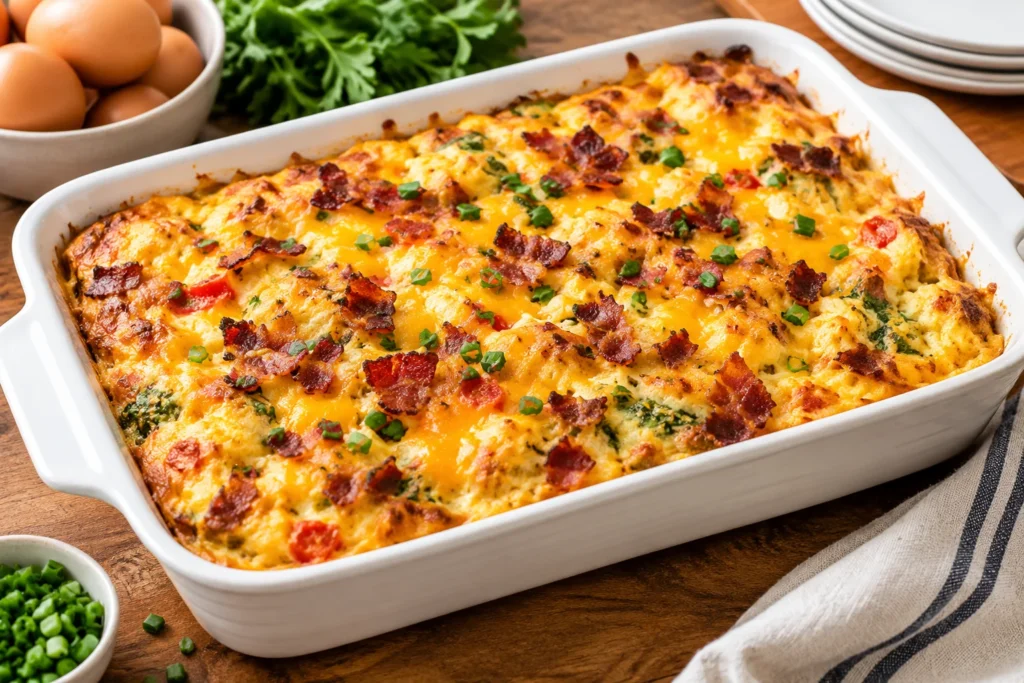
A big egg bake is the easiest make-ahead breakfast, and this card follows the University of Illinois Extension recipe. Bread cubes, sausage, two cheeses, and mushrooms go into a 9 by 13 inch pan, and an egg and milk mixture goes over the top.
The pan sits in the refrigerator 8 hours or overnight before it ever sees the oven. That soak is what turns dry bread into a custard. Don't skip it.
The nutrition: About 12 g protein per square (1 of 12). The sausage is counted raw at 14 g protein per 100 g.
Bake it at 350°F, covered with foil, for 45 minutes. The source then says to keep baking until the eggs and sausage reach 160°F, which is the USDA mark for dishes with eggs, but it never says when to take the foil off. I'd lift it after the 45 minutes so the top can set.
The source suggests other vegetables for the mushrooms, such as green onions, tomatoes, or zucchini, and turkey sausage for a lighter bake. Cut into 12 squares and each one lands near the 12 grams the source lists.
Egg Muffin Bites
Egg muffins are the grab-and-go version of an omelet. This card follows a Two Peas and Their Pod recipe that Tennessee's Working for a Healthier Tennessee program shares, and it takes about 10 minutes to mix.
Whisk twelve eggs with a little milk, then stir in chopped tomatoes, spinach, green onions, garlic powder, and most of the cheese. Spoon the mixture into a generously sprayed 12 cup tin. Spray it well. Eggs cling to bare metal.
Why this works: The source lists 8 grams of protein per muffin, and the card's math lands at about the same number, so two muffins make a serving of 17 g.
The nutrition: Each serving (2 muffins) has about 17 g protein, and the batch makes 6. The cheese is counted at 23 g protein per 100 g, as cheddar.
Bake at 350°F for 20 to 25 minutes, until the eggs are fully set. I'd check one in the center with a thermometer, since the USDA wants 160°F for egg dishes. Let the tin sit 5 minutes before loosening them with a knife.
Breakfast Burritos
Frozen burritos are a gift to a groggy morning. This card follows Slender Kitchen's freezer burritos, which fold scrambled eggs, black beans, peppers, onion, and cheese into a tortilla.
Cook the peppers and onion first, add the beans, then scramble the eggs right in the same pan. Keep the eggs firm. A soft scramble is also a wetter one, and wet fillings turn a frozen tortilla soggy.
The nutrition: Count on roughly 23 g protein per burrito, from 6 equal servings. The tortillas are counted as flour tortillas at 9 g protein per 100 g.
Two tips come straight from the source. Sprinkle the cheese on the tortilla before the filling, because it acts as a moisture barrier, and keep the salsa out of the freezer, adding it after reheating.
The source used low-carb tortillas and lists 27 g protein per burrito. I counted ordinary flour tortillas, so the card shows a lower number. Our meal prep ideas on a budget have more freezer-friendly dishes.
Why this works: The source says the burritos freeze 3 to 4 months, but the USDA lists 2 to 3 months for egg dishes, so the card uses the shorter window.
Sheet Pan Eggs
A sheet pan of eggs is the fastest way to prep a week of breakfasts. Julie Blanner's method pours beaten eggs straight onto a greased pan, and the oven does the rest at 375°F.
The nutrition: One square comes to about 20 g protein, with 9 in all. The ham is counted cooked, at 18 g protein per 100 g.
Never Miss a Recipe
Fresh high-protein recipes, meal prep ideas, and kitchen tips, straight to your inbox every week. No spam, just good food.
No spam. Unsubscribe anytime.
The source says to bake 13 to 14 minutes for fully cooked eggs and about 15 for the scrambled version. I chose the scrambled version, beaten with salt and pepper, because it gives an even sheet you can cut into squares.
Add ham and cheddar before baking, which the source allows as optional add-ins. It also warns that raw meats and vegetables won't cook in a short bake, so use cooked ones.
Check the center for 160°F. The source's pan size is stated two ways, a 21 by 15 inch sheet and a 9 by 13 inch pan, so I used a standard half sheet and suggest checking at 12 minutes. The squares work in sandwiches and bowls.
Make-Ahead Breakfast Sandwiches
Breakfast sandwiches beat the drive-thru line, and these are easy to batch. This card follows Tastes Better From Scratch: one pan of eggs, cut into squares, stacked with cheddar and bacon on English muffins.
Bake the eggs at 325°F in a 9 by 13 inch pan, 18 to 22 minutes. The source says not to overcook them, and I'd agree, because eggs that are already dry get worse in the microwave.
Wrap each sandwich in foil and freeze them in a bag. The source says they keep up to 1 month, so the card uses that, even though the USDA allows 2 to 3 months for egg dishes.
The nutrition: Per sandwich, it's about 20 g protein (12 servings). The bacon is counted raw at 13 g protein per 100 g, and the muffins are whole wheat.
Thaw one overnight in the refrigerator, then microwave at half power for 40 seconds to a minute, flip, then use high for 10 to 30 seconds. Or bake at 350°F. Either way, the center should hit 165°F, as the USDA asks of reheated egg dishes.
Frittata Slices
A frittata is a quiche with no crust, which is why it slices so cleanly. This card follows Eggland's Best: eight eggs, two cheeses, onion, red pepper, garlic, and a big pile of spinach.
Cook the vegetables first, about 10 minutes, then let them cool for 5 before they meet the eggs. Hot vegetables would start cooking the egg mixture in the pan, and you want it to set in the oven instead.
The nutrition: About 18 g protein per slice (1 of 6). The mozzarella is counted at 22 g protein per 100 g.
Bake in a parchment-lined 9 inch pan at 375°F for 30 to 40 minutes, until the center is set. A thermometer should read 160°F. The source suggests a quick broil for color, which I'd skip for a meal-prep pan.
Why this works: The source's label lists 27 g protein and 622 calories per serving, which doesn't match its six servings, so the card counts the ingredients itself and lands near 18 g.
Cinnamon Roll Egg Bake
A cinnamon roll egg bake is the sweet one on this list, and it only reaches a respectable protein number because of sausage. This card follows Jimmy Dean's sausage cinnamon roll breakfast casserole.
The nutrition: Each square has about 15 g protein, and the batch makes 8. The sausage is counted raw at 14 g protein per 100 g, and the rolls with icing at 4.6 g.
The rolls are cut into quarters and baked first, 12 to 15 minutes, then folded into the egg mixture with cooked sausage. Pre-baking helps them hold their shape. It rests overnight.
Bake covered at 325°F for 30 minutes, then uncovered for about 15 more. The source tests with a knife, but I'd also check for 160°F, which the USDA sets for egg dishes.
The source's baking dish size, 10 by 6 inches, is unusual, so the card says a 2 quart dish. Ice it after baking and top it with the crispy reserved sausage.
Protein Pancakes
Protein pancakes freeze better than most pancakes, because the batter is mostly oats and banana. This card follows Well Plated, which blends oats, banana, Greek yogurt, an egg, egg whites, and protein powder.
Blend the batter for about 2 minutes, then let it rest at least 10 minutes. Resting thickens it. Skipping it gives you flat pancakes that stick.
Cook on a medium-high griddle, about 400°F, with quarter cup portions. Flip when the edges look dry and bubbles form, about 3 minutes in, and give the second side 1 to 2 minutes.
The recipe makes about 14 pancakes. Freeze them in a single layer on a parchment-lined sheet before bagging them, so they don't fuse into one block. The source freezes them for up to 2 months.
The nutrition: Count on roughly 26 g protein per serving (about 3 pancakes), from 4 equal servings. The protein powder is counted at 80 g per 100 g, so check your label.
Fridge Eggs and Proteins: Good for 3 to 4 Days
Cooked eggs and proteins stay good 3 to 4 days in the refrigerator, so these 6 recipes are for the first half of the week. Most reheat best gently, because eggs turn rubbery when blasted.
The poached eggs and bacon are made in parts and put together in the morning.
Egg and Cheese Crepe Pinwheels
The nutrition: One serving (5 pinwheels) comes to about 24 g protein, with 4 in all. Ham is counted at 18 g protein per 100 g.
Egg crepes sound fussy, but they're just thin omelets. This card adapts Annabel Karmel's omelette pinwheels from British Lion Eggs: each omelet gets cream cheese, broccoli, tomato, and cheddar, then gets rolled and sliced.
Cook each crepe 2 minutes on the first side and 1 minute on the second, in a lightly oiled nonstick pan. Cool them completely before filling them. Warm crepes tear.
I added diced ham and used two eggs per crepe, which the source doesn't, to bring the protein up. The source makes 18 pinwheels from three omelets, and this card makes 20 from four.
Chill the rolled logs about 15 minutes so they slice cleanly. Pinwheels with cream cheese and egg should be reheated like any egg dish, to 165°F, before you eat them.
Veggie Omelet with Spinach and Feta
An omelet reheats better than you'd expect, as long as it was cooked all the way through. This card adapts the American Diabetes Association's spinach and feta omelet, which uses egg substitute for one serving.
I used real eggs, three per omelet, and made two at once. The ADA recipe cooks onion until soft, wilts the spinach, pours in the eggs, then folds in tomato and feta.
The nutrition: Per omelet, it's about 23 g protein (2 servings). The feta is counted at 14.2 g protein per 100 g.
Keep the heat at medium and cook 3 to 4 minutes, until no liquid egg is left. The USDA says to cook eggs until both the white and the yolk are firm. Fold, slide out, and cool.
Reheat in a microwave or skillet until steaming hot. A reheated omelet can turn rubbery, so I'd use 20 second bursts instead of one long run.
Avocado Toast with Poached Egg
Avocado toast with a poached egg looks like a restaurant order, and the egg is the part you can make ahead. The method here combines America's Test Kitchen's make-ahead window of up to 3 days with Food Republic's ice bath and warm water reheat.
Poach the eggs in a wide pot at a gentle simmer with a splash of vinegar, then move them straight to ice water. Store them in a container of cold water in the refrigerator.
The nutrition: About 19 g protein per toast (2 eggs) (1 of 4). The eggs are counted at 12.6 g protein per 100 g, and the avocado at 2 g.
Why this works: Sources often leave poached yolks runny, but the USDA says to cook eggs until the yolk and white are firm, so the card poaches 5 to 6 minutes.
Warm the eggs in hot water just below a simmer for a minute or two. Mash the avocado fresh with lemon juice, because mashed avocado browns overnight and doesn't make a good prep item. Do that part fresh.
Poached Eggs with Bacon
This plate is the poached eggs from the previous card with a better side. Bake the bacon in the oven the way Natasha's Kitchen does, at 400°F, so you can cook a whole batch on one sheet.
The nutrition: Each serving (2 eggs, 3 slices bacon) has about 29 g protein, and the batch makes 4. The bacon is counted raw at 13 g protein per 100 g, so the number is an estimate.
Regular-cut bacon needs 15 to 20 minutes. Lay the slices out in a single layer, touching but not overlapping, and drain them on paper towels. The source says to skip the microwave. It makes bacon chewy.
Poach the eggs 5 to 6 minutes until the yolks firm, chill them in ice water, and store them in cold water. Crisp the bacon again in a skillet or the oven.
Scrambled Egg Tacos
Breakfast tacos are a build-your-own plate, and the filling stores well on its own. This card follows Sweet Peas and Saffron's meal prep tacos: scrambled eggs, crumbled sausage, and sautéed pepper and onion.
Cook each component separately, then move it to its own bowl. The source says the cooked filling keeps up to 4 days, but the card uses the USDA's 3 to 4 days. Leave the tortillas out.
The nutrition: Count on roughly 36 g protein per serving (2 tacos), from 4 equal servings. The sausage is counted raw at 14 g protein per 100 g.
Cook the sausage until a thermometer reads 160°F, which the USDA sets for ground pork. Then rewarm the filling to 165°F with the tortillas on the side.
Why this works: Sausage and eggs together put this plate near 36 g protein, the highest of the fridge items on this list.
Hard-Boiled Egg Snack Box
The egg snack box is the simplest card here. Five eggs, whole wheat English muffins, grapes, and cheese cubes go into five containers, as in SideChef's breakfast egg boxes.
Put the eggs in a pot, cover with water, bring them to a boil, and simmer 10 minutes. Then give them 2 minutes in ice water. They peel more easily that way.
The source says the boxes keep 5 days. FoodSafety.gov lists hard-cooked eggs at 1 week, but with cut cheese and fruit in the same box, I'd stick to 3 to 4 days.
The nutrition: One box comes to about 23 g protein, with 5 in all. The cheddar is counted at 23 g protein per 100 g.
Don't freeze the eggs. For a school-day version, see our quick high-protein dinners for busy school nights.
Cold Jars: Assemble the Night Before
Cold jars need no stove and no reheating. These 5 recipes are assembled the night before, then eaten straight from the refrigerator.
Sources keep them up to 5 days. The cards use 3 to 4, to match the USDA's rule for leftovers.
Overnight Oats with Greek Yogurt
Overnight oats with Greek yogurt is the make-ahead breakfast that needs the least work. This card follows Sun Kissed Kitchen: rolled oats, chia, hemp seeds, yogurt, and almond milk, stirred and left to soak.
The nutrition: Per jar, it's about 17 g protein (3 servings). The hemp seeds are counted at 31.6 g protein per 100 g.
Use rolled oats, not quick oats, and start with 1.5 cups of almond milk. Add up to half a cup more if the jar is too thick, because chia brands absorb liquid differently.
The source says to chill at least 1 hour, but notes that 3 hours lets the oats and chia fully thicken. It also lists storage as up to a week or 5 days, and the 5 day figure is safer. The card uses 3 to 4 days.
Add the berries last. For a bigger menu of morning plates, see our high-protein breakfast bowls.
Greek Yogurt Parfait
A parfait is a jar of layers, and the trick is keeping the granola dry. This card scales Well Plated's yogurt parfait from two servings to four.
Layer about a third of a cup of yogurt, then fruit, then repeat. A mix of strawberries, blueberries, and peaches suits it. Finish with a drizzle of honey.
The nutrition: About 23 g protein per jar (1 of 4). The granola is counted at 9 g protein per 100 g, so brands differ.
Pack the granola separately. Well Plated says to add it just before serving, and The Girl on Bloor's meal prep version gives the same tip for extra crunch.
The sources keep parfaits 4 to 5 days. I'd stop at 3 to 4 days, to match the USDA's rule for leftovers.
Cottage Cheese Breakfast Bowl
Cottage cheese is the quiet high-protein hero. This card follows Skinnytaste's berry cottage cheese breakfast bowl and multiplies it by four, so you get a week of jars.
The nutrition: Each bowl has about 22 g protein, and the batch makes 4. The cottage cheese is counted at 10.5 g per 100 g, and the source lists 19 g per bowl, which uses a different brand.
Put three quarters of a cup of low-fat cottage cheese in each jar and top it with a quarter cup each of blackberries, raspberries, blueberries, and sliced strawberries.
The source doesn't say how long the prepped bowls keep, so the card uses 3 to 4 days. Keep the almonds apart until you eat, so they stay crunchy.
Stir when you're ready. I'd stay with plain cottage cheese here, since flavored ones add sugar the berries already supply.
Chia Pudding
Chia pudding is the lightest on protein of the jars, and I'd rather say so than hide it. This card follows Natasha's Kitchen: chia seeds soaked in milk and sweetened with maple syrup.
The source suggests swapping some milk for Greek yogurt as a protein boost. I went further and used a cup of yogurt, which thickens the pudding. Thin it with a splash of milk if it sets too firm.
Whisk the chia in, rest 10 to 15 minutes, whisk again to break the clumps, and chill at least 4 hours. Overnight is thicker.
The nutrition: Count on roughly 13 g protein per jar, from 4 equal servings. The chia is counted at 16.5 g protein per 100 g.
The source keeps it 5 days, and the card uses 3 to 4. Add berries and almonds just before eating.
Yogurt and Berry Cups
Yogurt cups are the lazy cousin of the parfait, with no layers to build. This card adapts The Girl on Bloor's meal prep parfaits but uses far more yogurt, since her version has only a quarter cup per jar.
Stir Greek yogurt with vanilla and honey, divide it among four jars, and swirl in some crushed berries. Top with whole berries.
Pack the walnuts separately. They go soft in a wet jar, and soft walnuts aren't why anyone eats a yogurt cup.
The source keeps its jars 5 days. I'd stay at 3 to 4.
The nutrition: One cup comes to about 18 g protein, with 4 in all. The yogurt is counted at 9 g protein per 100 g, as plain Greek yogurt.
Freezer Packs: Blend in the Morning
Freezer packs are bags you fill once and blend later. These 2 recipes take about 15 minutes to prep and 3 hours in the freezer.
Both lean on protein powder, so the numbers depend on your label.
Protein Smoothie Packs
The nutrition: Per pack, it's about 31 g protein (5 servings). The protein powder is counted at 80 g per 100 g, about 24 g per scoop, so check your label.
Smoothie packs move the work to the freezer. This card adapts Fed and Fit's green protein smoothie freezer packs: spinach, banana, protein powder, frozen coconut milk cubes, and chia.
Freeze the banana slices on a baking sheet first, so they don't clump, and freeze the coconut milk in ice cube trays. Then fill five labeled bags. In the morning, empty one pack into a blender with water.
The source lists 10 g protein per smoothie, because it suggests collagen peptides. A whey or plant powder gives more per scoop, which is why this card shows a higher number.
The source keeps the packs for 5 months. I'd use them within 3, for quality.
Smoothie Bowl Packs
A smoothie bowl needs a thick base, so the pack is built to blend with very little milk. This card follows Fed and Fit's protein smoothie bowl and adds its freezer pack tip.
The nutrition: About 45 g protein per pack (1 of 4). The source lists 39 g protein, and the card's higher figure comes from counting the powder at 80 g per 100 g.
Each bag holds 10 ounces of mixed berries, half a cup of Greek yogurt, a scoop of protein powder, and a tablespoon of peanut butter. Freeze all of it together, and add the milk at the blender.
Use little milk. The source also says a high-powered blender and mostly frozen ingredients give the thickest result.
Time and Protein at a Glance
Use this list to pick by the clock. Times include chilling, soaking, and resting, and protein is per serving.
- Egg Bake Casserole: 9 hr 20 min, about 12 g protein per square
- Egg Muffin Bites: 40 min, about 17 g protein per serving (2 muffins)
- Breakfast Burritos: 1 hr 10 min, about 23 g protein per burrito
- Sheet Pan Eggs: 35 min, about 20 g protein per square
- Make-Ahead Breakfast Sandwiches: 1 hr 15 min, about 20 g protein per sandwich
- Frittata Slices: 1 hr 5 min, about 18 g protein per slice
- Cinnamon Roll Egg Bake: 9 hr 35 min, about 15 g protein per square
- Protein Pancakes: 45 min, about 26 g protein per serving (about 3 pancakes)
- Egg and Cheese Crepe Pinwheels: 1 hr 10 min, about 24 g protein per serving (5 pinwheels)
- Veggie Omelet with Spinach and Feta: 25 min, about 23 g protein per omelet
- Avocado Toast with Poached Egg: 1 hr 10 min, about 19 g protein per toast (2 eggs)
- Poached Eggs with Bacon: 1 hr 15 min, about 29 g protein per serving (2 eggs, 3 slices bacon)
- Scrambled Egg Tacos: 40 min, about 36 g protein per serving (2 tacos)
- Hard-Boiled Egg Snack Box: 50 min, about 23 g protein per box
- Overnight Oats with Greek Yogurt: 3 hr 5 min, about 17 g protein per jar
- Greek Yogurt Parfait: 15 min, about 23 g protein per jar
- Cottage Cheese Breakfast Bowl: 10 min, about 22 g protein per bowl
- Chia Pudding: 4 hr 15 min, about 13 g protein per jar
- Yogurt and Berry Cups: 10 min, about 18 g protein per cup
- Protein Smoothie Packs: 3 hr 15 min, about 31 g protein per pack
- Smoothie Bowl Packs: 3 hr 15 min, about 45 g protein per pack
Make-Ahead Safety: Egg Temperatures, Cooling, and Reheating
The USDA's egg safety guidance says to cook dishes that contain eggs to 160°F and to cook eggs until both the white and the yolk are firm. Refrigerated egg dishes should be reheated to 165°F before eating.
Per FoodSafety.gov, baked egg casseroles keep 3 to 4 days in the refrigerator and 2 to 3 months in the freezer. Hard-cooked eggs keep 1 week and shouldn't be frozen. Refrigerate cooked food within 2 hours, or within 1 hour when it's above 90°F.
Many sources here keep jars and egg dishes longer, up to 5 days. The cards use the stricter 3 to 4 day leftovers rule instead. Our healthy meal prep dinner ideas cover portioning and containers.
How I Counted Protein
I multiplied typical USDA FoodData Central values by the weights on each card, then divided by the servings. Meats are counted raw, so the numbers are upper estimates. Toppings that are optional or discarded aren't counted.
Several inputs rest on assumptions. Protein powder is counted at 80 g per 100 g, about 24 g per 30 g scoop, so check your label. Pork sausage is 14 g per 100 g raw, bacon 13 g, cottage cheese 10.5 g, and Greek yogurt 9 g. Tortillas, English muffins, granola, and cinnamon rolls use typical label values.
Where a card follows one source closely, its section names it. I scaled some amounts and swapped a few ingredients, so a test cook is wise. These numbers are estimates, not medical advice. If you manage a health condition, ask your doctor or dietitian what target suits you.
Where These Cards Differ From Their Sources
Several sources keep food longer than the USDA does: burritos 3 to 4 months, jars up to 5 days, and sheet pan eggs 3 to 5 days. The cards use the USDA numbers. The sources for the poached eggs leave the yolk runny, but the cards cook it firm, as the USDA advises.
The burritos use flour tortillas instead of low-carb ones, so their protein is lower than the source's 27 g. The chia pudding, crepe pinwheels, and sheet pan eggs add yogurt, ham, or cheese the sources don't. The frittata source lists a label that doesn't match its six servings, and the Illinois casserole doesn't say when to remove the foil.
Questions About Make-Ahead Breakfasts
Which recipe has the most protein?
Smoothie Bowl Packs leads at about 45 grams per pack, followed by Scrambled Egg Tacos at about 36 grams and Protein Smoothie Packs at about 31. The lowest is the Egg Bake Casserole at about 12 grams.
How long do egg dishes keep?
Baked egg casseroles keep 3 to 4 days in the refrigerator and 2 to 3 months in the freezer, per FoodSafety.gov. Cool them within 2 hours, or within 1 hour above 90°F, before refrigerating.
Can I freeze hard-boiled eggs?
No. FoodSafety.gov says not to freeze hard-cooked eggs. They keep 1 week in the refrigerator, so the egg snack box is a refrigerator recipe.
What temperature should an egg bake reach?
Cook it until a thermometer in the center reads 160°F, which is the USDA mark for dishes with eggs. When you reheat it later, bring it back to 165°F.
Is a runny poached egg safe?
The USDA says to cook eggs until both the white and the yolk are firm. The poached egg cards cook 5 to 6 minutes for that reason. If you want a runny yolk, pasteurized eggs are the lower-risk choice.
Can I reheat these in the microwave?
Yes. Cover the food, heat it in short bursts, and stop when the center reaches 165°F. Egg dishes turn rubbery when blasted, so stir or flip halfway.
Which recipes take the least hands-on time?
Overnight Oats with Greek Yogurt takes 5 minutes of work, followed by Cottage Cheese Breakfast Bowl and Egg Muffin Bites at 10 to 10 minutes.
Which recipes need no cooking?
7 of the 21 need no stove or oven: the five cold jars and the two smoothie pack recipes. Everything else involves a pan or the oven.
Do I need protein powder?
Three cards use it: the protein pancakes and the two smoothie pack recipes. The rest get their protein from eggs, dairy, and meat. Our 50 gram protein dinners show how far food alone can go.
Are these protein numbers exact?
No. They're estimates based on typical USDA values, and brands of protein powder, tortillas, and granola change the total. Raw meat weights run slightly high.
1. Egg Bake Casserole
Approx. 12g ProteinIngredients: 10 slices bread, cubed (28 g each, 280 g); 8 oz (227 g) bulk pork sausage; 1/2 cup shredded low-fat cheddar cheese (57 g); 1/2 cup shredded low-fat Swiss cheese (57 g); 1/2 cup canned mushrooms, drained (78 g); 6 large eggs, beaten (300 g); 2 cups nonfat milk (488 g); Salt and black pepper, to taste; Nonstick cooking spray; Aluminum foil.
Step 1: Wash your hands with soap and water. Cook the sausage in a skillet over medium heat until a thermometer reads 160°F, then drain and crumble it.
Step 2: Spray a 9 by 13 inch pan with nonstick cooking spray. Layer the bread, sausage, cheddar, Swiss, and mushrooms in the pan.
Step 3: Whisk the eggs, milk, salt, and pepper, and pour the mixture over the layers. Cover and refrigerate 8 hours or overnight.
Step 4: Heat the oven to 350°F. Cover the pan with foil and bake 45 minutes.
Step 5: Remove the foil and keep baking until a food thermometer in the center reads 160°F, about 15 more minutes. The source doesn't say when to remove the foil, so that timing is an adaptation.
Step 6: Rest 10 minutes and cut into 12 squares. Cool within 2 hours, or within 1 hour above 90°F. Refrigerate up to 3 to 4 days, or freeze up to 2 to 3 months, and reheat to 165°F before eating.
2. Egg Muffin Bites
Approx. 17g ProteinIngredients: 12 large eggs (600 g); 1/4 cup low-fat milk (61 g); 1 cup chopped grape tomatoes (150 g); 1 cup chopped spinach (30 g); 3/4 cup shredded cheddar cheese, divided (85 g); 1/4 cup chopped green onions (25 g); 1/2 tsp garlic powder; Kosher salt and black pepper, to taste; Nonstick cooking spray.
Step 1: Heat the oven to 350°F. Coat a 12 cup muffin tin generously with nonstick cooking spray.
Step 2: Whisk the eggs, then whisk in the milk. Stir in the tomatoes, spinach, 1/2 cup of the cheddar, the green onions, garlic powder, salt, and pepper.
Step 3: Divide the mixture evenly among the cups and sprinkle the remaining cheddar on top.
Step 4: Bake 20 to 25 minutes, until the eggs are fully set and a thermometer in the center of a muffin reads 160°F.
Step 5: Cool 5 minutes in the pan, then loosen with a knife. Cool within 2 hours, or within 1 hour above 90°F. Refrigerate up to 3 to 4 days, or freeze up to 2 to 3 months, and reheat to 165°F before eating.
3. Breakfast Burritos
Approx. 23g ProteinIngredients: 1 tsp olive oil; 2 bell peppers (1 red, 1 green), sliced thin (300 g); 1/2 cup red onion, sliced thin (80 g); 1 to 2 tbsp water, if needed; 1 can (14 oz) black beans, drained and rinsed (about 240 g drained); 10 large eggs (500 g); Salt and black pepper, to taste; 3/4 cup shredded cheddar cheese (85 g); 6 large flour tortillas (70 g each, 420 g); 6 tbsp salsa, for serving after reheating; Plastic wrap and aluminum foil.
Step 1: Heat the olive oil in a large skillet over medium heat. Cook the bell peppers and red onion 6 to 8 minutes, until tender, adding 1 to 2 tablespoons of water if they start to burn.
Step 2: Stir in the black beans and cook 1 to 2 minutes.
Step 3: Whisk the eggs with salt and pepper, pour them into the skillet, and scramble until the eggs are firm and cooked through.
Step 4: Warm the tortillas in the microwave or oven until soft, so they don't crack. Sprinkle each with the cheddar first, since it works as a moisture barrier, then spoon on the filling.
Step 5: Roll the burritos, tucking in the sides. Cool them completely, then wrap each in plastic wrap and then foil.
Step 6: Refrigerate within 2 hours, or within 1 hour above 90°F, and eat within 3 to 4 days, or freeze up to 2 to 3 months. To reheat, unwrap, wrap in a paper towel, and microwave 2 to 3 minutes, flipping halfway, until the center reads 165°F. Add the salsa after reheating.
4. Sheet Pan Eggs
Approx. 20g ProteinIngredients: 18 large eggs (900 g); 1 cup shredded cheddar cheese (113 g); 8 oz (227 g) diced cooked ham; 1/2 tsp salt; 1/2 tsp black pepper; Nonstick cooking spray.
Step 1: Heat the oven to 375°F and grease a half sheet pan (18 by 13 inches) with nonstick cooking spray.
Step 2: Beat the eggs with the salt and pepper and pour them into the pan. Scatter the ham and cheddar over the top.
Step 3: Bake about 15 minutes, until the eggs are just set and a thermometer in the center reads 160°F. The source's pan size is stated two ways, so check at 12 minutes.
Step 4: Cool 5 to 10 minutes, then cut into 9 squares. Cool within 2 hours, or within 1 hour above 90°F. Refrigerate up to 3 to 4 days, or freeze up to 2 to 3 months, and reheat to 165°F before eating.
5. Make-Ahead Breakfast Sandwiches
Approx. 20g ProteinIngredients: 12 large eggs (600 g); 2 tbsp milk (30 g); 1 tsp salt; 1/2 tsp black pepper; 12 slices bacon (25 g each, 300 g raw); 12 whole wheat English muffins (57 g each, 684 g); 12 slices cheddar cheese (21 g each, 252 g); Nonstick cooking spray; Aluminum foil.
Step 1: Heat the oven to 400°F. Bake the bacon in a single layer on a parchment-lined rimmed sheet 15 to 20 minutes, then drain it on paper towels.
Step 2: Lower the oven to 325°F and grease a 9 by 13 inch pan with nonstick cooking spray. Whisk the eggs, milk, salt, and pepper until blended and pour into the pan.
Step 3: Bake 18 to 22 minutes, until the center is set and a thermometer reads 160°F. Don't overcook. Cool, then cut into 12 squares.
Step 4: Split the English muffins. Layer an egg square, a slice of cheddar, and a slice of bacon on each bottom half and add the top half.
Step 5: Wrap each sandwich in foil and place the wrapped sandwiches in a freezer bag.
Step 6: Cool within 2 hours. Refrigerate up to 3 to 4 days, or freeze up to 1 month. To reheat, thaw in the refrigerator overnight, microwave at 50 percent power 40 seconds to 1 minute, flip, and microwave on high 10 to 30 seconds, or bake at 350°F 10 to 15 minutes, until the center reads 165°F.
6. Frittata Slices
Approx. 18g ProteinIngredients: 8 large eggs (400 g); 1/4 cup milk (61 g); Salt and black pepper, to taste; 1 cup shredded mozzarella cheese (113 g); 1 cup shredded cheddar cheese (113 g); 2 tbsp olive oil; 1 yellow onion, chopped (150 g); 1 red bell pepper, diced (150 g); 2 garlic cloves, minced (6 g); 5 oz (142 g) baby spinach.
Step 1: Heat the oven to 375°F and line a 9 inch cake pan with parchment paper.
Step 2: Whisk the eggs until slightly frothy, then whisk in the milk, salt, and pepper. Fold in half of the mozzarella and half of the cheddar.
Step 3: Heat the olive oil in a skillet over medium heat. Cook the onion and bell pepper about 10 minutes, until tender, add the garlic for 1 minute, then stir in the spinach until wilted. Cool 5 minutes.
Step 4: Spread the vegetables in the pan, pour the egg mixture over them, and sprinkle on the remaining mozzarella and cheddar.
Step 5: Bake 30 to 40 minutes, until the center is set and a thermometer reads 160°F. Rest 5 minutes and cut into 6 slices. Cool within 2 hours, or within 1 hour above 90°F. Refrigerate up to 3 to 4 days, or freeze up to 2 to 3 months, and reheat to 165°F before eating.
7. Cinnamon Roll Egg Bake
Approx. 15g ProteinIngredients: 1 lb (454 g) bulk pork breakfast sausage; 1 can (12.4 oz, 352 g) refrigerated cinnamon rolls with icing (8 rolls); 4 large eggs (200 g); 2 cups milk (488 g); 1 tsp vanilla extract; Nonstick cooking spray; Aluminum foil.
Step 1: Heat the oven to 350°F. Cook the sausage in a large skillet over medium-high heat 8 to 10 minutes, until a thermometer reads 160°F. Drain and set aside 1/2 cup of the crumbles.
Step 2: Refrigerate the icing. Separate the cinnamon rolls, cut each into 4 pieces, and bake them on a baking sheet coated with nonstick cooking spray 12 to 15 minutes, until golden. Cool.
Step 3: Whisk the eggs, milk, and vanilla. Stir in the sausage, then fold in the cinnamon roll pieces.
Step 4: Pour into a 2 quart baking dish coated with cooking spray (the source lists 10 by 6 inches), cover with foil, and refrigerate overnight.
Step 5: Heat the oven to 325°F. Bake covered 30 minutes, then uncovered about 15 minutes, until a thermometer in the center reads 160°F.
Step 6: Crisp the reserved sausage in a skillet over medium heat about 5 minutes. Spread the icing over the bake, scatter on the sausage, and rest 10 minutes. Cool within 2 hours, or within 1 hour above 90°F. Refrigerate up to 3 to 4 days, or freeze up to 2 to 3 months, and reheat to 165°F before eating.
8. Protein Pancakes
Approx. 26g ProteinIngredients: 1 1/2 cups old-fashioned oats (135 g); 2 very large bananas (1 1/2 cups mashed, 340 g); 1/3 cup plain Greek yogurt (80 g); 1 large egg (50 g); 3/4 cup liquid egg whites (183 g); 1/2 cup vanilla protein powder (about 2 scoops, 60 g); 1 1/2 tsp baking powder; 3/4 tsp ground cinnamon; 1/2 tsp kosher salt; 1/4 tsp ground nutmeg; Cooking oil, for the pan.
Step 1: Pulse the oats in a blender until ground. Add the bananas, yogurt, egg, egg whites, protein powder, baking powder, cinnamon, salt, and nutmeg.
Step 2: Blend on high about 2 minutes, scraping the sides, until very smooth. Let the batter rest at least 10 minutes.
Step 3: Heat a griddle or nonstick skillet to medium-high, about 400°F, and grease it lightly with oil.
Step 4: Pour 1/4 cup portions, leaving room to spread, and cook about 3 minutes, until the edges look dry and bubbles form. Flip and cook 1 to 2 minutes more, until cooked through. Makes about 14 pancakes.
Step 5: Cool the pancakes, freeze them in a single layer on a parchment-lined sheet until solid, then move them to a freezer bag.
Step 6: Refrigerate within 2 hours, or within 1 hour above 90°F, and eat within 3 to 4 days, or freeze up to 2 months. Reheat in a toaster or microwave, straight from frozen, until hot and 165°F.
9. Egg and Cheese Crepe Pinwheels
Approx. 24g ProteinIngredients: 8 large eggs (400 g); 1/4 cup milk (61 g); 1/4 tsp salt; 1 tbsp vegetable oil; 1 cup broccoli florets (90 g); Water, for steaming; 6 tbsp softened cream cheese (90 g); 4 oz (113 g) diced cooked ham; 6 cherry tomatoes, chopped (100 g); 1/2 cup shredded cheddar cheese (57 g).
Step 1: Steam the broccoli over water for 6 minutes, until just cooked. Cool, then chop it finely.
Step 2: Beat the eggs, milk, and salt. Brush a 9 inch nonstick skillet lightly with oil and heat it over medium heat.
Step 3: Pour in one quarter of the egg mixture and swirl it into a thin layer. Cook 2 minutes, until set underneath, flip, and cook 1 minute, until firm. Slide it onto a plate and repeat for 4 egg crepes, oiling the pan between them.
Step 4: Cool the crepes completely. Spread each with 1 1/2 tablespoons of cream cheese and top with the ham, broccoli, tomatoes, and cheddar.
Step 5: Roll each crepe into a log, chill the logs 15 minutes, and slice each into 5 pinwheels.
Step 6: Refrigerate within 2 hours, or within 1 hour above 90°F, and eat within 3 to 4 days. Microwave in 20 second bursts until the center reads 165°F.
10. Veggie Omelet with Spinach and Feta
Approx. 23g ProteinIngredients: 6 large eggs (300 g); 2 tsp olive oil, divided; 1/2 cup diced red onion (80 g); 2 cups chopped spinach (60 g); 1/2 cup diced Roma tomatoes (90 g); 1/4 cup crumbled feta cheese (38 g); 1/4 tsp salt; 1/4 tsp black pepper.
Step 1: Whisk the eggs with the salt and pepper.
Step 2: Heat 1 teaspoon of the olive oil in a 10 inch nonstick skillet over medium heat. Cook the red onion until soft, add the spinach until wilted, and move the vegetables to a bowl.
Step 3: Wipe the skillet, heat the remaining oil, and pour in half of the eggs. As they begin to set, spoon half of the vegetables, tomatoes, and feta over one side.
Step 4: Cook 3 to 4 minutes, until the eggs are fully set with no liquid left, then fold the omelet in half and slide it onto a plate. Repeat with the rest.
Step 5: Cool the omelets before packing. Refrigerate within 2 hours, or within 1 hour above 90°F, and eat within 3 to 4 days. Reheat to 165°F before eating.
11. Avocado Toast with Poached Egg
Approx. 19g ProteinIngredients: 8 large eggs (400 g); Water, for poaching and storing the eggs; 1 tbsp white vinegar; Ice, for the ice bath; 4 slices whole wheat bread (45 g each, 180 g); 2 ripe avocados, peeled (150 g each, 300 g); 1 tbsp lemon juice; 1/2 tsp salt; 1/4 tsp black pepper.
Step 1: Bring a wide pot of water to a gentle simmer and stir in the vinegar. Crack each egg into a small cup.
Step 2: Slide in 4 eggs at a time and poach 5 to 6 minutes, until the whites are set and the yolks have firmed. The USDA says to cook eggs until both the white and the yolk are firm.
Step 3: Lift the eggs out with a slotted spoon into a bowl of ice water. Repeat with the other 4 eggs.
Step 4: Store the cooled eggs in a container of cold water in the refrigerator up to 3 days.
Step 5: To serve, warm the eggs in hot water, just below a simmer, for 1 to 2 minutes, then pat them dry.
Step 6: Toast the bread. Mash the avocado fresh with the lemon juice, salt, and pepper, spread it on the toast, and top each with 2 eggs. Refrigerate cooked eggs within 2 hours, or within 1 hour above 90°F, and eat within 3 days. Make sure the eggs are steaming hot, about 165°F, before serving.
12. Poached Eggs with Bacon
Approx. 29g ProteinIngredients: 12 slices regular-cut bacon (12 oz, 340 g); 8 large eggs (400 g); Water, for poaching and storing the eggs; 1 tbsp white vinegar; Ice, for the ice bath; 4 slices whole wheat bread (45 g each, 180 g).
Step 1: Heat the oven to 400°F and line a rimmed baking sheet with parchment paper. Lay the bacon in a single layer and bake 15 to 20 minutes, until crisp, then drain it on paper towels.
Step 2: Bring a wide pot of water to a gentle simmer and stir in the vinegar. Slide in 4 eggs at a time and poach 5 to 6 minutes, until the whites are set and the yolks have firmed.
Step 3: Move the eggs to a bowl of ice water, then store them in a container of cold water in the refrigerator up to 3 days.
Step 4: Cool the bacon completely and keep it in an airtight container. Crisp it again in a skillet or the oven, not the microwave, which makes it chewy.
Step 5: To serve, warm the eggs in hot water, just below a simmer, for 1 to 2 minutes and pat them dry. Toast the bread and top each slice with 2 eggs and 3 slices of bacon.
Step 6: Refrigerate within 2 hours, or within 1 hour above 90°F, and eat within 3 days. Make sure the eggs are steaming hot, about 165°F, before serving.
13. Scrambled Egg Tacos
Approx. 36g ProteinIngredients: 8 large eggs (400 g); 1/4 cup milk (61 g); Salt and black pepper, to taste; 1 tbsp olive oil; 1 lb (454 g) bulk pork breakfast sausage; 1 bell pepper, chopped small (150 g); 1/2 red onion, chopped small (70 g); 8 small corn tortillas (26 g each, 208 g); 1/2 cup shredded Monterey Jack cheese (57 g); 1/2 cup salsa.
Step 1: Whisk the eggs, milk, salt, and pepper. Heat the olive oil in a medium pan over medium heat and scramble the eggs until firm and fully cooked, then move them to a clean bowl.
Step 2: Cook the sausage in the pan 8 to 10 minutes, until crumbled and a thermometer reads 160°F. Drain off the grease and move it to a clean bowl.
Step 3: Cook the bell pepper and red onion 5 to 7 minutes, until soft.
Step 4: Warm the tortillas. Spoon the eggs, sausage, and vegetables into the tortillas and top with the cheese and salsa.
Step 5: Store the cooked filling in portioned containers, without the tortillas. Refrigerate within 2 hours, or within 1 hour above 90°F, and eat within 3 to 4 days. Reheat to 165°F before eating.
14. Hard-Boiled Egg Snack Box
Approx. 23g ProteinIngredients: 5 large eggs (250 g); Water, for boiling; Ice, for the ice bath; 5 whole wheat English muffins, split and toasted (57 g each, 285 g); 2 1/2 cups grapes (375 g); 1 3/4 cups cubed cheddar cheese (230 g).
Step 1: Put the eggs in a pot, cover with water, and bring to a boil. Reduce the heat and simmer 10 minutes, until the yolks are firm.
Step 2: Move the eggs to a bowl of ice water for 2 minutes, then peel and halve them.
Step 3: Divide the English muffin halves, grapes, cheddar, and eggs among 5 containers and cover.
Step 4: Refrigerate the eggs within 2 hours of cooking. The boxes keep 3 to 4 days, and hard-cooked eggs alone keep 1 week. Don't freeze hard-cooked eggs.
15. Overnight Oats with Greek Yogurt
Approx. 17g ProteinIngredients: 1 cup rolled oats (90 g); 4 tbsp chia seeds (48 g); 2 tbsp hemp seeds (20 g); 1 cup plain Greek yogurt (245 g); 1 1/2 cups unsweetened almond milk (360 g); 1 tsp ground cinnamon; 1 1/2 cups mixed berries, for topping (225 g).
Step 1: Stir the oats, chia seeds, hemp seeds, yogurt, almond milk, and cinnamon in a container with a lid.
Step 2: Refrigerate at least 3 hours or overnight, until the oats and chia have soaked and thickened.
Step 3: Stir, adding up to 1/2 cup more almond milk if it is too thick, since chia brands absorb liquid differently.
Step 4: Divide among 3 jars and top with the berries just before eating. Keep refrigerated and eat within 3 to 4 days.
16. Greek Yogurt Parfait
Approx. 23g ProteinIngredients: 3 1/2 cups plain Greek yogurt (860 g); 4 cups chopped strawberries, blueberries, and peaches (600 g); 1 cup granola (110 g); 4 tsp honey.
Step 1: In each of 4 jars, layer 1/3 cup of yogurt and 1/3 cup of fruit, repeat once, and finish with a last layer of yogurt and fruit.
Step 2: Drizzle each jar with 1 teaspoon of honey.
Step 3: Put the granola in 4 small containers, so it stays crisp, and add it just before eating.
Step 4: Cover the jars. Keep refrigerated and eat within 3 to 4 days.
17. Cottage Cheese Breakfast Bowl
Approx. 22g ProteinIngredients: 3 cups low-fat cottage cheese (680 g); 4 cups mixed berries (1 cup each blackberries, raspberries, blueberries, and sliced strawberries, 600 g); 1/2 cup slivered almonds (55 g); 4 tsp honey.
Step 1: Divide the cottage cheese among 4 jars, about 3/4 cup each.
Step 2: Top each jar with 1/4 cup of each type of berry.
Step 3: Pack the almonds in 4 small containers and keep the honey on hand.
Step 4: When you're ready to eat, add the almonds and honey and stir everything together. Keep refrigerated and eat within 3 to 4 days.
18. Chia Pudding
Approx. 13g ProteinIngredients: 1/2 cup chia seeds (80 g); 1 cup plain Greek yogurt (245 g); 1 cup milk (244 g); 2 tbsp maple syrup; 1/2 tsp vanilla extract; 1 cup mixed berries, for topping (150 g); 1/4 cup sliced almonds, for topping (28 g).
Step 1: Whisk the milk, yogurt, maple syrup, and vanilla until smooth, then whisk in the chia seeds.
Step 2: Rest 10 to 15 minutes, then whisk again to break up clumps.
Step 3: Cover and refrigerate at least 4 hours, or overnight for a thicker pudding.
Step 4: Stir, thin with a splash of milk if needed, and divide among 4 jars. Add the berries and almonds just before eating. Keep refrigerated and eat within 3 to 4 days.
19. Yogurt and Berry Cups
Approx. 18g ProteinIngredients: 3 cups plain Greek yogurt (735 g); 1 tsp vanilla extract; 4 tsp honey; 1 1/2 cups blueberries and raspberries (225 g); 1/4 cup chopped walnuts (30 g).
Step 1: Stir the yogurt with the vanilla and honey.
Step 2: Spoon about 3/4 cup into each of 4 jars.
Step 3: Crush half of the berries with a fork, swirl them into the yogurt, and top with the whole berries.
Step 4: Pack the walnuts separately and add them before eating. Keep refrigerated and eat within 3 to 4 days.
20. Protein Smoothie Packs
Approx. 31g ProteinIngredients: 5 cups frozen spinach (about 600 g); 3 medium bananas, sliced and frozen (350 g); 5 scoops protein powder (30 g each, 150 g); 1 can (13.5 oz, 400 g) full-fat coconut milk, frozen in ice cube trays; 5 tsp chia seeds (20 g); Water or coconut water, for blending.
Step 1: Slice the bananas and freeze them on a baking sheet until solid, about 2 hours, then move them to a bag.
Step 2: Pour the coconut milk into ice cube trays and freeze until solid, about 3 hours.
Step 3: Label 5 freezer bags. Into each, put 1 cup of frozen spinach, about 1/2 of a banana, 1 scoop of protein powder, 3 coconut milk cubes, and 1 teaspoon of chia seeds.
Step 4: Seal the bags and freeze. Freeze up to 3 months for best quality.
Step 5: To blend, empty one pack into a blender with 1 to 1 1/2 cups of water or coconut water and blend until smooth.
21. Smoothie Bowl Packs
Approx. 45g ProteinIngredients: 40 oz (1134 g) mixed berries, fresh or frozen; 2 cups plain Greek yogurt (490 g); 4 scoops protein powder (30 g each, 120 g); 4 tbsp peanut butter (64 g); 2 cups milk (488 g).
Step 1: Label 4 freezer bags. Into each, put 10 oz of mixed berries, 1/2 cup of yogurt, 1 scoop of protein powder, and 1 tablespoon of peanut butter.
Step 2: Press out the air, seal the bags flat, and freeze at least 3 hours. Freeze up to 3 months for best quality.
Step 3: To make a bowl, empty one pack into a blender with 1/2 cup of milk and blend on high until smooth and thick, using as little milk as you can.
Step 4: Pour into a bowl and serve.
Get Fresh Recipes Every Week
Join readers getting fresh recipes, meal prep systems, and high-protein meal ideas delivered to your inbox every week.
No spam. Unsubscribe anytime.