
See all 16 recipes
Table of Contents
- The One Rule That Cooks All 16
- Reading Doneness Without Guessing
- Safety Notes Before You Start
- Choosing and Prepping the Fillet
- A Week of Salmon Without Repeating Yourself
- Thick Fillets: Bake, Broil, and Sear
- Cubes, Bites, and a Whole Side
- Flaked and Ground: Burgers and Fried Rice
- Raw, Smoked, and No-Cook Plates
- Leftovers and Meal Prep
- FAQ
- Recipe Cards
Most salmon goes wrong for one reason. The recipe says "10 minutes" and the fillet in your hand is a different thickness than the fillet the recipe writer used.
So this collection is organized around that single variable. Salmon is forgiving about flavors, sauces, and sides. It is not forgiving about thickness, and almost every timing in these 16 dinners comes from one rule you can carry in your head. Once you have it, a 1-inch fillet, a pile of cubes, a whole side, and a burger patty all stop feeling like different problems.
Cooking times in this article come from the Alaska Seafood Marketing Institute's published guidelines, vegetable times come from university extension roasting charts, and food safety temperatures come from the USDA. Protein is calculated from USDA nutrient data for the exact quantities on each recipe card. If you want to push the numbers higher on a given night, our high-protein dinners with 30g of protein are a good companion to this list.
Our Take
USDA data lists raw farmed Atlantic salmon at about 20 grams of protein per 100 grams, so a 6-ounce raw fillet holds roughly 35 grams.
The One Rule That Cooks All 16
Cook salmon about 10 minutes per inch of thickness, measured at the thickest part. The Alaska Seafood Marketing Institute gives this rule for baking at 400°F and for grilling over medium-high heat of roughly 400 to 450°F. For pan-searing, it lists 3 to 4 minutes per side in hot oil, and for air frying a fillet at 400°F, about 8 to 10 minutes.
Everything else in the article is that rule applied to a different shape:
- A 1-inch fillet takes about 10 minutes.
- A 1.5-inch fillet takes about 15.
- A 1-inch cube takes far less, because heat reaches the center from all sides.
- A burger patty and a ground or flaked salmon dish follow a thermometer instead of a clock.
Measure the fillet at its thickest point with a ruler the first time. It takes ten seconds and settles most timing arguments.
The protein math is just as simple. USDA data lists raw farmed Atlantic salmon at about 20.4g of protein per 100 grams, which works out to about 5.8g per raw ounce. A 6-ounce raw fillet therefore holds about 35g of protein, and that number barely changes when you cook it, because heat drives off water and fat, not protein. We use that figure throughout and add the protein from rice, beans, pasta, eggs, and the other ingredients on each card.
Reading Doneness Without Guessing
Salmon changes in ways you can see. Raw salmon is translucent and deep orange; as it heats, the flesh turns opaque and lighter in color, and white protein called albumin can seep out along the surface. That white film is harmless, and it shows up most when the fish cooks too fast or too hot. When the thickest part flakes into separate layers under a fork, the fish is close, but a thermometer inserted sideways into the thickest part is the only reliable check, and the USDA's number is 145°F.
Carryover heat matters a little with thick fillets. They keep cooking for a minute or two after they leave the heat, so if you cook to a lower temperature by preference, remember the final number will creep up. If you follow the USDA, you'll land at or above 145°F either way, which is the point.
Safety Notes Before You Start
Three things about salmon deserve a straight answer before the recipes.
Doneness. The USDA's safe minimum for fish is 145°F. America's Test Kitchen reports that its tasters preferred farmed Atlantic salmon at about 125°F and wild salmon at about 120°F, which is well below the USDA number. Every recipe here follows the USDA's 145°F. If you cook it lower, that's a personal decision, and the added risk matters most for young children, older adults, pregnant guests, and anyone with a weakened immune system.
Raw and smoked salmon. Two of the dinners in this list, the poke bowls and the smoked salmon bagel plate, involve fish that isn't cooked. Those recipes carry their own notes, because the rules are different from everything else here.
Leftovers. Refrigerate cooked salmon within 2 hours and eat it within 3 to 4 days. Reheat to 165°F.
Choosing and Prepping the Fillet
A few decisions at the fish counter make every recipe below easier.
Pick the cut by thickness. Center-cut fillets are thickest and most even, which makes them the best choice for baking, grilling, and searing. Tail pieces are thin and cook in half the time, so save them for cubes, burgers, or fried rice, where uneven thickness doesn't matter.
Farmed or wild. Both work, and the protein is close. USDA data lists raw wild Atlantic salmon at about 19.8g per 100 grams and raw farmed Atlantic at about 20.4g. Wild salmon is leaner and has more connective tissue, which is part of why test kitchens treat the two differently, and why it tends to dry out sooner if you push it past its time.
Thaw it in the refrigerator. Overnight on a plate on the lowest shelf is the safest method, and it keeps the thickness even, which matters for the timing rule.
Dry the surface. Pat every fillet with paper towels before it touches a pan, an oven tray, or a grill. A wet surface steams instead of browning, and it's the difference between crisp skin and soft skin.
Never Miss a Recipe
Fresh high-protein recipes, meal prep ideas, and kitchen tips, straight to your inbox every week. No spam, just good food.
No spam. Unsubscribe anytime.
A Week of Salmon Without Repeating Yourself
If you buy salmon once a week, as many people do, the trick is changing the shape of it. Here's how the 16 dinners can fill a week without feeling like leftovers.
Start Sunday with a sheet pan of tapenade salmon, and keep the leftovers for lunch. Monday is the day for bowls, either the teriyaki cubes or the poke if you've got the right fish. Tuesday belongs to a fast sear, like the blackened salmon, while Wednesday is for the oven, where the bake with cauliflower and broccoli does the work. Thursday can be the burger night, since patties form ahead and cook in minutes. Friday, when nobody wants to cook, is perfect for fried rice made from whatever salmon is left, and Saturday is for the one that looks like effort, like the seared salmon with purple potato puree.
None of that needs a spreadsheet. It only needs the thickness rule and a thermometer.
Thick Fillets: Bake, Broil, and Sear
Nine dinners built on a whole portion of salmon, each timed by thickness.
Baked Salmon with Roasted Cauliflower and Broccoli
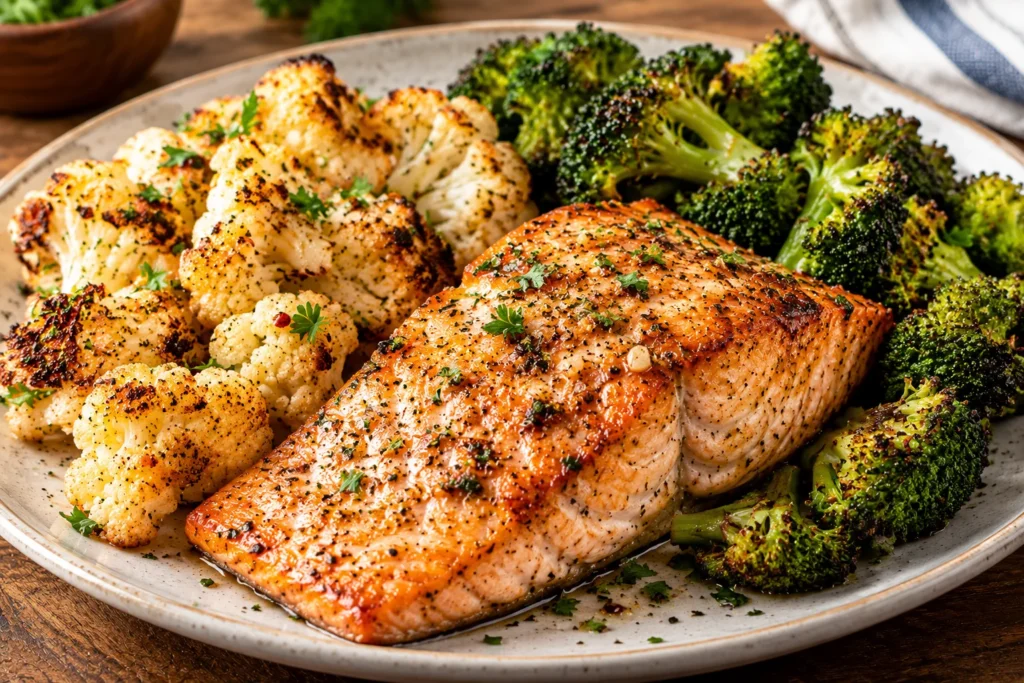
Can the whole plate really finish in 15 minutes? The salmon can. The vegetables can't, and that's the mistake that turns this dinner into raw cauliflower with a nice fillet.
University extension roasting charts put broccoli and cauliflower at 15 to 25 minutes in a 425°F oven, and cauliflower on its own often needs closer to 25 to 30. Salmon needs about 10 minutes per inch. So stagger them:
- Heat the oven to 425°F and roast cauliflower florets tossed in olive oil for 10 minutes.
- Add the broccoli to the pan and tuck the 6-ounce fillets in beside it.
- Roast another 10 to 12 minutes, until the fish flakes and a thermometer reads 145°F.
- Squeeze lemon over everything.
At 425°F the salmon cooks slightly faster than the 400°F guideline, so check it at 10 minutes.
Why this works: Giving the cauliflower a ten-minute head start lets the slow vegetable and the fast fish finish together.
The nutrition: About 35g of protein per fillet. The vegetables add a little more and aren't counted.
Blackened Salmon with Rice and Arugula
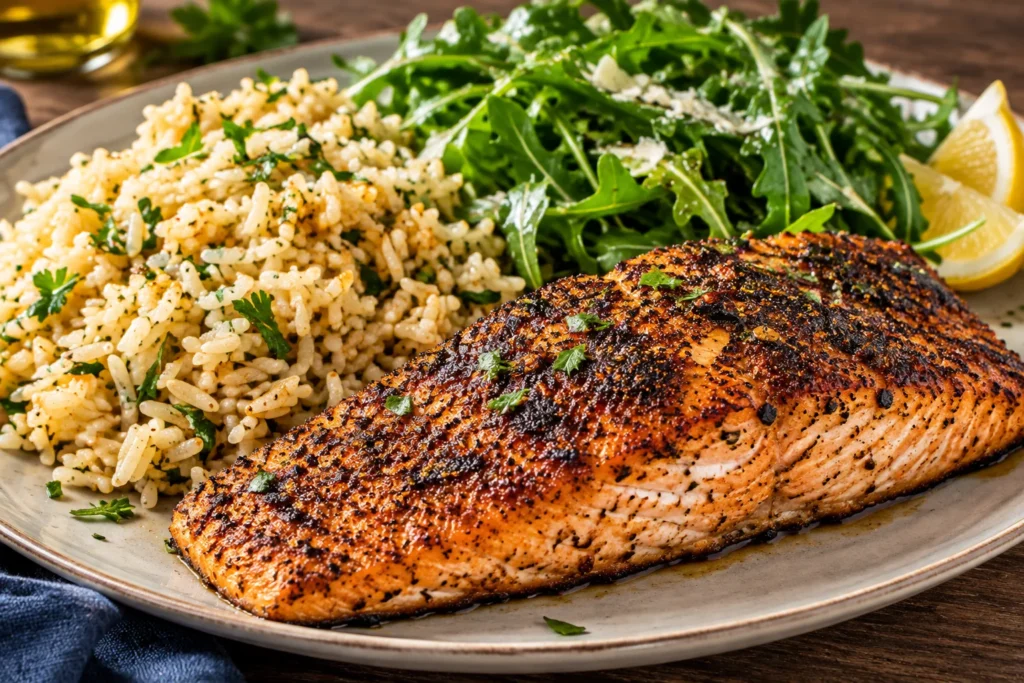
Blackening turns an ordinary fillet into something with a smoky, spicy crust, and the technique is mostly about heat and spice.
Mix paprika, garlic powder, cumin, dried thyme, cayenne, salt, and pepper, and press it onto the fillets. Heat a cast iron skillet until it's very hot, add a little oil, and sear the fillets 3 to 4 minutes per side, the Alaska Seafood Marketing Institute's guideline for a seared fillet. Turn on the vent fan first, because the spices smoke.
Serve over rice with a handful of peppery arugula dressed in lemon and olive oil. The rice cuts the heat of the cayenne and brings carbs for a harder training day. For more dinners that move this quickly, see our quick high-protein dinners for busy school nights.
Why this works: A very hot, dry cast iron pan browns the spice crust before the center overcooks.
The nutrition: About 38g of protein per serving, from a 6-ounce fillet and about three-quarters of a cup of cooked rice.
Creamy Tuscan Salmon
The sauce is the point here, and it's built in the same pan after the fish comes out.
Sear four fillets 3 to 4 minutes per side, then move them to a plate. In the same skillet, cook garlic and drained sun-dried tomatoes for a minute, add a half cup of chicken broth and a half cup of cream, simmer until it thickens, then wilt in a few handfuls of spinach and a couple of tablespoons of grated Parmesan. Return the salmon, spoon the sauce over it, and let it finish for 2 to 3 minutes until it reaches 145°F.
Cutting the cream with broth keeps the sauce rich without feeling heavy. Serve over rice or zucchini noodles. Because everything happens in one skillet, this fits right in with our one-pot dinners with real protein.
Why this works: Building the sauce in the same pan picks up the browned bits left behind by the fish, which adds depth without extra work.
The nutrition: About 35g of protein per fillet with its sauce. Cream and spinach aren't counted.
Grilled Salmon with Quinoa and Chickpea Salad
The idea is a double dose of protein on one plate. Quinoa and chickpeas bring plant protein and fiber alongside the fish, which gets the total to 45g without anything exotic.
Make the salad first: cooked quinoa, a drained can of chickpeas, cucumber, tomato, red onion, parsley, and a lemon and olive oil dressing. Cook the quinoa the way a USDA recipe does, 1 cup of quinoa to 2 cups of water, simmered covered for 15 to 20 minutes. The salad holds well in the refrigerator, so it can be made a day or two ahead and stay fresh within the 3 to 4 day leftover window.
Then grill the salmon. Heat the grill to medium-high, brush the grates with oil, and cook the fillets skin side down for about 10 minutes per inch of thickness. A grill pan indoors does the job just as well. If you like building bigger plates, our 50g protein dinners take this idea further.
Why this works: Quinoa and chickpeas hold their texture in a dressed salad, so the salad improves after a night in the refrigerator.
The nutrition: About 45g of protein per plate, from a 6-ounce fillet, three-quarters of a cup of cooked quinoa, and about a quarter of the chickpeas.
Salmon with Angel Hair and Broccolini
Pasta night can still be a high-protein night, and the trick is setting the fish on top of the noodles rather than hiding it in the sauce.
Roast broccolini with olive oil at 425°F, since thin vegetables like this one usually need 10 to 20 minutes. Cook 8 ounces of angel hair, which takes only a few minutes, and toss it with garlic cooked in olive oil and a half cup of grated Parmesan. Bake the fillets alongside the broccolini, about 10 minutes for a 1-inch fillet, and lay one on each plate of pasta.
The whole dinner takes about 25 minutes, and every forkful gets a bit of fish.
The nutrition: About 46g of protein per serving, from the fillet, the pasta, and the Parmesan. Broccolini isn't counted.
Seared Salmon with Purple Potato Puree
This is the dish for the nights when you want the table to look like you tried, and it takes about 25 minutes.
The puree is easy: boil 1.5 pounds of peeled purple potatoes until tender, then blend or mash them with butter, a splash of milk, and salt. Keep it warm while you cook the fish.
For the salmon, pat the skin-on fillets very dry, heat a skillet with oil until it's properly hot, and cook skin side down for 3 to 4 minutes, pressing lightly so the skin makes contact. Turn and cook another 3 to 4 minutes, until the center reaches 145°F. Serve the fillets skin side up over a spoonful of the puree.
Why this works: A dry surface and a hot pan let the skin crisp quickly, so the flesh doesn't overcook while you wait for the crust.
The nutrition: About 39g of protein per serving. We used the USDA value for regular potatoes for the purple ones, which are a close match.
Seared Salmon with Asparagus and Squash
Spring and early summer dinners run on this plate. After the salmon comes out of the skillet, the asparagus and squash cook in everything left behind.
Sear the fillets 3 to 4 minutes per side, rest them on a plate, then add trimmed asparagus and sliced yellow squash to the same pan with a little more oil. Cook until crisp-tender and lightly browned, a few minutes. Season with salt, pepper, and lemon zest.
It's low in carbohydrates and high in protein, and it's a good fit when you want a lighter plate. More skillet dinners like it are in our high-protein skillet dinners.
The nutrition: About 35g of protein per fillet. The vegetables add a little more and aren't counted.
Miso-Glazed Salmon with Bok Choy
White miso seasons salmon better than most dry rubs, because the paste is salty, sweet, and savory at the same time.
Whisk 2 tablespoons of white miso with 2 tablespoons of maple syrup, a tablespoon of rice vinegar, and a teaspoon of grated ginger. Published miso salmon recipes broil the glazed fillets for 6 to 8 minutes, on a rack about 4 to 6 inches from the element, until the top turns dark and sticky.
Bok choy takes longer than you'd think, so give it a head start. Halve it, toss it with a little oil, and roast it at 425°F for 10 minutes. Push it to the side, add the glazed fillets, move the rack up, and broil 6 to 8 minutes. The pan does double duty and the plate looks like a restaurant dish.
Why this works: The sugar in the glaze caramelizes under the broiler's direct heat, which gives the top its dark, sticky finish in minutes.
The nutrition: About 35g of protein per fillet. Miso and bok choy add a little more and aren't counted.
Lemon Pepper Salmon with Crispy Potatoes
Some nights the plain version is the right one. A heavy dusting of lemon pepper and a crowded tray of potatoes turn the oven into a classic meat-and-potatoes plate, only with fish in the middle.
The potatoes need much more time than the fish. Extension roasting charts give halved new potatoes about 30 to 35 minutes at 425°F, and root vegetables in general 30 to 45 minutes. So start the potatoes first, and add the lemon pepper fillets to the same pan for the last 10 to 12 minutes. A 15 minute head start isn't enough for the potatoes to crisp.
This is a good plate after a long run day, when carbs matter as much as protein.
The nutrition: About 38g of protein per serving, from a 6-ounce fillet and about 6 ounces of potatoes.
Cubes, Bites, and a Whole Side
When the salmon is cut small, the cooking is quick and the sauce does more of the work. When it's a whole side, one pan feeds the table.
Teriyaki Salmon Rice Bowls
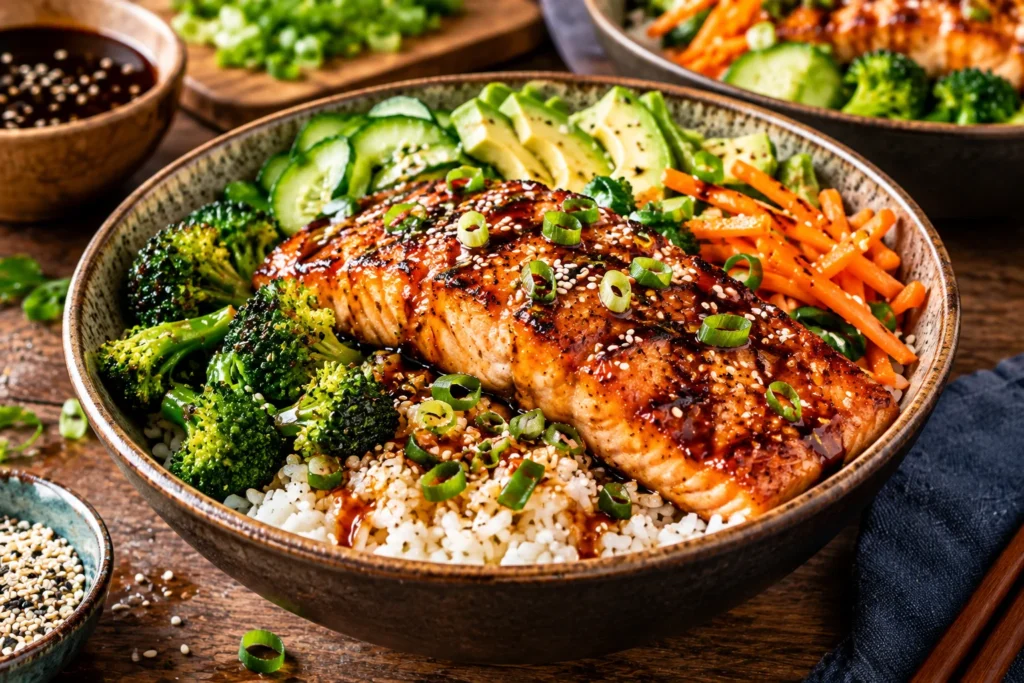
Cutting the salmon into cubes before cooking speeds up teriyaki night. Small pieces brown on several sides and pick up more sauce than one big fillet does.
Cut 1.5 pounds of salmon into 1-inch cubes and pat them dry. Whisk a quick sauce from soy sauce, honey, rice vinegar, garlic, and ginger. Sear the cubes in a hot, oiled skillet for about 5 to 6 minutes, turning them to color several sides, then pour in the sauce for the last minute. Check the largest cube for 145°F.
Don't Miss the Next Recipe
Get fresh recipes, meal prep systems, and high-protein meal ideas delivered to your inbox every week.
No spam. Unsubscribe anytime.
Build each bowl with rice, a half cup of shelled edamame, sliced cucumber, and shredded carrot. The edamame is a quiet protein booster. Bowls also pack well, which is why they show up in our healthy meal prep dinner ideas.
The nutrition: About 47g of protein per bowl, from about 6 ounces of raw salmon, three-quarters of a cup of cooked rice, and a half cup of edamame.
Honey Garlic Salmon Bites
Small cubes cook quickly, brown nicely, and get eaten fast, which makes this a good answer for kids and picky eaters.
Toss 1-inch salmon cubes with honey, soy sauce, minced garlic, and a few chili flakes. Air fry at 400°F in a single layer, working in batches if the basket is crowded. Published air fryer salmon times for cubes run from about 4 to 5 minutes up to 8 minutes depending on the machine, so start checking at 4 minutes and pull them when the largest piece reaches 145°F.
They also work in a 400°F oven (roughly 8 to 10 minutes) or in a skillet. Serve with rice and a green vegetable, or on toothpicks as a game-day food.
The nutrition: About 35g of protein per serving, from 6 ounces of raw salmon. The honey and soy sauce add none worth counting.
Sheet Pan Salmon with Olive Tapenade
The tapenade does all the seasoning for you. Chop or pulse a cup of pitted olives with capers, garlic, lemon zest and juice, parsley, and olive oil, and spread it over a whole 1.5 pound side of salmon.
Bake at 400°F on a lined sheet pan, using the 10 minutes per inch rule. A side that's 1 inch thick at the center takes about 10 minutes, and a thicker one up to 15. Check for 145°F in the thickest spot and serve straight from the pan.
One side feeds four, and a 3-pound side can feed eight, which makes this a quiet star on big-table nights. If you're feeding a crowd, our cheap high-protein dinners that feed six have the right companions. The olives and the fish also bring healthy fats, and the plan fits well with our omega-3 rich dinners.
The nutrition: About 35g of protein per serving when a 1.5-pound side feeds four.
Flaked and Ground: Burgers and Fried Rice
When salmon is chopped or flaked, a clock stops being reliable and the thermometer takes over.
Salmon Burgers
Salmon forms a sturdier burger than most people expect, provided you don't grind it into a paste.
Pulse 1.5 pounds of skinless salmon in a food processor in short bursts until it's coarsely chopped, not puréed. Fold in an egg, a half cup of panko, a tablespoon of Dijon, and sliced green onion. Shape four patties, and chill them for 20 minutes so they firm up and keep their shape in the skillet.
Cook in an oiled skillet over medium heat, about 4 to 5 minutes per side, until the center reaches 145°F. Serve on toasted buns with a sauce of Greek yogurt, dill, lemon, and a pinch of salt. They're an easy way to get fish onto the plate of anyone who says they don't like it.
Why this works: Chilling the patties lets the egg and panko bind the salmon so the burgers hold together in the pan.
The nutrition: About 48g of protein per burger, including the bun and yogurt sauce.
Salmon Fried Rice
Leftover salmon finds its best second life here, though this dish comes with a food safety rule that fried rice famously ignores.
Cooked rice can carry spores of a bacterium called Bacillus cereus that survive cooking and multiply when rice cools slowly at room temperature. University extension guidance says to get cooked rice into the refrigerator within an hour and spread it in a shallow container so it cools fast. The USDA's outer limit is 2 hours. Use refrigerated rice within 3 to 4 days, and reheat it to 165°F, which the hot wok does naturally.
With that settled, it's a 10-minute dinner. Scramble four eggs in a hot pan with a little oil and push them aside. Add 4 cups of day-old rice, a cup of frozen peas, and 1 pound of cooked, flaked salmon, then splash on soy sauce and sesame oil and finish with scallions. Between the eggs and the fish, one serving lands above 40g of protein. It's also a budget-friendly use of leftovers, in the spirit of our high-protein meal prep ideas on a budget.
Why this works: Cold, dry rice fries instead of steaming, so the grains stay separate and take on color.
The nutrition: About 42g of protein per serving, from about 5 ounces of cooked salmon per serving, the eggs, rice, and peas.
Raw, Smoked, and No-Cook Plates
These two need an extra note, because they involve fish that isn't cooked to 145°F.
Salmon Poke Bowls
Poke needs no cooking at all, which makes it quick, but everything depends on finding the right fish.
The FDA Food Code recommends that fish served raw be frozen first to kill parasites, either at -4°F or below for 7 days, or at -31°F or below until solid and then held for 15 hours (or 24 hours at -4°F). Most home freezers don't get cold enough for that. The label "sushi-grade" isn't a regulated term, so ask the fish counter whether the salmon is intended to be eaten raw and has been frozen to those standards.
Raw seafood can also carry bacteria, so the bowl isn't for pregnant guests, young children, older adults, or anyone with a weakened immune system. If that describes someone at your table, sear the cubes for the same bowl and enjoy it cooked to 145°F.
For the bowl itself, cube 1.5 pounds of salmon, mix it with soy sauce, sesame oil, and a spoonful of sriracha mayo, and spoon it onto rice with sliced avocado and cucumber. Eat it right away.
The nutrition: About 38g of protein per bowl, from 6 ounces of raw salmon and three-quarters of a cup of cooked rice.
Smoked Salmon Bagel Plate
For nights when turning on a burner feels like too much, this plate is five minutes of assembly. Spread cream cheese on a toasted everything bagel and top it with smoked salmon, capers, thin red onion, and cucumber.
Here's the correction that matters. Smoked salmon is not always cooked. The refrigerated kind sold as lox, nova-style, or simply smoked is typically cold-smoked, and the government's food safety guidance for pregnant women warns that refrigerated smoked seafood carries a real Listeria risk. The CDC gives the same warning for adults 65 and older and people with weakened immune systems. For those groups, the advice is to eat it only in a cooked dish that reaches 165°F, or to choose canned or shelf-stable smoked fish instead.
For everyone else, it's a classic and a good source of protein. If you want a plate that works for any guest, flake leftover baked salmon (cooked to 145°F) onto the bagel instead.
A word on the cottage cheese swap. Replacing the cream cheese with a quarter cup of whipped cottage cheese adds about 4g of protein by USDA data, not 10, because cottage cheese runs about 11g per 100 grams compared with about 6g for cream cheese.
The nutrition: About 28g of protein per plate, from 3 ounces of smoked salmon, a medium bagel, and 2 tablespoons of cream cheese.
Leftovers and Meal Prep
Salmon is one of the easiest dinners to turn into lunch, with a few rules.
- Refrigerate cooked salmon within 2 hours, and eat it within 3 to 4 days.
- Reheat to 165°F, gently, with a splash of water or broth so it doesn't dry out. Cold flaked salmon is also good on salads and bowls.
- Cool rice quickly, in shallow containers, and refrigerate it within an hour.
- Cubes and burgers hold up better than thin fillets, so they're the best candidates for a make-ahead lunch.
Questions About Cooking Salmon at Home
How long do I cook salmon per inch?
About 10 minutes per inch of thickness at 400°F, measured at the thickest part, according to the Alaska Seafood Marketing Institute. Searing takes 3 to 4 minutes per side, and a fillet in an air fryer takes about 8 to 10 minutes.
What temperature should salmon reach?
The USDA's minimum is 145°F. Some cooks and test kitchens prefer salmon at a lower temperature, but that's below the USDA number and carries more risk for children, older adults, pregnant guests, and people with weakened immune systems.
How much protein is in a salmon fillet?
USDA data lists raw farmed Atlantic salmon at about 20.4g per 100 grams, so a 6-ounce raw fillet has roughly 35g. Cooked weight is lower than raw weight because of water loss, but the protein stays about the same.
Is it safe to eat raw salmon?
It can carry parasites and bacteria. The FDA Food Code recommends freezing fish meant for raw eating at specific cold temperatures to kill parasites, and the term "sushi-grade" isn't a regulated standard. Raw salmon isn't recommended for pregnant women, young children, older adults, or anyone with a weakened immune system.
Is smoked salmon already cooked?
Not always. Cold-smoked salmon, often sold as lox or nova-style, isn't cooked. Government guidance warns about Listeria in refrigerated smoked seafood for pregnant women and says to eat it only in a cooked dish that reaches 165°F.
Why does my salmon turn dry?
Usually because it was cooked longer than its thickness called for. Measure the fillet at its thickest part, use the 10 minutes per inch rule, and check with a thermometer a couple of minutes early.
Can I cook salmon from frozen?
The Alaska Seafood Marketing Institute publishes cook-from-frozen methods that add a few minutes, but thawing it overnight in the refrigerator gives the most predictable timing.
How long can I keep cooked rice for fried rice?
Refrigerate it within an hour, store it in a shallow container, and use it within 3 to 4 days. Reheat to 165°F, as a hot wok does.
Can I swap one cut of salmon for another?
Yes, if you match the thickness and the method. A thin tail piece cooks faster than a thick center cut, so adjust the time by the 10 minutes per inch rule rather than by the recipe's number.
1. Baked Salmon with Roasted Cauliflower and Broccoli
Approx. 35g ProteinIngredients: Four 6 oz salmon fillets (about 1 inch thick), 1 small head cauliflower (cut into florets), 2 broccoli crowns (cut into florets), 3 tbsp olive oil, 1 tsp kosher salt, 1/2 tsp black pepper, 1 lemon.
Step 1: Preheat the oven to 425°F. Toss the cauliflower with half the oil, salt, and pepper and spread on a sheet pan. Roast 10 minutes.
Step 2: Toss the broccoli with the remaining oil and add to the pan. Rub the salmon with a little oil, salt, and pepper and nestle the fillets on the pan.
Step 3: Roast 10 to 12 minutes more, until the salmon flakes and a thermometer reads 145°F and the vegetables are tender and browned.
Step 4: Squeeze the lemon over everything and serve.
2. Teriyaki Salmon Rice Bowls
Approx. 47g ProteinIngredients: 1 1/2 lb salmon (skinless, cut into 1-inch cubes), 2 tbsp oil. Sauce: 1/4 cup soy sauce, 2 tbsp honey, 1 tbsp rice vinegar, 2 cloves garlic (minced), 1 tsp grated ginger. Bowls: 1 cup long-grain white rice (cooked per package), 2 cups shelled edamame (frozen, cooked), 1 cucumber (sliced), 2 carrots (shredded).
Step 1: Cook the rice and edamame. Whisk the sauce ingredients together.
Step 2: Pat the salmon cubes dry. Heat the oil in a large skillet over medium-high heat.
Step 3: Sear the cubes 5 to 6 minutes, turning to brown several sides. Pour in the sauce for the last minute. Check the largest cube for 145°F.
Step 4: Divide the rice among four bowls and top with the salmon, edamame, cucumber, and carrots.
3. Blackened Salmon with Rice and Arugula
Approx. 38g ProteinIngredients: Four 6 oz salmon fillets, 1 tbsp paprika, 1 tsp garlic powder, 1 tsp ground cumin, 1 tsp dried thyme, 1/2 tsp cayenne, 1 tsp kosher salt, 1/2 tsp black pepper, 2 tbsp oil, 1 cup long-grain white rice (cooked per package), 5 oz arugula, 1 tbsp lemon juice, 1 tbsp olive oil.
Step 1: Cook the rice. Mix the spices and press them onto the salmon.
Step 2: Heat a cast iron skillet over high heat until very hot (turn on the vent fan). Add the oil.
Step 3: Sear the fillets 3 to 4 minutes per side, until a thermometer reads 145°F.
Step 4: Toss the arugula with the lemon juice and olive oil and serve with the rice and salmon.
4. Salmon Burgers
Approx. 48g ProteinIngredients: 1 1/2 lb skinless salmon, 1 large egg, 1/2 cup panko breadcrumbs, 1 tbsp Dijon mustard, 2 green onions (sliced), 1/2 tsp kosher salt, 1 tbsp oil, 4 hamburger buns (toasted). Sauce: 1/2 cup plain nonfat Greek yogurt, 1 tbsp chopped dill, 1 tbsp lemon juice, pinch of salt.
Step 1: Pulse the salmon in short bursts until coarsely chopped, not puréed. Fold in the egg, panko, Dijon, green onion, and salt.
Step 2: Shape into four patties and refrigerate 20 minutes.
Step 3: Cook in the oiled skillet over medium heat 4 to 5 minutes per side, until the center reaches 145°F.
Step 4: Stir the sauce together and serve the burgers on toasted buns.
5. Sheet Pan Salmon with Olive Tapenade
Approx. 35g ProteinIngredients: 1 1/2 lb side of salmon (skin-on, about 1 inch thick), 1 tbsp olive oil, 1/2 tsp kosher salt. Tapenade: 1 cup pitted olives, 2 tbsp capers, 2 cloves garlic, zest and juice of 1 lemon, 1/4 cup olive oil, 2 tbsp chopped parsley.
Step 1: Preheat the oven to 400°F and line a sheet pan.
Step 2: Chop or pulse the tapenade ingredients together.
Step 3: Set the salmon skin side down, rub with the oil and salt, and spread the tapenade over the top.
Step 4: Bake about 10 minutes per inch of thickness (10 to 15 minutes), until the thickest part reads 145°F.
Step 5: Serve straight from the pan.
6. Creamy Tuscan Salmon
Approx. 35g ProteinIngredients: Four 6 oz salmon fillets, 1 tbsp oil, 1/2 tsp kosher salt, 3 cloves garlic (minced), 1/2 cup drained oil-packed sun-dried tomatoes (chopped), 1/2 cup chicken broth, 1/2 cup heavy cream, 5 oz baby spinach, 2 tbsp grated Parmesan.
Step 1: Season the salmon with the salt. Heat the oil in a large skillet and sear the fillets 3 to 4 minutes per side. Move to a plate.
Step 2: Cook the garlic and sun-dried tomatoes in the same skillet for 1 minute.
Step 3: Add the broth and cream and simmer until thickened, then stir in the spinach and Parmesan until wilted.
Step 4: Return the salmon and spoon the sauce over it. Cook 2 to 3 minutes until a thermometer reads 145°F.
Step 5: Serve over rice or zucchini noodles.
7. Grilled Salmon with Quinoa and Chickpea Salad
Approx. 45g ProteinIngredients: Four 6 oz salmon fillets, 1 tbsp oil. Salad: 1 cup quinoa (cooked in 2 cups water), one 15-oz can chickpeas (drained and rinsed), 1 cucumber (diced), 1 cup cherry tomatoes (halved), 1/4 red onion (diced), 1/4 cup chopped parsley. Dressing: 3 tbsp olive oil, 3 tbsp lemon juice, 1/2 tsp kosher salt.
Step 1: Simmer the quinoa covered 15 to 20 minutes and cool slightly. Mix with the chickpeas, vegetables, parsley, and dressing.
Step 2: Heat the grill to medium-high (about 400 to 450°F) and oil the grates.
Step 3: Grill the salmon skin side down about 10 minutes per inch of thickness, until a thermometer reads 145°F.
Step 4: Serve the salmon over the salad.
8. Honey Garlic Salmon Bites
Approx. 35g ProteinIngredients: 1 1/2 lb salmon (skinless, cut into 1-inch cubes), 2 tbsp honey, 2 tbsp soy sauce, 3 cloves garlic (minced), 1/2 tsp chili flakes, 1 tbsp oil. Serve with cooked rice and a green vegetable.
Step 1: Preheat the air fryer to 400°F. Whisk the honey, soy sauce, garlic, chili flakes, and oil and toss with the salmon cubes.
Step 2: Arrange the cubes in a single layer, working in batches.
Step 3: Air fry, checking from 4 minutes (up to 8 minutes), until the largest cube reads 145°F.
Step 4: Serve with rice and vegetables.
9. Salmon with Angel Hair and Broccolini
Approx. 46g ProteinIngredients: Four 6 oz salmon fillets, 1 lb broccolini, 3 tbsp olive oil (divided), 8 oz angel hair pasta, 4 cloves garlic (sliced), 1/2 cup grated Parmesan, 1/2 tsp kosher salt, 1/4 tsp black pepper.
Step 1: Preheat the oven to 425°F. Toss the broccolini with 1 tbsp oil and roast on a sheet pan, adding the seasoned salmon for the last 10 minutes.
Step 2: Cook the pasta per the package, saving 1/2 cup cooking water.
Step 3: Warm the remaining oil with the garlic until fragrant, then toss with the drained pasta, Parmesan, and a splash of cooking water.
Step 4: Check the salmon reads 145°F. Serve each fillet on a bed of pasta with the broccolini.
10. Salmon Poke Bowls
Approx. 38g ProteinIngredients: 1 1/2 lb raw salmon intended for raw eating (previously frozen to FDA standards, cut into 3/4-inch cubes), 1 cup long-grain white rice (cooked), 3 tbsp soy sauce, 1 tbsp sesame oil, 2 tbsp mayonnaise, 1 tbsp sriracha, 1 avocado (sliced), 1 cucumber (sliced), sesame seeds, 2 green onions (sliced).
Step 1: Keep the salmon refrigerated until ready to use. Cook and cool the rice.
Step 2: Mix the soy sauce and sesame oil, and the mayonnaise and sriracha separately.
Step 3: Toss the salmon gently with the soy mixture.
Step 4: Spoon the rice into bowls and top with the salmon, avocado, cucumber, sriracha mayo, sesame seeds, and green onion. Eat right away. (For a cooked version, sear the cubes to 145°F.)
11. Seared Salmon with Purple Potato Puree
Approx. 39g ProteinIngredients: Four 6 oz skin-on salmon fillets, 1 tbsp oil, 1/2 tsp kosher salt. Puree: 1 1/2 lb purple potatoes (peeled and cut up), 3 tbsp butter, 1/4 cup milk, 1/2 tsp kosher salt.
Step 1: Boil the potatoes in salted water until tender, 15 to 20 minutes. Drain and blend or mash with the butter, milk, and salt. Keep warm.
Step 2: Pat the salmon very dry and season. Heat the oil in a skillet over medium-high heat.
Step 3: Cook skin side down 3 to 4 minutes, pressing lightly, then turn and cook 3 to 4 minutes more, until a thermometer reads 145°F.
Step 4: Serve skin side up over the puree.
12. Salmon Fried Rice
Approx. 42g ProteinIngredients: 1 1/4 lb raw salmon fillet (cooked to 145°F and flaked, about 1 lb cooked), 4 large eggs, 4 cups cooked day-old rice (cooled and refrigerated within 1 hour), 1 cup frozen peas, 2 tbsp oil, 3 tbsp soy sauce, 1 tbsp sesame oil, 3 green onions (sliced).
Step 1: Bake or pan-cook the salmon to 145°F and flake it. Chill the rice quickly after cooking and use within 3 to 4 days.
Step 2: Heat 1 tbsp oil in a large pan or wok, scramble the eggs, and push them aside.
Step 3: Add the remaining oil, the rice, and the peas and stir-fry until hot all the way through (165°F).
Step 4: Fold in the salmon, soy sauce, and sesame oil. Top with green onion.
13. Seared Salmon with Asparagus and Squash
Approx. 35g ProteinIngredients: Four 6 oz salmon fillets, 2 tbsp oil (divided), 1/2 tsp kosher salt, 1 lb asparagus (trimmed), 2 yellow squash (sliced), 1/4 tsp black pepper, zest of 1 lemon.
Step 1: Season the salmon. Heat 1 tbsp oil in a large skillet and sear the fillets 3 to 4 minutes per side until a thermometer reads 145°F. Move to a plate.
Step 2: Add the remaining oil, asparagus, and squash to the same skillet.
Step 3: Cook until crisp-tender and lightly browned, a few minutes. Season with pepper and lemon zest.
Step 4: Serve the vegetables with the salmon.
14. Miso-Glazed Salmon with Bok Choy
Approx. 35g ProteinIngredients: Four 6 oz salmon fillets, 2 tbsp white miso, 2 tbsp maple syrup, 1 tbsp rice vinegar, 1 tsp grated ginger, 4 heads baby bok choy (halved), 1 tbsp oil.
Step 1: Preheat the oven to 425°F. Toss the bok choy with the oil and roast on a sheet pan 10 minutes.
Step 2: Whisk the miso, maple syrup, vinegar, and ginger. Switch the oven to broil.
Step 3: Push the bok choy to the edges, add the salmon, and brush with the glaze.
Step 4: Broil 6 to 8 minutes, 4 to 6 inches from the element, until a thermometer reads 145°F.
15. Smoked Salmon Bagel Plate
Approx. 28g ProteinIngredients: 4 everything bagels (toasted), 1/2 cup cream cheese (2 tbsp per bagel), 12 oz refrigerated smoked salmon (3 oz per plate), 2 tbsp capers, 1/4 red onion (thinly sliced), 1 cucumber (sliced), dill. Safe option: flaked baked salmon (cooked to 145°F) in place of smoked salmon.
Step 1: Toast the bagels and spread each with 2 tablespoons of cream cheese.
Step 2: Top with the smoked salmon (or flaked cooked salmon), capers, onion, and cucumber.
Step 3: Refrigerated smoked salmon is not cooked. Pregnant women, adults 65 and older, and people with weakened immune systems should skip it or heat it to 165°F in a cooked dish.
Step 4: Garnish with dill and serve.
16. Lemon Pepper Salmon with Crispy Potatoes
Approx. 38g ProteinIngredients: Four 6 oz salmon fillets, 1 1/2 lb baby potatoes (halved), 3 tbsp olive oil, 1 tsp kosher salt, 1 1/2 tbsp lemon pepper seasoning, 1 lemon (sliced).
Step 1: Preheat the oven to 425°F. Toss the potatoes with 2 tbsp oil and the salt and roast on a sheet pan 25 to 30 minutes, until starting to brown.
Step 2: Rub the salmon with the remaining oil and lemon pepper and add to the pan with the lemon slices.
Step 3: Roast 10 to 12 minutes more, until the salmon reads 145°F and the potatoes are crisp (potatoes need 30 to 35 minutes total).
Step 4: Serve right away.
Get Fresh Recipes Every Week
Join readers getting fresh recipes, meal prep systems, and high-protein meal ideas delivered to your inbox every week.
No spam. Unsubscribe anytime.