
See all 31 recipes
Table of Contents
Meal prep is usually sold as a two-hour Sunday project, and that's the reason many people never start. Twenty minutes is a different promise: one short session that fills several containers, using rotisserie chicken, canned beans, frozen vegetables, and a single pan. This article collects 31 of those preps, each with protein per serving calculated from USDA nutrient data for the exact quantities on its card, and each sorted by the question that decides whether a prepped meal gets eaten: how will you reheat it?
Some prep is eaten cold at a desk, some goes into a microwave at work, and some tastes best warmed in a skillet at home. We sorted the recipes into those three groups, with 10 cold lunches, 11 microwave meals, and 10 skillet reheats, and each group opens by comparing the options inside it. The comparisons rest on USDA and university extension guidance, and where sources differ we say which one we followed. You'll also find a short storage section with the FoodSafety.gov rules that apply to every container.
Don't Miss the Next Recipe
Get fresh recipes, meal prep systems, and high-protein meal ideas delivered to your inbox every week.
No spam. Unsubscribe anytime.
Twenty minutes here means the time from starting to having filled containers, with tasks overlapping: water heats while you chop, and the oven isn't used at all. Time-savers like a rotisserie chicken, a microwave rice pouch, canned beans, and frozen shelled edamame carry most of the load. Where a recipe depends on a store-bought shortcut, we say so, and where a number rests on an assumption, we say that too. For longer cooking sessions, our healthy meal prep dinner ideas cover bigger batches.
Protein per serving ranges from about 16 to 41 grams, and most recipes make four containers. If you're counting cost, our high-protein meal prep ideas on a budget show how to stretch the same staples. If you want a bigger plate, our high-protein dinners with 30g of protein work from the same base.
Our Take
The USDA says to cover food in the microwave, stir or rotate it partway through, allow standing time, and reheat leftovers to 165°F.
Reheating, Compared: Cold, Microwave, and Skillet
Three methods are worth comparing before you pick a prep. Eating cold needs no equipment and carries no reheating risk, but it limits you to salads, boxes, and jars. A microwave is the fastest way to warm a bowl, though the USDA warns that microwave ovens cook unevenly and leave cold spots where bacteria can survive, which is why it says to cover the food, stir or rotate partway through, allow standing time, and reheat leftovers to 165°F.
A skillet or saucepan takes a few more minutes, but you can stir the food, see it steaming, and re-crisp tortillas and noodles that a microwave makes soft. University of Nebraska-Lincoln Extension notes that microwave energy penetrates only about 1 to 1.5 inches into food, so thick, dense containers heat unevenly, while a pan reaches the whole layer. Neither method is risky when you follow the 165°F rule, and a thermometer settles any doubt.
The choice also depends on where you'll eat. A desk with a microwave favors the middle group, a desk with nothing favors the cold group, and a kitchen at home favors the skillet group. Pick one group per prep session and you'll avoid reheating problems later.
Eat It Cold
Ten preps that go from the refrigerator to your mouth. The main decision is jar versus box: jars keep wet ingredients away from dry ones, and boxes keep foods separate for people who dislike mixing. Both need a cold source if they'll be out of the refrigerator for hours.
Tuna White Bean Salad Jars
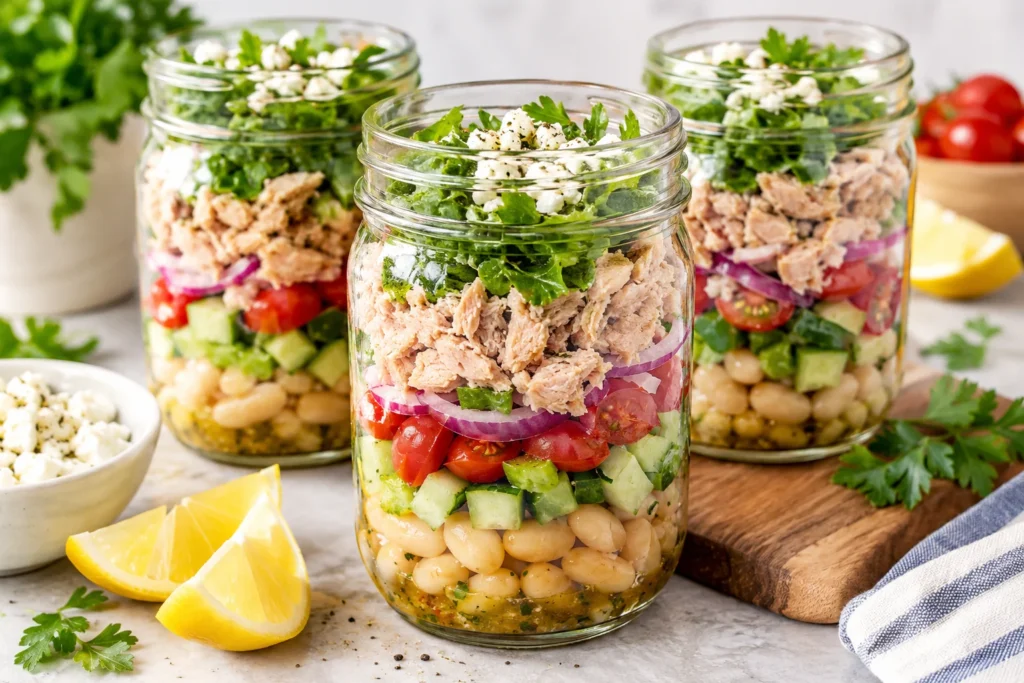
Tuna and white beans are two pantry cans that turn into lunch with a squeeze of lemon. Drain two 5-ounce cans of light tuna and one 15-ounce can of white beans, then fold them together with olive oil, parsley, red onion, and arugula. Layer the dressing at the bottom of the jar, the beans and tuna next, and the greens on top so nothing wilts.
The nutrition: Each jar delivers about 31g of protein, from the tuna and the white beans; the greens aren't counted.
This recipe makes two jars on purpose. The FDA and EPA advise 2 to 3 servings a week of canned light tuna, using a 4-ounce serving, and albacore is limited to 1 serving a week, so two tuna lunches a week is a sensible ceiling. Fill the other prep days with something from the egg or chicken groups.
Chickpea Feta Salad Jars
Which prep food goes in the jar first, the dressing or the chickpeas? The dressing, because anything that sits in it for days should be sturdy. Whisk lemon juice, olive oil, and oregano, pour a few tablespoons into each of four jars, and add two rinsed cans of chickpeas, a cup of crumbled feta, cucumber, and cherry tomatoes. Slice four hard-cooked eggs on top so each jar holds one.
The FDA says hard-cooked eggs keep up to a week, which makes them a good partner for a prep that has to last several days. Salads with eggs fall under the shorter 3 to 4 day rule once the egg is chopped into the mix, so keep the eggs whole or halved. Choose pasteurized feta for anyone who is pregnant.
The nutrition: A jar comes to about 21g of protein, from the chickpeas, feta, and egg.
Greek Yogurt Chicken Salad Cups
A rotisserie chicken is the shortcut that makes a 20-minute prep realistic. The USDA says to refrigerate it within 2 hours of buying it and to use it within 3 to 4 days, so pull the meat off the bones while it's still warm from the store and chill it quickly in a shallow container. Chop 12 ounces of meat, stir in three-quarters of a cup of plain Greek yogurt, celery, mustard, and lemon, and spoon the salad into four cups.
Why this works: Greek yogurt replaces most of the mayonnaise, so the salad stays creamy while it adds protein.
The nutrition: A cup holds roughly 26g of protein; the chicken supplies most and the yogurt adds the rest.
Serve it on lettuce leaves or crackers at lunch. The current FoodSafety.gov chart lists chicken, tuna, and egg salads at 3 to 4 days, while some older charts say 3 to 5, so we plan around the shorter figure. We used the lower dark-meat protein value for the rotisserie meat, because the mix of white and dark meat varies from bird to bird.
Overnight Oats with Greek Yogurt and Cottage Cheese
Overnight oats ask for five minutes at the counter and nothing at the stove, which is why they fit a 20-minute prep session easily. Divide 1.5 cups of rolled oats, 2 cups of plain Greek yogurt, a cup of cottage cheese, and a cup of milk among four jars and stir each one. Add berries on top of each jar, cover, and refrigerate overnight so the oats soften.
Cottage cheese blends into the oats and disappears, adding about 11 grams of protein for every 100 grams by USDA data. If you dislike the curds, whisk the cottage cheese with the milk first. Raw rolled oats hold about 17 grams of protein per 100 grams, so they contribute a share too.
The nutrition: One jar comes to about 26g of protein, from the oats, yogurt, cottage cheese, and milk; the fruit isn't counted.
Egg Salad Lettuce Cups
Boiling is the slowest step here, so start the eggs first. Lower ten eggs into simmering water, cook them for 10 to 12 minutes, and cool them in cold water while you chop celery and chives. The FDA says hard-cooked eggs, in the shell or peeled, can be used within a week of cooking.
The nutrition: A serving of the salad delivers about 19g of protein, from the eggs and the yogurt.
Mash the peeled eggs with half a cup of plain Greek yogurt, a teaspoon of mustard, and the chives, then spoon the salad into romaine leaves. Once mixed, the salad follows the 3 to 4 day rule for egg salads, so make it no more than a few days before you eat it. Pack the lettuce separately so it stays crisp.
Turkey Roll-Up Bento Boxes
Opened luncheon meat keeps 3 to 5 days in the refrigerator, per USDA storage guidance, so buy the package close to prep day. Lay a slice of cheddar on each slice of deli turkey, roll them up, and cut them in half. Divide 12 ounces of turkey and 6 ounces of cheddar among four boxes with a quarter cup of hummus, cucumber, and cherry tomatoes.
Why this works: Rolling the meat around the cheese keeps both from drying out in the container, so the box tastes fresh on day three.
Anyone who is pregnant, 65 or older, or has a weakened immune system should heat deli meat to 165°F before eating it, according to CDC advice, so this is a box for everyone else unless you swap in cooked chicken. Keep the boxes cold and eat them within the window on the package. Nothing here needs a microwave.
The nutrition: One box brings about 28g of protein, from the turkey, cheddar, and hummus.
Cottage Cheese Fruit Jars
Cottage cheese is the least fussy ingredient in this article, because it's already prepared when you buy it. Spoon three-quarters of a cup into each of four jars, add sliced peaches or pineapple, and sprinkle on chopped pecans just before eating. Tree nuts are a common allergen, so leave the pecans out for anyone who shouldn't have them.
The jars take about five minutes to fill, so they pair well with a more involved prep from another section. Keep them cold and eat them within the date on the cottage cheese container. If the fruit is canned, drain it first so the jar doesn't turn watery.
The nutrition: Each jar delivers about 20g of protein, from the cottage cheese and pecans.
Edamame Hummus Snack Boxes
Frozen shelled edamame is a quick source of plant protein, at about 12 grams per 100 grams by USDA data. Microwave 2 cups according to the package, cool them under cold water, and divide them among four boxes with a quarter cup of hummus each, an ounce of cheddar, and a hard-cooked egg. Cut cucumbers or bell peppers into sticks for the remaining space.
The nutrition: Each box provides about 27g of protein, from the edamame, hummus, cheddar, and egg.
Why this works: Several small proteins add up, so one disliked item doesn't ruin the box.
Pack each egg unpeeled if the box will sit for a day or two, since the shell protects it. The box needs no reheating, which makes it a good one for desks without a microwave. Keep everything cold, and eat the boxes within 3 to 4 days.
Shrimp Cocktail Salad Jars
Shrimp cook faster than almost anything else in this article. The FDA and USDA say to cook shrimp until the flesh is pearly or white and opaque, which takes only a few minutes in simmering water. Cook 1.5 pounds of peeled shrimp, drain, and chill them in ice water while you dice cucumber, tomato, and avocado.
The nutrition: A jar delivers about 39g of protein, almost all of it from the shrimp and edamame; the shrimp are weighed raw.
Toss the cold shrimp with lime juice, cilantro, and a cup of cooked edamame, then divide them among four jars over a spoonful of cocktail sauce. Cooked seafood has a 3 to 4 day window, per the USDA, so this prep is for the first half of the week. Keep the avocado separate and add it at lunch so it stays green.
Black Bean Corn Salad Jars
Three cans of beans seem like a lot until you divide them among four jars. Rinse three 15-ounce cans of black beans, mix them with a can of corn, diced bell pepper, red onion, and cilantro, and dress with lime juice and olive oil. A drained can of black beans holds about 15 grams of protein by USDA data, which is why beans anchor our cheap high-protein dinners to feed six.
Stir three-quarters of a cup of Greek yogurt with extra lime and spoon some into each jar as a creamy topping, and crumble feta over it. Keep the yogurt layer on top so it doesn't thin the salad. Because the jars contain only beans and dairy, they hold up well for a few days.
The nutrition: One jar comes to about 20g of protein, from the black beans, yogurt, and feta.
Why this works: Black beans soak up the lime dressing and get better after a day, so the jar tastes more cohesive on day two.
Microwave Meals
Eleven preps for a desk with a microwave. Rice-based bowls reheat evenly, pasta needs a splash of water, and anything with eggs needs a firm center. Whichever you choose, cover it, stir it, and let it stand.
Chicken Burrito Rice Bowls
A microwave rice pouch is the reason this bowl fits in 20 minutes, and the same shortcut shows up in our quick high-protein dinners for busy school nights. Heat three cups of cooked rice per the package, then divide it among four containers with 12 ounces of shredded rotisserie chicken, a can of black beans, and half a cup of shredded cheddar. Top with salsa after you've packed the bowls.
The USDA's microwave guidance has four habits worth following: cover the dish, stir or rotate partway through, let it stand for a few minutes, and check that leftovers reach 165°F. UNL Extension notes that microwave energy penetrates only 1 to 1.5 inches, which is why a deep, dense bowl heats unevenly. Spread the food in an even layer when you reheat it.
The nutrition: Count on about 31g of protein per bowl, with the chicken and beans doing most of the work and the cheddar and rice adding the rest.
Turkey Taco Bowls
Crumbled ground turkey takes about 5 to 7 minutes to brown on a stovetop, according to University of Missouri Extension, but keep cooking until it's no longer pink and a thermometer reads 165°F. Cook a pound with taco seasoning and a splash of water, then stir in a can of rinsed black beans. Divide the mixture among four containers over cooked rice.
The nutrition: Each taco bowl comes to about 30g of protein, shared among the turkey, beans, rice, and cheese.
Add shredded cheddar and salsa at the end so they don't melt away during storage. Cooked ground turkey should be refrigerated within 2 hours of cooking and used within about 4 days, per the same extension guidance. Reheat the bowl until the center reaches 165°F.
Egg Fried Rice Bowls
Scrambled eggs set quickly in a hot skillet, which is the whole trick behind a fast fried rice. Scramble eight beaten eggs until they're fully set and no longer runny, push them aside, and add four cups of cooked rice, a cup of shelled edamame, and a splash of soy sauce. Stir everything together until it's hot and add frozen peas or carrots if you like.
Why this works: Spreading the rice out cools it quickly and keeps the grains separate when they hit the pan, so a pouch or yesterday's rice works well.
The nutrition: A bowl comes to about 21g of protein, from the eggs, rice, and edamame.
Cooked rice should be cooled and refrigerated quickly, within about an hour, according to university extension guidance. Spread the fried rice on a sheet pan for a few minutes so it cools fast before it goes into containers. Reheat covered, stirring partway through, until it reaches 165°F.
Beef and Broccoli Rice Bowls
Ground beef stands in for the usual sliced steak so the whole dish cooks in one pan. Brown a pound of 90% lean beef with garlic and ginger until it reaches 160°F, the USDA's number for ground beef, then add a bag of frozen broccoli and cook until it's hot. Stir in soy sauce and a spoonful of brown sugar.
Why this works: Browning the beef first builds flavor that a sauce alone can't supply.
Spoon the mixture over cooked rice in four containers. The sauce clings better if you simmer it for a minute before packing. If your office has a microwave, reheat covered and stir halfway through.
The nutrition: Each bowl gives about 26g of protein, from the beef (counted at 75 percent of raw weight) and the rice.
Chicken Pesto Pasta
Pasta sets the clock for this recipe, so check the package and put the water on first. Cook 12 ounces of rotini or penne, drain it, and toss it with three-quarters of a pound of shredded rotisserie chicken, three tablespoons of pesto, and a quarter cup of grated Parmesan. Add halved cherry tomatoes after the pasta cools.
The nutrition: One container comes to about 34g of protein, from the pasta, chicken, and Parmesan.
Pasta salad dishes with chicken keep 3 to 4 days in the refrigerator per FoodSafety.gov. Eat it cold, or reheat it covered with a splash of water so the noodles don't dry out. Check dense portions with a thermometer, since leftovers should reach 165°F.
Shrimp Rice Bowls
Shrimp need only a few minutes, so everything else in the bowl should be ready before they hit the pan. Sauté 1.25 pounds of peeled shrimp with garlic until pearly and opaque, which is how the USDA describes doneness for shrimp, and set them aside. Divide four cups of cooked rice among four containers and add the shrimp, a cup of cooked shelled edamame, and sliced scallions.
Finish with a drizzle of soy sauce and a squeeze of lime. Cooked seafood has a similar window, and shrimp turn rubbery if reheated too long. Reheat covered for short intervals and stop as soon as the rice is steaming.
The nutrition: Each bowl brings about 37g of protein, from raw-weight shrimp, rice, and edamame.
Turkey Chili
Chili is one of the few stove recipes that still fits 20 minutes if you start with ground meat and canned beans. Brown a pound of ground turkey with onion and garlic for 5 to 7 minutes until a thermometer reads 165°F, add two rinsed cans of kidney beans, a can of diced tomatoes, chili powder, and cumin, and simmer for about 10 minutes. Canned kidney beans are already cooked, so they're safe to use here without any soaking.
Why this works: Beans and turkey hold their texture through reheating, so the chili tastes the same on day four as on day one.
Divide the chili among four containers and cool it quickly in shallow dishes. Reheat until it reaches 165°F, stirring halfway if you use a microwave. For more one-pot ideas, see our one-pot dinners with real protein.
The nutrition: A container of chili provides about 30g of protein, from the turkey and kidney beans.
Microwave Egg and Veggie Mugs
Montana State University Extension's microwave eggs method cooks 2 eggs with 2 tablespoons of milk for 45 seconds, stirs, and cooks 30 to 45 seconds more, covered. Use that as a guide for each mug: whisk two eggs with a tablespoon of milk, stir in diced peppers and spinach, microwave, and check that the egg is firm. The FDA says egg dishes should reach 160°F.
The nutrition: One mug provides about 17g of protein, from the eggs, cheddar, and milk.
Add two tablespoons of shredded cheddar to each mug while it's hot. Cool the mugs, cover, and refrigerate them within two hours. Leftover egg dishes last 3 to 4 days, per the FDA, and should be reheated until steaming.
Why this works: A mug keeps the eggs in a thick layer that reheats evenly, which a flat pan of eggs often doesn't.
Chicken Fajita Bowls
Fajita bowls start with a skillet of peppers and onions, which take about five minutes over high heat. Slice two bell peppers and an onion, cook them with chili powder, cumin, and lime juice until tender and charred at the edges, and add 12 ounces of rotisserie chicken, shredded to warm through. Divide the mixture among four containers over three cups of cooked rice with one 15-ounce can of black beans.
Mix half a cup of Greek yogurt with lime for a quick crema and keep it in a separate small container. The yogurt adds about 10 grams of protein per 100 grams, so it contributes more than sour cream would. Reheat the bowl covered, add the crema afterward, and make sure the center is steaming.
The nutrition: Each fajita bowl brings about 31g of protein, with the yogurt crema adding a little to the chicken, beans, and rice.
Chicken Quinoa Bowls
Quinoa simmers for 15 to 20 minutes from scratch, which would eat the entire clock, so this recipe uses a precooked pouch or leftover quinoa. Divide three cups of cooked quinoa among four containers with 12 ounces of shredded rotisserie chicken, a can of chickpeas, and half a cup of crumbled feta. Dress with lemon and olive oil.
The nutrition: Chicken, quinoa, chickpeas, and feta together reach about 34g of protein per bowl.
Quinoa reheats well, and a splash of water before covering keeps it from drying. Chickpeas add about 18 grams of protein per drained can by USDA data. Keep the feta separate if you plan to microwave the bowl.
Chicken Edamame Noodle Bowls
Edamame and noodles make a good base for a sesame-soy bowl. Cook 8 ounces of spaghetti or rice noodles per the package, drain, and toss with 12 oz of pulled rotisserie meat, a cup and a half of cooked shelled edamame, soy sauce, sesame oil, and sliced scallions. Divide among four containers.
Why this works: Edamame adds plant protein and a firm bite that survives reheating better than most vegetables.
The nutrition: The chicken, noodles, and edamame add up to about 35g of protein per bowl.
Noodles absorb sauce as they sit, so add a little extra liquid to each container. Reheat covered, stirring partway through, until the middle hits 165°F. The edamame is a whole bean, so keep this in mind for young children.
Skillet Reheats
Ten preps that taste best warmed in a pan. Quesadillas and pancakes need a skillet to stay crisp, and stir-fries and shrimp dishes reheat better after adding a little water than in a microwave. If you do use a microwave for them, expect softer textures.
Black Bean Quesadillas
Quesadillas are the one prep in this article that wants a skillet when you reheat it, because a microwave makes the tortilla soft. Mash a can of black beans, spread it over half of each of four tortillas, add a cup and a half of shredded cheddar divided among them, and fold. Brown each quesadilla in a lightly oiled skillet for 2 to 3 minutes per side.
Cool the quesadillas on a rack so they don't steam each other, then stack them with parchment between and refrigerate. To reheat, warm them in a dry skillet over medium heat until the cheese is hot and the tortilla is crisp, which usually takes a few minutes per side. Check that the center is steaming.
The nutrition: A quesadilla comes to about 18g of protein, from the tortilla, black beans, and cheddar.
Chicken Stir-Fry Noodles
A stir-fry is a good example of food that tastes better when reheated in a pan. Cook 8 ounces of noodles, scramble four eggs until fully set, and then stir-fry 12 ounces of rotisserie chicken that you've shredded with frozen stir-fry vegetables and a sauce of soy sauce, garlic, and a little honey. Toss everything together with the noodles and eggs.
The nutrition: Expect about 35g of protein per container, from the chicken, noodles, and eggs.
Reheating in a skillet over medium heat with a splash of water brings back the texture that a microwave can flatten. Stir often and make sure it reaches 165°F. The dish stay good for 3 to 4 days when chilled.
Garlic Shrimp Pasta
Boil the pasta while you cook the shrimp, and the dish comes together in about 20 minutes. If a bigger plate is the goal, our 50g protein dinners show how to scale it. Cook 12 ounces of spaghetti per the package, sauté 1.25 pounds of peeled shrimp in olive oil with garlic until they're pearly and opaque, and toss them with the pasta, lemon juice, parsley, and a quarter cup of grated Parmesan. Divide among four containers.
Shrimp pasta reheats best in a skillet and a spoonful of water or broth, over medium heat, for just a few minutes. Plan to eat this one early in the week, because cooked seafood has a short window. Overheating makes shrimp tough.
The nutrition: A container lands near 41g of protein, using raw shrimp weight, with the pasta and Parmesan adding more.
Why this works: Pasta water and lemon loosen the sauce, so a splash of water at reheat time brings it back to life.
Beef Taco Skillet
Everything for this skillet happens in one pan, which also makes it the easiest to reheat. Brown 1.25 pounds of 90% lean ground beef with onion and taco seasoning until it reaches 160°F, stir in a rinsed can of black beans, a cup of salsa, and two cups of cooked rice, and top with a cup of shredded cheddar until it melts. Divide among four containers.
The nutrition: Expect about 41g of protein per container, from the beef (counted at 75 percent of raw weight), beans, cheddar, and rice.
Why this works: Rice soaks up the taco juices as it sits, so the skillet tastes more seasoned on day two.
Reheat in a skillet over medium heat, stirring until steaming, or microwave covered. Ground beef dishes keep 3 to 4 days when refrigerated, per the USDA. For more one-pan ideas, see our high-protein skillet dinners.
Turkey Egg Roll Bowls
An egg roll bowl takes the filling and skips the wrapper. Brown a pound of ground turkey with garlic and ginger for 5 to 7 minutes to a thermometer reading of 165°F, add a bag of coleslaw mix and a splash of soy sauce, and cook until the cabbage wilts. Push everything aside, scramble four eggs until fully set, and mix them in.
There's no rice or noodles here, so the dish is lighter and the protein comes mostly from the turkey and eggs. Reheat it in a skillet so the cabbage stays crisp. Keep it up to 4 days when refrigerated.
The nutrition: A container gives about 26g of protein, nearly all of it from the turkey and eggs.
Never Miss a Recipe
Fresh high-protein recipes, meal prep ideas, and kitchen tips, straight to your inbox every week. No spam, just good food.
No spam. Unsubscribe anytime.
Cottage Cheese Pancakes
Blend a cup of rolled oats, four eggs, and a cup of cottage cheese until smooth, then let the batter rest while the griddle heats. Cook small pancakes over medium heat for about 2 to 3 minutes per side until the center is set and no longer wet, since the batter contains raw eggs. Stack them with parchment between layers once they cool.
The nutrition: A serving of three pancakes comes to about 16g of protein, from the oats, eggs, and cottage cheese.
Reheat in a skillet or toaster rather than a microwave, which makes pancakes soggy. Egg dishes stay safe for 3 to 4 days in the refrigerator, per the FDA. Serve with Greek yogurt and fruit.
Chicken Pesto Quesadillas
Pesto stands in for salsa in this quesadilla. Spread a teaspoon of pesto over half of each of four tortillas, add 2 ounces of shredded rotisserie chicken and a quarter cup of shredded mozzarella, and fold. Brown in a lightly oiled skillet for 2 to 3 minutes per side.
Why this works: Pesto brings moisture and flavor without a sauce that can leak out, so the quesadilla stays tidy in a container.
Cool the quesadillas on a rack, stack them with parchment between, and refrigerate. Reheat in a dry skillet until crisp and hot, or in a toaster oven. Check that the center reaches 165°F.
The nutrition: One quesadilla provides about 24g of protein, from the tortilla, chicken, and mozzarella.
Turkey Sloppy Joes
Sloppy joe mix is a good use of the 5 to 7 minutes ground turkey needs on the stove. Brown a pound of turkey with onion and green pepper once it hits 165°F, then add tomato sauce, a spoonful of mustard, and a splash of vinegar, and simmer for 5 minutes. Serve it over toasted bread.
Store the sloppy joe mixture separately from the bread, so the bread doesn't turn soggy. Reheat the mixture in a saucepan until it's steaming, and toast fresh bread at mealtime. The mixture keeps about 4 days chilled.
The nutrition: A serving with two slices of bread comes to about 30g of protein, and the turkey carries most of it.
Shrimp Veggie Stir-Fry Bowls
Frozen stir-fry vegetables mean no chopping, which keeps the clock short. Sauté 1.25 pounds of peeled shrimp in a hot skillet until pearly and opaque, set them aside, and cook a bag of frozen stir-fry vegetables in the same pan with soy sauce and ginger. Return the shrimp and divide the mixture over four cups of cooked rice.
The nutrition: A bowl comes to about 33g of protein, with the shrimp (counted raw) supplying nearly all of it.
Reheat in a skillet with a splash of water for just a couple of minutes. Overcooked shrimp turn rubbery, so reheat briefly. Cooked seafood has a 3 to 4 day window.
Chickpea Egg Skillet
Chickpea and egg skillets borrow from shakshuka. Sauté onion and a bell pepper, add two cans of rinsed chickpeas and a cup of crushed tomatoes with paprika and cumin, and simmer for 5 minutes. Make six wells in the mixture, crack in the eggs, cover, and cook until the whites and yolks are firm, then sprinkle with half a cup of feta.
Why this works: Chickpeas simmered in tomato sauce soften and absorb the spices, which makes the skillet taste cooked all day.
The nutrition: A container provides about 21g of protein, from the chickpeas, eggs, and feta.
Divide the skillet among four containers with one and a half eggs each, cutting through an egg when needed. Reheat in a skillet or microwave until the center is at 165°F, since egg dishes reheated from the refrigerator should be steaming hot. Leftovers keep 3 to 4 days.
Storing and Freezing Your Prep
The FoodSafety.gov cold food storage chart gives cooked meat and poultry 3 to 4 days in the refrigerator, and cooked fish the same. It lists chicken, tuna, and egg salads at 3 to 4 days on the current chart, while older charts say 3 to 5, so this article uses the shorter figure. Food kept continuously frozen at 0°F is safe indefinitely, and the freezer times on that chart are about quality, with cooked meat and poultry holding their best quality for 2 to 6 months.
That means a prep done on Sunday covers the first half of the week in the refrigerator, and anything for later should go in the freezer in single portions. Cool food quickly in shallow containers and refrigerate it within 2 hours, or within 1 hour if the air is above 90°F. Label containers with the date, and thaw them in the refrigerator overnight.
Salads built from chicken, tuna, or eggs don't freeze well, so freeze the cooked bowls, quesadillas, chili, and pancakes instead. Cooked rice should be cooled and refrigerated within about an hour, per university extension guidance. When you reheat anything, bring it to 165°F in the center.
How We Counted Protein
Protein is calculated from USDA nutrient data for the exact quantities on each recipe card, and most recipes make four containers; the tuna white bean jars make two. Rotisserie chicken is counted at the lower dark-meat value, about 25 grams per 100 grams, because the mix of white and dark meat varies. Ground beef is counted at 75 percent of its raw weight, and shrimp are weighed raw.
Vegetables, sauces, pesto, and fruit aren't counted unless they hold meaningful protein. Canned beans use the USDA values for drained beans, and rice and quinoa use cooked values. These numbers are close approximations, not lab measurements, and they'll shift with brand and portion size.
Questions About 20-Minute High-Protein Meal Prep
How long does meal prep last in the refrigerator?
Cooked meat, poultry, and fish hold for 3 to 4 days in the fridge per FoodSafety.gov. Chicken, tuna, and egg salads are listed at 3 to 4 days on the current chart, and hard-cooked eggs keep up to a week. Freeze anything you won't eat in that window.
Can I reheat meal prep in a microwave?
Yes. The USDA says to cover the food, stir or rotate it partway through, let it stand for a few minutes, and reheat leftovers to 165°F. Dense portions can have cold spots, so spread the food in an even layer.
Is rotisserie chicken safe for meal prep?
The USDA says to refrigerate it within 2 hours of buying it and use it within 3 to 4 days. Remove the meat from the bones soon after purchase so it chills quickly. Reheat leftovers to 165°F.
How much canned tuna is safe to eat?
The FDA and EPA recommend 2 to 3 servings a week of canned light tuna, using a 4-ounce serving, and 1 serving a week of albacore. That's why the tuna jars make only two servings. Count every tuna meal in your week, and not only the ones from this article.
How do I keep cooked rice safe?
Refrigerate it within about an hour of cooking, according to university extension guidance, and spread it in a shallow container so it cools quickly. Reheat it until it's steaming hot, and cover it in the microwave so the grains don't dry out. If a container has sat out for more than 2 hours, throw it away.
Which prep has the most protein?
The garlic shrimp pasta and the beef taco skillet lead at about 41g per container, followed by the shrimp cocktail salad jars at about 39g. The lightest are the cottage cheese pancakes at about 16g and the microwave egg and veggie mugs at about 17g. Those lighter preps pair well with a side of Greek yogurt or fruit.
Can I freeze these meals?
Cooked bowls, chili, quesadillas, and pancakes freeze well, and food kept at 0°F is safe indefinitely per FoodSafety.gov. Chicken, tuna, and egg salads don't freeze well, so keep those in the refrigerator. Thaw frozen portions overnight in the refrigerator and reheat them to 165°F.
Do I need a food thermometer?
It's the only reliable way to know. The USDA says to cook poultry and reheat leftovers to 165°F, ground beef to 160°F, and eggs and egg dishes until firm and 160°F. A thermometer is how you check those numbers, and it also helps with microwave cold spots.
1. Tuna White Bean Salad Jars
Approx. 31g ProteinIngredients: Two 5-oz cans light tuna (drained), one 15-oz can white beans (rinsed), 2 tbsp olive oil, juice of 1 lemon, 1/4 cup chopped parsley, 1/4 red onion, 2 cups arugula.
Step 1: Whisk the oil and lemon and pour into two jars.
Step 2: Fold the tuna, beans, parsley, and onion together and divide between the jars.
Step 3: Top with the arugula. Keep cold and eat within 3 to 4 days.
2. Chickpea Feta Salad Jars
Approx. 21g ProteinIngredients: Two 15-oz cans chickpeas (rinsed), 1 cup crumbled pasteurized feta, 1 cucumber, 1 cup cherry tomatoes, 4 hard-cooked eggs, juice of 1 lemon, 3 tbsp olive oil, 1 tsp oregano.
Step 1: Whisk the lemon, oil, and oregano and divide among four jars.
Step 2: Layer the chickpeas, feta, cucumber, and tomatoes in each jar.
Step 3: Halve an egg on top of each jar and keep cold.
3. Greek Yogurt Chicken Salad Cups
Approx. 26g ProteinIngredients: 12 oz shredded rotisserie chicken, 3/4 cup plain Greek yogurt, 1 celery rib (diced), 1 tsp mustard, juice of 1/2 lemon.
Step 1: Stir the chicken, yogurt, celery, mustard, and lemon together.
Step 2: Divide among four cups and keep cold. Use within 3 to 4 days.
4. Overnight Oats with Greek Yogurt and Cottage Cheese
Approx. 26g ProteinIngredients: 1 1/2 cups rolled oats, 2 cups plain Greek yogurt, 1 cup cottage cheese, 1 cup milk, berries.
Step 1: Divide the oats, yogurt, cottage cheese, and milk among four jars and stir.
Step 2: Top with berries, cover, and refrigerate overnight.
5. Egg Salad Lettuce Cups
Approx. 19g ProteinIngredients: 10 large eggs, 1/2 cup plain Greek yogurt, 1 tsp mustard, 2 tbsp chives, 1 celery rib, romaine leaves.
Step 1: Simmer the eggs 10 to 12 minutes, cool in cold water, and peel.
Step 2: Mash with the yogurt, mustard, chives, and celery.
Step 3: Spoon into containers and pack the romaine separately. Use within 3 to 4 days.
6. Turkey Roll-Up Bento Boxes
Approx. 28g ProteinIngredients: 12 oz sliced deli turkey, 6 oz sliced cheddar, 1 cup hummus (1/4 cup per box), cucumber, cherry tomatoes.
Step 1: Place a cheddar slice on each turkey slice, roll up, and cut in half.
Step 2: Divide among four boxes with the hummus and vegetables and keep cold.
7. Cottage Cheese Fruit Jars
Approx. 20g ProteinIngredients: 3 cups cottage cheese, 2 cups sliced peaches or pineapple (drained if canned), 1/2 cup chopped pecans (omit for nut allergies).
Step 1: Spoon 3/4 cup cottage cheese into each jar.
Step 2: Add the fruit and sprinkle the pecans on just before eating.
8. Edamame Hummus Snack Boxes
Approx. 27g ProteinIngredients: 2 cups frozen shelled edamame, 1 cup hummus (1/4 cup per box), 4 oz cheddar slices, 4 hard-cooked eggs (unpeeled), cucumber or bell pepper sticks.
Step 1: Microwave the edamame per the package and cool under cold water.
Step 2: Divide the edamame, hummus, cheddar, eggs, and vegetables among four boxes and keep cold.
9. Shrimp Cocktail Salad Jars
Approx. 39g ProteinIngredients: 1 1/2 lb peeled shrimp, juice of 2 limes, 1/4 cup cilantro, 1 cup cooked shelled edamame, 1 cucumber, 1 tomato, 1 avocado (add at lunch), 1/2 cup cocktail sauce.
Step 1: Cook the shrimp in simmering water until pearly and opaque, then chill in ice water.
Step 2: Spoon the cocktail sauce into four jars and add the vegetables, edamame, and shrimp.
Step 3: Add the avocado at lunch. Keep cold and eat within 3 to 4 days.
10. Black Bean Corn Salad Jars
Approx. 20g ProteinIngredients: Three 15-oz cans black beans (rinsed), one 15-oz can corn (drained), 1 bell pepper, 1/2 red onion, 1/2 cup cilantro, juice of 2 limes, 2 tbsp olive oil, 3/4 cup plain Greek yogurt, 3/4 cup crumbled feta.
Step 1: Mix the beans, corn, pepper, onion, cilantro, lime, and oil.
Step 2: Divide among four jars and top with yogurt (mixed with a little lime) and feta.
11. Chicken Burrito Rice Bowls
Approx. 31g ProteinIngredients: 3 cups cooked rice (microwave pouch), 12 oz shredded rotisserie chicken, one 15-oz can black beans (rinsed), 1/2 cup shredded cheddar, salsa.
Step 1: Heat the rice per the package.
Step 2: Divide the rice, chicken, beans, and cheddar among four containers.
Step 3: Add the salsa after packing. Reheat covered, stirring partway, to 165°F.
12. Turkey Taco Bowls
Approx. 30g ProteinIngredients: 1 lb ground turkey, 1 tbsp taco seasoning, 1/4 cup water, one 15-oz can black beans (rinsed), 3 cups cooked rice, 1/2 cup shredded cheddar, salsa.
Step 1: Brown the turkey with the seasoning and water for 5 to 7 minutes until a thermometer reads 165°F.
Step 2: Stir in the beans and divide among four containers over the rice.
Step 3: Add the cheddar and salsa. Refrigerate within 2 hours.
13. Egg Fried Rice Bowls
Approx. 21g ProteinIngredients: 8 large eggs, 4 cups cooked rice, 1 cup cooked shelled edamame, 3 tbsp soy sauce, 1 cup frozen peas and carrots, 1 tbsp oil.
Step 1: Scramble the eggs in the oiled skillet until fully set and push aside.
Step 2: Add the rice, edamame, and vegetables and stir until hot, then add the soy sauce.
Step 3: Spread on a sheet pan to cool quickly, then divide among four containers.
14. Beef and Broccoli Rice Bowls
Approx. 26g ProteinIngredients: 1 lb 90 percent lean ground beef, 2 cloves garlic, 1 tsp ginger, one 12-oz bag frozen broccoli, 3 tbsp soy sauce, 1 tbsp brown sugar, 4 cups cooked rice.
Step 1: Brown the beef with the garlic and ginger to 160°F.
Step 2: Add the broccoli, soy sauce, and sugar and cook until hot.
Step 3: Divide over the rice in four containers.
15. Chicken Pesto Pasta
Approx. 34g ProteinIngredients: 12 oz rotini or penne, 12 oz shredded rotisserie chicken, 3 tbsp basil pesto, 1/4 cup grated Parmesan, 1 cup cherry tomatoes (halved).
Step 1: Cook the pasta per the package and drain.
Step 2: Toss with the chicken, pesto, and Parmesan.
Step 3: Add the tomatoes after cooling and divide among four containers.
16. Shrimp Rice Bowls
Approx. 37g ProteinIngredients: 1 1/4 lb peeled shrimp, 2 cloves garlic, 1 tbsp oil, 4 cups cooked rice, 1 cup cooked shelled edamame, 3 scallions, soy sauce, lime.
Step 1: Sauté the shrimp with the garlic until pearly and opaque.
Step 2: Divide the rice among four containers and add the shrimp, edamame, and scallions.
Step 3: Finish with soy sauce and lime.
17. Turkey Chili
Approx. 30g ProteinIngredients: 1 lb ground turkey, 1 onion, 2 cloves garlic, two 15-oz cans kidney beans (rinsed), one 14-oz can diced tomatoes, 2 tbsp chili powder, 1 tsp cumin.
Step 1: Brown the turkey with the onion and garlic 5 to 7 minutes to 165°F.
Step 2: Add the beans, tomatoes, and spices and simmer about 10 minutes.
Step 3: Divide among four containers, cool in shallow dishes, and refrigerate.
18. Microwave Egg and Veggie Mugs
Approx. 17g ProteinIngredients: 8 large eggs, 4 tbsp milk, 1/2 cup shredded cheddar (2 tbsp per mug), diced bell pepper, 1 cup spinach.
Step 1: Whisk 2 eggs with 1 tbsp milk in each mug and stir in the vegetables.
Step 2: Microwave covered about 45 seconds, stir, and cook 30 to 45 seconds more until firm (160°F).
Step 3: Stir in the cheddar, cool, and refrigerate within 2 hours.
19. Chicken Fajita Bowls
Approx. 31g ProteinIngredients: 2 bell peppers and 1 onion (sliced), 1 tbsp chili powder, 1 tsp cumin, juice of 2 limes, 12 oz shredded rotisserie chicken, 3 cups cooked rice, one 15-oz can black beans (rinsed), 1/2 cup plain Greek yogurt (crema).
Step 1: Cook the peppers and onion with the spices and lime until tender and charred.
Step 2: Add the chicken and warm through.
Step 3: Divide over the rice and beans and pack the yogurt crema separately.
20. Chicken Quinoa Bowls
Approx. 34g ProteinIngredients: 3 cups cooked quinoa (precooked pouch or leftover), 12 oz shredded rotisserie chicken, one 15-oz can chickpeas (rinsed), 1/2 cup crumbled feta, lemon juice, olive oil.
Step 1: Divide the quinoa among four containers.
Step 2: Top with the chicken, chickpeas, and feta and dress with lemon and oil.
21. Chicken Edamame Noodle Bowls
Approx. 35g ProteinIngredients: 8 oz spaghetti or rice noodles, 12 oz shredded rotisserie chicken, 1 1/2 cups cooked shelled edamame, 3 tbsp soy sauce, 1 tbsp sesame oil, 3 scallions.
Step 1: Cook the noodles per the package and drain.
Step 2: Toss with the chicken, edamame, soy sauce, sesame oil, and scallions.
Step 3: Divide among four containers with a splash of extra liquid.
22. Black Bean Quesadillas
Approx. 18g ProteinIngredients: Four 8-inch tortillas, one 15-oz can black beans (mashed), 1 1/2 cups shredded cheddar, oil.
Step 1: Spread the beans over half of each tortilla and add cheddar.
Step 2: Fold and brown 2 to 3 minutes per side.
Step 3: Cool on a rack, stack with parchment, and refrigerate. Reheat in a dry skillet.
23. Chicken Stir-Fry Noodles
Approx. 35g ProteinIngredients: 8 oz noodles, 4 large eggs, 12 oz shredded rotisserie chicken, one 12-oz bag frozen stir-fry vegetables, 3 tbsp soy sauce, 2 cloves garlic, 1 tbsp honey.
Step 1: Cook the noodles and scramble the eggs until fully set.
Step 2: Stir-fry the chicken and vegetables with the soy sauce, garlic, and honey.
Step 3: Toss with the noodles and eggs and divide among four containers.
24. Garlic Shrimp Pasta
Approx. 41g ProteinIngredients: 12 oz spaghetti, 1 1/4 lb peeled shrimp, 3 cloves garlic, 2 tbsp olive oil, juice of 1 lemon, 1/4 cup parsley, 1/4 cup grated Parmesan.
Step 1: Cook the pasta per the package.
Step 2: Sauté the shrimp with the garlic until pearly and opaque.
Step 3: Toss with the pasta, lemon, parsley, and Parmesan and divide.
25. Beef Taco Skillet
Approx. 41g ProteinIngredients: 1 1/4 lb 90 percent lean ground beef, 1 onion, 2 tbsp taco seasoning, one 15-oz can black beans (rinsed), 1 cup salsa, 2 cups cooked rice, 1 cup shredded cheddar.
Step 1: Brown the beef with the onion and seasoning to 160°F.
Step 2: Stir in the beans, salsa, and rice and top with the cheddar until melted.
Step 3: Divide among four containers.
26. Turkey Egg Roll Bowls
Approx. 26g ProteinIngredients: 1 lb ground turkey, 2 cloves garlic, 1 tsp ginger, one 14-oz bag coleslaw mix, 3 tbsp soy sauce, 4 large eggs.
Step 1: Brown the turkey with the garlic and ginger 5 to 7 minutes to 165°F.
Step 2: Add the coleslaw mix and soy sauce and cook until wilted.
Step 3: Scramble the eggs until fully set and mix in. Divide among four containers.
27. Cottage Cheese Pancakes
Approx. 16g ProteinIngredients: 1 cup rolled oats, 4 large eggs, 1 cup cottage cheese, oil for the griddle, Greek yogurt and fruit to serve.
Step 1: Blend the oats, eggs, and cottage cheese until smooth and rest 5 minutes.
Step 2: Cook small pancakes 2 to 3 minutes per side until the center is set.
Step 3: Cool, stack with parchment, and reheat in a skillet or toaster.
28. Chicken Pesto Quesadillas
Approx. 24g ProteinIngredients: Four 8-inch tortillas, 4 tsp basil pesto, 8 oz shredded rotisserie chicken, 1 cup shredded mozzarella, oil.
Step 1: Spread the pesto over half of each tortilla and add the chicken and mozzarella.
Step 2: Fold and brown 2 to 3 minutes per side.
Step 3: Cool on a rack and stack with parchment. Reheat in a dry skillet.
29. Turkey Sloppy Joes
Approx. 30g ProteinIngredients: 1 lb ground turkey, 1 onion, 1 green bell pepper, one 8-oz can tomato sauce, 1 tbsp mustard, 1 tbsp vinegar, 8 slices bread (toasted at mealtime).
Step 1: Brown the turkey with the onion and pepper to 165°F.
Step 2: Add the tomato sauce, mustard, and vinegar and simmer about 5 minutes.
Step 3: Pack the mixture separately from the bread.
30. Shrimp Veggie Stir-Fry Bowls
Approx. 33g ProteinIngredients: 1 1/4 lb peeled shrimp, one 12-oz bag frozen stir-fry vegetables, 3 tbsp soy sauce, 1 tsp ginger, 4 cups cooked rice.
Step 1: Sauté the shrimp until pearly and opaque and set aside.
Step 2: Cook the vegetables in the same pan with the soy sauce and ginger.
Step 3: Return the shrimp and divide over the rice.
31. Chickpea Egg Skillet
Approx. 21g ProteinIngredients: 1 onion, 1 bell pepper, two 15-oz cans chickpeas (rinsed), 1 cup crushed tomatoes, 1 tsp paprika, 1 tsp cumin, 6 large eggs, 1/2 cup crumbled feta.
Step 1: Sauté the onion and pepper, add the chickpeas, tomatoes, and spices, and simmer 5 minutes.
Step 2: Make six wells, crack in the eggs, cover, and cook until the whites and yolks are firm.
Step 3: Top with the feta and divide among four containers.
Get Fresh Recipes Every Week
Join readers getting fresh recipes, meal prep systems, and high-protein meal ideas delivered to your inbox every week.
No spam. Unsubscribe anytime.