
See all 28 recipes
Table of Contents
- The Rule: How You Build It Sets the Timing
- Safety Rules for Casseroles
- Stir, Spread, and Bake: The Forgiving Pans
- Layer It: Foil On, Then Foil Off
- Arrange, Roll, or Pour: Cooked to a Temperature
- Time and Protein at a Glance
- How I Counted Protein
- Where These Cards Differ From Typical Versions
- FAQ
- Recipe Cards
A casserole is meal prep in one pan. Build it on Sunday, cut it into squares, and dinner is set for several nights.
This list is sorted by how you assemble the dish, because stirring, layering, and arranging each change the foil, the rest time, and the way you portion it. Every card lists exact weights and protein per serving, from 15 to 44 grams.
For quicker options, see our quick high-protein dinners.
Our Take
Cut the pan into squares, and reheat each portion to 165°F.
The Rule: How You Build It Sets the Timing
One rule runs through the whole list: the way a casserole is built decides when the foil comes off and how long it needs to rest. Learn it once, and every card becomes easier to read.
- Stirred and spread dishes bake mostly uncovered, since the filling is already hot and mixed. Rest them 5 minutes.
- Layered dishes need foil for the first half, so steam softens the noodles or tortillas, then bake uncovered to brown. Rest them 10 to 15 minutes before cutting.
- Arranged, rolled, or poured dishes depend on the center reaching a safe temperature. Probe them, and rest them a few minutes.
A 9 by 13 inch dish is the assumed pan on every card. A glass dish heats a little more slowly than metal, so give a glass pan a few extra minutes.
Safety Rules for Casseroles
The USDA's safe temperature chart lists 165°F for poultry and leftovers, 160°F for ground meats and egg dishes, and 145°F for fish and for whole cuts of beef, pork, and veal, with a 3 minute rest for the whole cuts. It also says to measure with a food thermometer.
- Check the center of the pan, not the edge, since the edge always runs hotter.
- Don't rinse raw poultry. The USDA advises against it because the water spreads bacteria.
- Refrigerate leftovers within 2 hours, or within 1 hour above 90°F, and eat them within 3 to 4 days, per FoodSafety.gov.
- Cut the pan into squares and cool them in a shallow dish, so the middle chills quickly.
- Cream sauces, rice, and noodle bakes don't freeze well, so those cards give refrigerator times only.
- Reheat every portion to 165°F.
Stir, Spread, and Bake: The Forgiving Pans
These 12 casseroles mix everything in a bowl or the skillet, then spread it in the dish. They're the most forgiving builds, and they reheat well, which is why most weeknight pans belong here.
The steps are short, and the only real skill is pulling the pasta early. For more pans in the same spirit, see our meatball dinners.
Don't Miss the Next Recipe
Get fresh recipes, meal prep systems, and high-protein meal ideas delivered to your inbox every week.
No spam. Unsubscribe anytime.
Baked Ziti
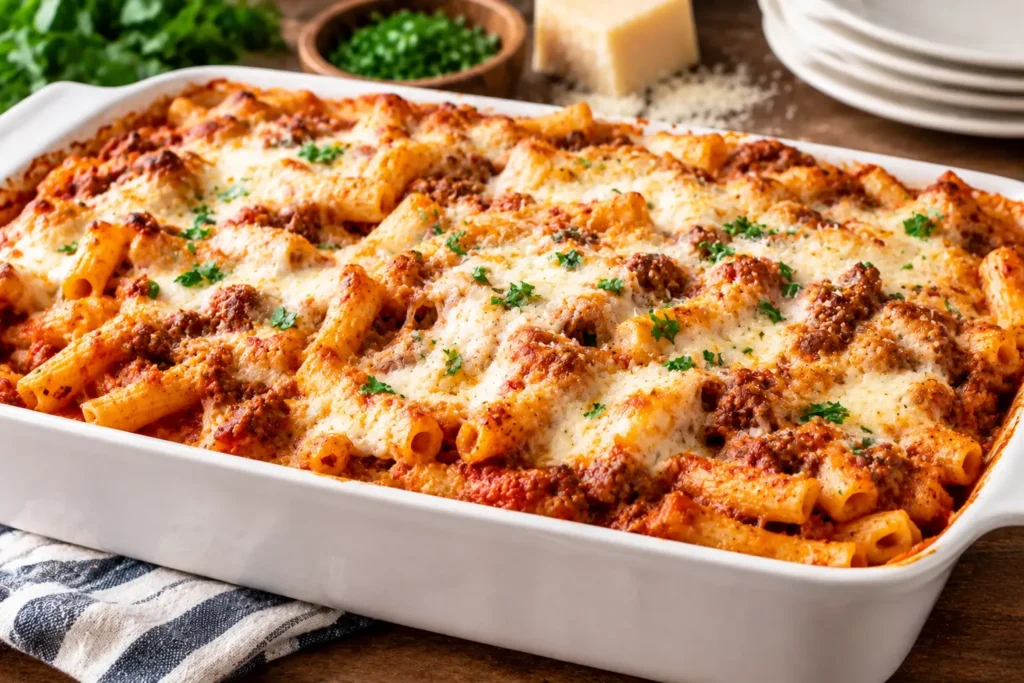
Baked ziti is the casserole most people reach for first, and it earns the spot. Ground beef, ricotta, and mozzarella turn one pan into dinner for eight.
Pull the pasta two minutes early, because it keeps cooking in the oven and a noodle that starts fully soft ends up mushy by the time the cheese bubbles. Drain it well.
Cover the pan with foil for the first 25 minutes. Otherwise the cheese browns long before the middle heats through, and you'd be serving a scorched top over a lukewarm center.
The nutrition: About 34 g protein per square (1 of 8). The beef and the two cheeses carry most of it.
Brown the beef to 160°F, the USDA number for ground beef. Then rest the pan 10 minutes so the squares hold their shape.
Cheeseburger Casserole
A cheeseburger in a pan sounds like a gimmick, but the mustard and pickles really do carry the flavor. Elbow macaroni stands in for the bun.
The nutrition: Each square has about 36 g protein, and the pan makes 6. The beef and cheddar carry the protein.
Use lean beef and spoon off any fat after browning, because a greasy pan separates into pools under the cheddar. Pressing the meat to one side of the skillet makes that easy.
Pickles go last. Save them for the top. Baked into the pasta they go limp and sour, but on the surface they keep a little bite.
Ground beef is done at 160°F. Check it in the skillet before it meets the macaroni, since you can't see pink spots later, since a short bake won't rescue pink spots.
Tuna Noodle Casserole
Tuna noodle casserole is cheap, retro, and still good. Two cans of tuna bring real protein to a pan that costs very little, and since it's built from the pantry, you can make it on a night when the refrigerator is nearly empty.
Make the sauce from butter, flour, and milk instead of opening a can of soup. It takes five minutes, and you'll control the salt, which a canned soup doesn't let you do.
Crush the crackers coarsely. Fine crumbs go soggy in the sauce, but larger pieces toast and give the top its crunch.
Drain the tuna well and flake it with a fork. Cool the leftovers within 2 hours, and the cream sauce keeps 3 to 4 days in the refrigerator.
The nutrition: Count on roughly 25 g protein per serving, from 6 equal servings. The tuna and noodles carry most of it.
Baked Mac and Cheese
The nutrition: One serving comes to about 23 g protein, with 8 in all. The cheddar, cottage cheese, and pasta share it.
Baked mac and cheese needs a crisp top and a sauce that stays creamy. Blended cottage cheese does the second job and adds protein.
Pull the macaroni two minutes early. It finishes in the sauce, and a pasta that starts the bake already soft turns to paste before the top browns.
Blend the cottage cheese smooth before you add it. Nobody will notice. It's invisible. That's the point, and it's why the sauce still tastes like plain cheese.
Take the sauce off the heat before the cheddar goes in. Boiling cheese turns grainy, and the bake needs a smooth start.
Chicken Tetrazzini
Chicken tetrazzini is where leftover roast chicken or turkey goes after a holiday. Spaghetti, mushrooms, and peas sit in a light parmesan sauce.
Cook the mushrooms until their water is gone before you whisk in the flour. Wet mushrooms thin the sauce, and a thin sauce leaves the pasta dry in the oven where it's meant to be creamy.
The nutrition: Per serving, it's about 28 g protein (8 servings). The chicken and parmesan carry most of it.
Milk keeps this lighter than a heavy cream version. The sauce thickens fully at a simmer, so give it the full five minutes. Don't rush.
Shredded cooked chicken only needs reheating. Check the center for 165°F, and the leftovers keep 3 to 4 days.
Broccoli Rice Casserole
Broccoli rice casserole shows up at every potluck. With shredded chicken stirred in, the side becomes dinner.
Use long grain white rice, not instant. Instant rice turns to mush over 40 minutes, but long grain finishes tender and keeps its shape.
Keep the foil tight for the first 30 minutes. Steam cooks the rice, and the cheese and crackers only go on once the grains are soft.
The nutrition: About 28 g protein per serving (1 of 8). The chicken, rice, and cheddar share it.
Rice dishes need quick cooling. Spread the leftovers in a shallow dish and refrigerate within 2 hours, then eat them within 3 to 4 days.
Creamy Chicken Pasta Bake
Creamy chicken pasta bake is the weeknight pan that reheats well. Penne, spinach, and sun-dried tomatoes sit in a parmesan sauce.
The nutrition: Each serving has about 30 g protein, and the pan makes 8. The chicken and parmesan carry most of it.
Cook the chicken in cubes instead of whole breasts. Small pieces brown fast and stay juicy, and the sauce picks up the browned bits from the pan, which gives the whole bake more depth than a plain white sauce would.
Whisk the flour into the pan juices before you add the milk. That one step keeps the sauce from turning lumpy. Don't skip it.
Check a piece of chicken for 165°F before it joins the pasta. Leftovers keep 3 to 4 days.
Chili Mac Bake
Chili mac bake puts chili and macaroni under one cheddar blanket, so it's a one pan comfort dinner with beans for extra fiber and enough heft to feed eight. You'll want a long spoon.
Simmer the chili base for ten minutes before the macaroni goes in. The spices bloom, and the liquid reduces enough to coat the pasta.
Undercook the macaroni by three minutes. It drinks the broth in the oven, and fully cooked pasta turns mushy.
Top it with Greek yogurt at the table. It's a lighter swap for sour cream.
The nutrition: Count on roughly 29 g protein per serving, from 8 equal servings. The beef, beans, and cheddar share it.
Sausage Stuffing Casserole
The nutrition: One square comes to about 20 g protein, with 8 in all. The sausage, eggs, and stuffing mix share it.
Stuffing deserves more than one dinner a year, and with browned sausage folded in and eggs to hold it together, it becomes a main that fills a square. Don't wait for November.
Break the sausage into small crumbs as it browns. Big lumps make uneven bites, while fine pieces spread through every forkful and cook through faster.
Let the stuffing soak a few minutes before it goes in the dish. Dry cubes drink the broth, and the middle won't end up dry.
Sausage is done at 160°F, and a casserole with eggs should reach 165°F in the center. Probe the middle, not the edge.
Broccoli Cauliflower Bake
Broccoli cauliflower bake proves winter tables don't have to be all pasta and potato, since a light cheese sauce and a little ham turn two vegetables into dinner. It's quick.
Steam the florets for only four minutes. They finish in the oven, and fully cooked ones turn watery under the sauce.
The nutrition: Per serving, it's about 21 g protein (6 servings). The ham, cheddar, and vegetables share it.
Cut the florets to the same size. Even pieces cook together, and the leftovers are good with a fried egg.
Stir the cheddar in off the heat. Check the center for 165°F, since the ham is already cooked.
Never Miss a Recipe
Fresh high-protein recipes, meal prep ideas, and kitchen tips, straight to your inbox every week. No spam, just good food.
No spam. Unsubscribe anytime.
Loaded Baked Potato Casserole
Loaded baked potato casserole packs the toppings into a pan. Roasted cubes, bacon, cheddar, and scallions replace the single potato.
Roast the cubes on a sheet pan first. They brown at 425°F, and a pan of raw cubes baked under cheese would steam instead.
Greek yogurt goes on after baking. Heat can make it separate, but a cool dollop on the hot potatoes is just as tangy as sour cream.
The nutrition: About 15 g protein per serving (1 of 8). The bacon, cheddar, and yogurt share it.
Crumble the bacon fully cooked. It only needs to be hot, and the 3 to 4 day refrigerator rule still applies to leftovers.
Beef Stroganoff Casserole
Stroganoff on the stove means standing and stirring. Baked, it looks after itself, and Greek yogurt replaces the sour cream.
The nutrition: Each serving has about 27 g protein, and the pan makes 8. The sirloin and yogurt share it.
Sear the steak in two batches. A crowded pan steams the cubes grey, while a hot, roomy pan browns them and leaves flavorful bits to season the mushrooms.
Don't boil it. Stir the yogurt in off the heat. Boiling yogurt splits, and a cool stir keeps the sauce smooth.
Sirloin is a whole cut, so 145°F with a 3 minute rest meets the USDA minimum. The noodles finish in the oven.
Layer It: Foil On, Then Foil Off
Layering takes ten extra minutes, and these 8 dishes repay it with clean squares and sauce in every bite. Cover them first, uncover them later, and let them rest before you cut.
If you're feeding a bigger table, our family dinners by servings covers the pan sizes.
Taco Casserole
Taco casserole puts tortilla chips under the beef instead of shells beside it. One dish replaces a whole taco bar.
Crush the chips by hand into pieces about the size of a thumbnail. Powder turns to paste under the beef, while chunks soften at the bottom and keep some crunch near the surface.
It's worth it. Hold back a third of the chips for the last five minutes. They crisp on top and add the crunch the bottom layer loses.
Cook the beef to 160°F with the seasoning. Add lettuce and tomato at the table, because they wilt in a hot dish.
The nutrition: Count on roughly 26 g protein per square, from 8 equal servings. The beef, beans, and cheddar share it.
Chicken Enchilada Casserole
The nutrition: One square comes to about 36 g protein, with 8 in all. The chicken, beans, and cheddar share the work.
Enchiladas without the rolling are a gift on a weeknight. Tortillas, chicken, and beans stack like lasagna, and the red sauce soaks through every layer.
Tear the tortillas to fit instead of overlapping them. Overlaps leave gummy patches, while one even layer bakes into tender sheets that slice cleanly into squares at the table.
Don't skimp. Pour the last of the sauce over the top so the cheddar sits on a wet surface. It melts evenly and doesn't scorch.
Cooked chicken only needs reheating, but the USDA still wants the center at 165°F. Probe it before you pull the pan.
King Ranch Chicken
King Ranch is the richer Texas cousin of the enchilada bake, with a creamy sauce in place of the red one. Green chiles and bell pepper keep it from tasting heavy.
Warm the cream cheese into the milk until it's smooth before you add the chicken. Lumps don't melt out in the oven, and they show up as white spots in the finished pan.
The nutrition: Per square, it's about 34 g protein (8 servings). The chicken and cheddar do most of the work.
Skip the flour. Corn tortillas hold up better here. They soak up the sauce and keep a little chew.
Cool the pan within 2 hours, and it keeps 3 to 4 days in the refrigerator. The cream sauce doesn't freeze well, so I'd plan on eating it that week.
Classic Beef Lasagna
Lasagna is the Sunday project that feeds ten and freezes unbaked. No boil noodles shorten the work, and the ricotta layer holds an egg so it sets firmly.
Spread sauce under the first layer of noodles. Dry noodles that touch the pan stay hard at the edges, and a thin coat of sauce fixes that before the oven has a chance to.
Don't skip the rest. Rest it for 15 minutes before cutting. I'd say that's the step most people skip, and it's why their squares slide apart.
The nutrition: About 33 g protein per square (1 of 10). Beef, ricotta, and mozzarella all contribute.
Brown the beef to 160°F first, then keep the pan covered for the first 40 minutes so the noodles soften in steam.
Never Miss a Recipe
Fresh high-protein recipes, meal prep ideas, and kitchen tips, straight to your inbox every week. No spam, just good food.
No spam. Unsubscribe anytime.
Million Dollar Spaghetti
Million dollar spaghetti is baked spaghetti and lasagna in one pan. A cream cheese and cottage cheese layer sits in the middle.
The nutrition: Each serving has about 30 g protein, and the pan makes 10. The beef, cottage cheese, and mozzarella share it.
Soften the cream cheese first. Cold cream cheese stays in lumps, and it won't spread over the spaghetti unless you mix it with the cottage cheese.
The cottage cheese quietly raises the protein, and in my view nobody at the table will notice it.
Brown the beef to 160°F. The pan bakes at 350°F, which is lower than the others, so it needs 25 minutes.
Cheesy Potatoes au Gratin
Potatoes au gratin is a side that steals the show. Diced ham turns thin sliced potatoes and Gruyère into a full dinner.
Slice the potatoes thin and even, about an eighth of an inch. Thick slices stay firm in the middle while the top browns too far, and a mandoline makes the job quick.
Warm the cream first. Cold cream slows the bake, whereas warm cream gets the potatoes cooking right away.
Keep the foil on for 45 minutes, then uncover. Poke a potato slice with a knife to confirm it's tender before the top browns.
The nutrition: Count on roughly 15 g protein per serving, from 8 equal servings. The ham, Gruyère, and cream share it.
Shepherd's Pie
The nutrition: One serving comes to about 21 g protein, with 8 in all. The beef, yogurt, and potatoes all contribute.
Shepherd's pie is winter in a dish. Savory beef and vegetables sit under a blanket of mashed potato that browns at the edges.
Mash the potatoes with Greek yogurt and butter, but leave them a little stiff. A loose mash sinks into the filling, whereas a thick one stays on top and browns, and that stiff surface is also what lets the fork ridges hold their shape under the broiler.
Broil it for the last two minutes. The ridges you make with a fork catch the heat and turn golden.
Brown the beef to 160°F. Lamb is traditional, and it's held to the same rule when ground.
Chicken Pot Pie
Chicken pot pie is the casserole with a crust. Cooked chicken and vegetables sit in a thick sauce under a golden lid.
Cool the filling for a few minutes before it goes in the crust. A hot filling melts the dough from underneath, and a soggy bottom is hard to fix once it has baked.
The nutrition: Per slice, it's about 21 g protein (8 servings). The chicken and milk based sauce carry it.
Vent it well. Cut four slits in the top crust. Steam needs a way out, or the filling bubbles over the edge.
Rest the pie 15 minutes before slicing. The sauce thickens as it cools, and the slices hold together.
Arrange, Roll, or Pour: Cooked to a Temperature
These 8 dishes skip the stirring. You arrange cutlets, roll noodles, stuff peppers, or pour a custard over the dish, and the oven does the rest. Most are cooked to a firm temperature, so the thermometer matters more than the clock.
For planning leftovers, our meal prep dinner ideas has storage ideas.
Cheesy Chicken Bake
Cheesy chicken bake is the dinner for nights with ten minutes of energy. Breasts sit on a bed of spinach under a blanket of mozzarella, and no side dish is needed.
Slice the thickest breasts so they're about the same height. A thick one needs ten more minutes than a thin one, and by then the thin one is dry, which is the main way this dish goes wrong.
Salt matters. Season the chicken itself, not just the spinach. Garlic powder, salt, and pepper on the meat carry through every bite.
The nutrition: About 44 g protein per portion (1 of 6). The chicken breasts supply nearly all of it.
Poultry is safe at 165°F, so probe the thickest breast. The spinach wilts into the juices and makes a light sauce of its own.
Tomato Basil Chicken Mozzarella Bake
Tomato basil chicken is the light one in the pan. Sliced tomatoes and fresh basil sit over the breasts, and mozzarella melts across the top.
The nutrition: Each portion has about 43 g protein, and the pan makes 6. The chicken and mozzarella carry it.
Salt the tomato slices and let them sit a few minutes before they go on. They shed some water that way, so the chicken roasts instead of steaming, and the cheese browns instead of sliding off.
Timing matters. Add most of the basil at the end. Heat turns it dark and bitter, but a handful scattered on the hot pan stays bright and fragrant.
Check the thickest breast for 165°F. If one is much bigger, slice it in half so every piece finishes together.
Veal Parmesan Bake
Veal Parmesan Bake is the dressy one in this list. Breaded cutlets sit under marinara and mozzarella, and the pan looks like a restaurant dish.
Bake the cutlets before they meet the sauce. Ten minutes in a hot oven sets the crumbs, which then stay crisp at the edges even after the marinara goes on top.
Check the label. Veal is sold as thin cutlets and can be hard to find. Chicken cutlets work, but they need 165°F instead of 145°F, so check the temperature.
Veal is a whole cut, so the USDA minimum is 145°F with a 3 minute rest. Give the pan that time before you serve.
The nutrition: Count on roughly 37 g protein per serving, from 6 equal servings. The veal and the cheese carry the protein.
Stuffed Peppers
The nutrition: One pepper comes to about 30 g protein, with 6 in all. The beef, rice, and mozzarella share it.
Stuffed peppers portion themselves. Each pepper holds beef, rice, and tomato sauce, and one counts as a serving.
Stand the peppers upright and snug in the dish so they don't tip. If they wobble, trim a thin slice off the base, though not so much that it opens a hole in the bottom and lets the sauce leak into the dish.
Pre-cook the rice for 12 minutes. It finishes inside the pepper, and the cheese goes on for the last five minutes.
Brown the beef to 160°F. The peppers are done when a knife slides in easily.
Stuffed Pasta Rolls
Stuffed pasta rolls are lasagna that's already portioned, since each noodle wraps a spoon of ricotta, turkey, and spinach and two rolls make a serving. They're easy to plate.
Boil the noodles until they bend without tearing, then lay them flat on a tray. Stacked wet noodles stick together, and a torn one leaks filling into the sauce.
The nutrition: Per serving, it's about 29 g protein (8 servings). The turkey, ricotta, and egg carry most of it.
Squeeze hard. Squeeze the spinach dry before it goes in the filling. Extra water thins the ricotta, and a runny filling squirts out when you roll.
Ground turkey is done at 165°F, not 160°F. Check it in the skillet, since it's much easier to probe loose meat than a finished roll.
Baked Feta Pasta
Baked feta pasta went viral for good reason, because a block of feta and a pile of tomatoes roast into a creamy sauce with almost no work at all. It's hands off.
Let the tomatoes burst fully before you mash anything. They need 35 minutes at 400°F, and rushing leaves firm tomatoes that won't make a sauce.
Stir gently. Add the shredded chicken at the end. It only needs to heat through, and stirring it in keeps it moist.
The nutrition: About 34 g protein per serving (1 of 6). The feta, chicken, and pasta share it.
Mash the feta in the pan until the sauce turns creamy and pink. Basil goes on last because heat dulls it.
Creamed Corn Casserole
Creamed corn casserole is usually a side. With diced ham, it holds up as a light dinner.
The nutrition: Each serving has about 15 g protein, and the pan makes 8. The eggs, ham, and cheddar carry it.
Whisk the base until it's completely smooth before the corn goes in. Cream cheese lumps don't dissolve in the oven, and they sit in the finished dish as dry white flecks.
Bake until the center is set, which you can test by sliding a knife near the middle and checking that it comes out clean while the edges turn golden first.
Egg dishes should reach 160°F. Use frozen corn straight from the bag if fresh isn't in season.
Ham and Cheese Egg Bake
Ham and cheese egg bake is breakfast for dinner. It reheats well, so squares in the refrigerator cover quick lunches.
Whisk the eggs and milk until no streaks remain, because streaks of white bake rubbery and an even mix sets as one tender slab that cuts into clean squares.
Spray it well. Coat the dish with cooking spray. Egg sticks to bare glass, and a clean square matters when you're serving.
The USDA says to cook egg dishes to 160°F. Cut it only after the center is firm, then rest it 5 minutes.
The nutrition: Count on roughly 25 g protein per square, from 8 equal servings. Eggs, ham, and cheddar all contribute.
Time and Protein at a Glance
Use this list to plan the day. Times include prep, baking, and resting, and protein's per serving.
- Baked Ziti: 1 hr 15 min, about 34 g protein per square
- Cheeseburger Casserole: 55 min, about 36 g protein per square
- Tuna Noodle Casserole: 50 min, about 25 g protein per serving
- Baked Mac and Cheese: 55 min, about 23 g protein per serving
- Chicken Tetrazzini: 1 hr, about 28 g protein per serving
- Broccoli Rice Casserole: 1 hr 10 min, about 28 g protein per serving
- Creamy Chicken Pasta Bake: 1 hr 5 min, about 30 g protein per serving
- Chili Mac Bake: 1 hr, about 29 g protein per serving
- Sausage Stuffing Casserole: 1 hr 10 min, about 20 g protein per square
- Broccoli Cauliflower Bake: 1 hr 5 min, about 21 g protein per serving
- Loaded Baked Potato Casserole: 1 hr 20 min, about 15 g protein per serving
- Beef Stroganoff Casserole: 1 hr 5 min, about 27 g protein per serving
- Taco Casserole: 50 min, about 26 g protein per square
- Chicken Enchilada Casserole: 1 hr, about 36 g protein per square
- King Ranch Chicken: 1 hr 5 min, about 34 g protein per square
- Classic Beef Lasagna: 1 hr 45 min, about 33 g protein per square
- Million Dollar Spaghetti: 1 hr 10 min, about 30 g protein per serving
- Cheesy Potatoes au Gratin: 1 hr 45 min, about 15 g protein per serving
- Shepherd's Pie: 1 hr 20 min, about 21 g protein per serving
- Chicken Pot Pie: 1 hr 25 min, about 21 g protein per slice
- Cheesy Chicken Bake: 45 min, about 44 g protein per portion
- Tomato Basil Chicken Mozzarella Bake: 50 min, about 43 g protein per portion
- Veal Parmesan Bake: 1 hr, about 37 g protein per serving
- Stuffed Peppers: 1 hr 20 min, about 30 g protein per pepper
- Stuffed Pasta Rolls: 1 hr 20 min, about 29 g protein per serving
- Baked Feta Pasta: 55 min, about 34 g protein per serving
- Creamed Corn Casserole: 1 hr 5 min, about 15 g protein per serving
- Ham and Cheese Egg Bake: 1 hr, about 25 g protein per square
How I Counted Protein
I multiplied typical USDA FoodData Central values by the weights on each card, then divided by the servings. Meats are counted raw and canned beans are counted drained, so the numbers are estimates and raw meat runs high.
Several inputs rest on assumptions: tuna at 25.5 g per 100 g drained, ground beef at 18.8, ground turkey at 18, veal at 21, cottage cheese at 10.5, and plain Greek yogurt at 9. Brands of stuffing mix, pie crust, and cheese vary, so check yours.
Where These Cards Differ From Typical Versions
These cards are my own builds, weighed so the protein can be counted. They aren't copies of one published recipe, so a test cook is wise before you serve them to guests. Don't skip it.
Two habits don't meet the USDA minimums. Egg bakes are often served soft, and veal or beef is often pulled early, so the cards use 160°F for egg dishes and 145°F with a rest for whole cuts. That matters most for children, older adults, and pregnant guests.
Several dishes here, including baked ziti, lasagna, enchilada casserole, shepherd's pie, and stuffed peppers, resemble cards in our earlier sheet pan dinners and family lists. Cook one version a week and not both.
Questions About Winter Casseroles
Which casserole has the most protein?
Cheesy Chicken Bake leads at about 44 grams per portion, followed by Tomato Basil Chicken Mozzarella Bake at about 43 grams and Veal Parmesan Bake at about 37. The lowest's the Loaded Baked Potato Casserole at about 15 grams.
Can I freeze these casseroles?
Some freeze well, such as the lasagna, the ziti, and the enchilada bake. Cream sauces, rice, and noodle dishes can turn grainy or watery, so those cards give refrigerator times only. Cool the pan fully first.
How long do leftovers keep?
Cooked casseroles keep 3 to 4 days in the refrigerator, per FoodSafety.gov. Refrigerate within 2 hours, cut into squares so they chill quickly, and reheat each portion to 165°F.
Why rest a casserole before cutting?
Resting lets the sauce and cheese set, so squares hold their shape. Layered dishes need 10 to 15 minutes, and the others need about 5.
Is veal required for the veal parmesan?
No. Chicken cutlets work, but they must reach 165°F instead of 145°F, so check the temperature in the thickest piece.
Are these protein numbers exact?
No. They're estimates based on typical USDA values, and raw meat weights run slightly high. For heavier meals, see our 50 gram protein dinners.
1. Baked Ziti
Approx. 34g ProteinIngredients: 1 lb (454 g) ziti pasta; Water for the pasta pot; 1 1/2 lb (680 g) lean ground beef; 1 jar (24 oz) marinara sauce (680 g); 1 cup (250 g) ricotta cheese; 2 cups (226 g) shredded mozzarella cheese; 1 tsp Italian seasoning; Aluminum foil; Salt and black pepper, to taste.
Step 1: Heat the oven to 375°F. Cook the ziti pasta in boiling salted water 2 minutes short of tender and drain.
Step 2: Brown the beef 8 minutes with salt and pepper, until a thermometer reads 160°F, then stir in the marinara sauce and Italian seasoning.
Step 3: Fold in the pasta and ricotta, spread it in a 9 by 13 inch baking dish, top with the mozzarella, and cover with foil. Bake 25 minutes, uncover, and bake 10 minutes more, until bubbling. Rest 10 minutes. Cool within 2 hours, or within 1 hour above 90°F, in a shallow dish or cut into squares. Refrigerate up to 3 to 4 days, or freeze portions up to 2 to 3 months, and reheat in the oven or microwave to 165°F.
2. Cheeseburger Casserole
Approx. 36g ProteinIngredients: 1 1/2 lb (680 g) lean ground beef; 1 yellow onion, diced (150 g); 8 oz (227 g) elbow macaroni pasta; Water for the pasta pot; 1 can (14.5 oz) diced tomatoes (411 g); 2 tbsp yellow mustard; 2 tbsp ketchup; 2 cups (226 g) shredded cheddar cheese; 1/2 cup dill pickle slices; Salt and black pepper, to taste.
Step 1: Heat the oven to 375°F. Cook the macaroni pasta in boiling salted water 3 minutes short of tender and drain.
Step 2: Brown the beef and onion 8 minutes with salt and pepper, until a thermometer reads 160°F. Stir in the diced tomatoes, mustard, and ketchup.
Step 3: Fold in the macaroni and half the cheddar, spread it in a 9 by 13 inch baking dish, and top with the remaining cheddar and the pickle slices. Bake 20 minutes, until the cheese bubbles and browns. Rest 5 minutes. Cool within 2 hours, or within 1 hour above 90°F, in a shallow dish or cut into squares, refrigerate up to 3 to 4 days, and reheat in the oven or microwave to 165°F.
3. Tuna Noodle Casserole
Approx. 25g ProteinIngredients: 12 oz (340 g) wide egg noodles; Water for the noodle pot; 3 tbsp butter; 1/4 cup (30 g) all purpose flour; 1 1/2 cups (360 g) milk; 2 cans (5 oz each) tuna, drained (284 g); 1 cup (150 g) frozen peas; 1/2 cup (50 g) crushed butter crackers; Salt and black pepper, to taste.
Step 1: Heat the oven to 375°F. Cook the egg noodles in boiling salted water 3 minutes short of tender and drain.
Step 2: Melt the butter in a saucepan, whisk in the flour for 1 minute, then whisk in the milk and cook 4 minutes, until thick. Season with salt and pepper.
Step 3: Fold the noodles, tuna, peas, and sauce together, spread in a 9 by 13 inch baking dish, and top with the crushed crackers. Bake 20 minutes, until golden and bubbling. Cool within 2 hours, or within 1 hour above 90°F, in a shallow dish or cut into squares, refrigerate up to 3 to 4 days, and reheat in the oven or microwave to 165°F.
4. Baked Mac and Cheese
Approx. 23g ProteinIngredients: 1 lb (454 g) elbow macaroni pasta; Water for the pasta pot; 3 tbsp butter; 3 tbsp (25 g) all purpose flour; 2 cups (480 g) milk; 1 cup (240 g) cottage cheese, blended smooth; 3 cups (340 g) shredded sharp cheddar cheese; 1/2 cup (30 g) plain bread crumbs; Salt and black pepper, to taste.
Step 1: Heat the oven to 375°F. Cook the macaroni pasta in boiling salted water 2 minutes short of tender and drain.
Step 2: Melt the butter, whisk in the flour for 1 minute, then whisk in the milk and cook 4 minutes, until thick. Off the heat, stir in the cottage cheese, two thirds of the cheddar, salt, and pepper.
Step 3: Fold in the macaroni, spread in a 9 by 13 inch baking dish, and top with the remaining cheddar and the bread crumbs. Bake 20 minutes, until golden and bubbling. Cool within 2 hours, or within 1 hour above 90°F, in a shallow dish or cut into squares, refrigerate up to 3 to 4 days, and reheat in the oven or microwave to 165°F.
5. Chicken Tetrazzini
Approx. 28g ProteinIngredients: 12 oz (340 g) spaghetti pasta; Water for the pasta pot; 3 tbsp butter; 8 oz (227 g) sliced mushrooms; 3 tbsp (30 g) all purpose flour; 2 cups (480 g) milk; 1 cup (240 g) chicken broth; 1 lb (454 g) shredded cooked chicken; 1 cup (150 g) frozen peas; 1/2 cup (60 g) grated parmesan cheese; Salt and black pepper, to taste.
Step 1: Heat the oven to 375°F. Cook the spaghetti pasta in boiling salted water 3 minutes short of tender and drain.
Step 2: Cook the mushrooms in the butter 5 minutes, whisk in the flour for 1 minute, then whisk in the milk and chicken broth and cook 5 minutes, until thick. Season with salt and pepper.
Step 3: Fold in the spaghetti, chicken, peas, and half the parmesan, spread in a 9 by 13 inch baking dish, and top with the remaining parmesan. Bake 20 minutes, until golden and a thermometer reads 165°F in the center. Cool within 2 hours, or within 1 hour above 90°F, in a shallow dish or cut into squares, refrigerate up to 3 to 4 days, and reheat in the oven or microwave to 165°F.
6. Broccoli Rice Casserole
Approx. 28g ProteinIngredients: 1 1/2 cups (300 g) long grain white rice; 2 cups chicken broth; 1 cup (240 g) milk; 1 lb (454 g) broccoli florets; 1 lb (454 g) shredded cooked chicken; 2 cups (226 g) shredded cheddar cheese; 1/2 cup (50 g) crushed butter crackers; Aluminum foil; Salt and black pepper, to taste.
Step 1: Heat the oven to 375°F. Stir the rice, chicken broth, milk, salt, and pepper in a 9 by 13 inch baking dish, cover with foil, and bake 30 minutes.
Step 2: Stir in the broccoli, chicken, and half the cheddar, cover, and bake 10 minutes more, until the rice is tender.
Step 3: Top with the remaining cheddar and the crushed crackers and bake uncovered 8 minutes, until golden and a thermometer reads 165°F. Cool within 2 hours, or within 1 hour above 90°F, in a shallow dish or cut into squares, refrigerate up to 3 to 4 days, and reheat in the oven or microwave to 165°F.
7. Creamy Chicken Pasta Bake
Approx. 30g ProteinIngredients: 1 1/2 lb (680 g) chicken breast, cut in cubes; 1 tbsp olive oil; 12 oz (340 g) penne pasta; Water for the pasta pot; 2 cups (480 g) milk; 2 tbsp (15 g) all purpose flour; 1/2 cup (60 g) grated parmesan cheese; 5 oz (142 g) baby spinach; 1/2 cup (60 g) sun-dried tomatoes; Salt and black pepper, to taste.
Step 1: Heat the oven to 375°F. Cook the penne pasta in boiling salted water 3 minutes short of tender and drain.
Step 2: Season the chicken with salt and pepper, cook it in the olive oil 6 minutes, until golden, and whisk in the flour, then the milk. Simmer 4 minutes, until thick, and stir in the parmesan.
Step 3: Fold in the pasta, spinach, and sun-dried tomatoes, pour into a 9 by 13 inch baking dish, and bake 20 minutes, until bubbling and a thermometer reads 165°F in the chicken. Cool within 2 hours, or within 1 hour above 90°F, in a shallow dish or cut into squares, refrigerate up to 3 to 4 days, and reheat in the oven or microwave to 165°F.
8. Chili Mac Bake
Approx. 29g ProteinIngredients: 1 1/2 lb (680 g) lean ground beef; 1 yellow onion, diced (150 g); 2 tbsp chili powder; 1 can (14.5 oz) diced tomatoes (411 g); 1 can (15 oz) kidney beans, drained (255 g); 8 oz (227 g) elbow macaroni pasta; Water for the pasta pot; 2 cups (226 g) shredded cheddar cheese; 2 cups beef broth; Salt and black pepper, to taste.
Step 1: Heat the oven to 375°F. Cook the macaroni pasta in boiling salted water 3 minutes short of tender and drain.
Step 2: Brown the beef and onion 8 minutes with salt and pepper, until a thermometer reads 160°F. Stir in the chili powder, diced tomatoes, kidney beans, and beef broth and simmer 10 minutes.
Step 3: Fold in the macaroni, spread in a 9 by 13 inch baking dish, top with the cheddar, and bake 15 minutes, until bubbling. Cool within 2 hours, or within 1 hour above 90°F, in a shallow dish or cut into squares, refrigerate up to 3 to 4 days, and reheat in the oven or microwave to 165°F.
9. Sausage Stuffing Casserole
Approx. 20g ProteinIngredients: 1 1/2 lb (680 g) Italian sausage, casings removed; 1 yellow onion, diced (150 g); 2 celery stalks, diced (100 g); 1 bag (14 oz) seasoned stuffing mix (400 g); 2 cups chicken broth; 2 large eggs (50 g each, 100 g); 2 tbsp butter, melted.
Step 1: Heat the oven to 375°F. Brown the sausage with the onion and celery 9 minutes, breaking it up, until a thermometer reads 160°F.
Step 2: Toss the stuffing mix with the chicken broth, eggs, and melted butter, then fold in the sausage mixture.
Step 3: Spread in a 9 by 13 inch baking dish and bake 35 minutes, uncovered, until the top is crisp and golden and a thermometer reads 165°F in the center. Cool within 2 hours, or within 1 hour above 90°F, in a shallow dish or cut into squares. Refrigerate up to 3 to 4 days, or freeze portions up to 2 to 3 months, and reheat in the oven or microwave to 165°F.
10. Broccoli Cauliflower Bake
Approx. 21g ProteinIngredients: 1 lb (454 g) broccoli florets; 1 lb (454 g) cauliflower florets; 2 tbsp butter; 2 tbsp (15 g) all purpose flour; 1 1/2 cups (360 g) milk; 2 cups (226 g) shredded cheddar cheese; 8 oz (227 g) fully cooked ham, diced; Salt and black pepper, to taste.
Step 1: Heat the oven to 375°F. Steam the broccoli and cauliflower 4 minutes, until barely tender.
Step 2: Melt the butter, whisk in the flour for 1 minute, then whisk in the milk and cook 4 minutes, until thick. Off the heat, stir in two thirds of the cheddar, salt, and pepper.
Step 3: Fold in the vegetables and ham, spread in a 9 by 13 inch baking dish, and top with the remaining cheddar. Bake 25 minutes, until browned and a thermometer reads 165°F in the center. Cool within 2 hours, or within 1 hour above 90°F, in a shallow dish or cut into squares, refrigerate up to 3 to 4 days, and reheat in the oven or microwave to 165°F.
11. Loaded Baked Potato Casserole
Approx. 15g ProteinIngredients: 2 lb (907 g) potatoes, cut in 3/4 inch cubes; 2 tbsp olive oil; 8 oz (227 g) cooked bacon, crumbled; 2 cups (226 g) shredded cheddar cheese; 1 cup (240 g) plain Greek yogurt; 4 scallions, sliced (40 g); Salt and black pepper, to taste.
Step 1: Heat the oven to 425°F. Toss the potatoes with the olive oil, salt, and pepper on a rimmed baking sheet and roast 30 minutes, until tender.
Step 2: Move the potatoes to a 9 by 13 inch baking dish, fold in the bacon and half the cheddar, and top with the remaining cheddar.
Step 3: Bake 10 minutes, until the cheese melts, and top with the Greek yogurt and scallions. Cool within 2 hours, or within 1 hour above 90°F, in a shallow dish or cut into squares, refrigerate up to 3 to 4 days, and reheat in the oven or microwave to 165°F.
12. Beef Stroganoff Casserole
Approx. 27g ProteinIngredients: 1 1/2 lb (680 g) sirloin steak, cut in 1 inch cubes; 2 tbsp olive oil; 8 oz (227 g) sliced mushrooms; 12 oz (340 g) wide egg noodles; Water for the noodle pot; 2 cups beef broth; 1 tbsp Worcestershire sauce; 1 cup (240 g) plain Greek yogurt; Salt and black pepper, to taste.
Step 1: Heat the oven to 375°F. Sear the steak in the olive oil in two batches, 2 minutes each, with salt and pepper, and move it to a plate. Cook the mushrooms in the same pan 5 minutes.
Step 2: Cook the egg noodles in boiling salted water 4 minutes short of tender and drain. Stir the beef broth and Worcestershire sauce into the mushrooms.
Step 3: Combine the noodles, steak, and mushrooms in a 9 by 13 inch baking dish and bake 20 minutes, until a thermometer reads 145°F in the steak. Stir in the Greek yogurt off the heat. Cool within 2 hours, or within 1 hour above 90°F, in a shallow dish or cut into squares, refrigerate up to 3 to 4 days, and reheat in the oven or microwave to 165°F.
13. Taco Casserole
Approx. 26g ProteinIngredients: 1 1/2 lb (680 g) lean ground beef; 1 tbsp olive oil; 2 tbsp taco seasoning; 1 can (15 oz) black beans, drained (255 g); 1 1/2 cups (340 g) salsa; 4 oz (120 g) tortilla chips; 2 cups (226 g) shredded cheddar cheese.
Step 1: Heat the oven to 375°F. Brown the beef in the olive oil 8 minutes with the taco seasoning, until a thermometer reads 160°F, then stir in the black beans and salsa.
Step 2: Crush two thirds of the chips into a 9 by 13 inch baking dish, spread the beef mixture over them, and top with the cheddar.
Step 3: Bake 20 minutes, add the remaining crushed chips for the last 5 minutes, and serve once the cheese bubbles. Cool within 2 hours, or within 1 hour above 90°F, in a shallow dish or cut into squares, refrigerate up to 3 to 4 days, and reheat in the oven or microwave to 165°F.
14. Chicken Enchilada Casserole
Approx. 36g ProteinIngredients: 1 1/2 lb (680 g) shredded cooked chicken; 1 can (15 oz) black beans, drained (255 g); 2 cups (560 g) red enchilada sauce; 8 small flour tortillas (45 g each, 360 g); 2 cups (226 g) shredded cheddar cheese; 1 tsp ground cumin; Aluminum foil.
Step 1: Heat the oven to 375°F. Mix the chicken, black beans, cumin, and 1 cup of the enchilada sauce.
Step 2: Spread a little sauce in a 9 by 13 inch baking dish and layer in half the tortillas, half the chicken mixture, and a third of the cheddar. Repeat, then pour the remaining sauce over the top and sprinkle with the remaining cheddar.
Step 3: Cover with foil and bake 20 minutes, uncover, and bake 10 minutes more, until bubbling and a thermometer reads 165°F in the center. Rest 10 minutes. Cool within 2 hours, or within 1 hour above 90°F, in a shallow dish or cut into squares. Refrigerate up to 3 to 4 days, or freeze portions up to 2 to 3 months, and reheat in the oven or microwave to 165°F.
15. King Ranch Chicken
Approx. 34g ProteinIngredients: 1 1/2 lb (680 g) shredded cooked chicken; 1 tbsp olive oil; 2 bell peppers, diced (300 g); 1 yellow onion, diced (150 g); 4 oz (113 g) cream cheese; 1 cup (240 g) milk; 1 can (4 oz) diced green chiles; 12 corn tortillas (30 g each, 360 g); 2 cups (226 g) shredded cheddar cheese; 1 tsp chili powder; Salt and black pepper, to taste.
Step 1: Heat the oven to 375°F. Cook the bell peppers and onion in the olive oil 5 minutes, then stir in the chili powder, salt, and pepper.
Step 2: Warm the milk with the cream cheese and green chiles until smooth, then stir in the chicken and vegetables.
Step 3: Layer half the corn tortillas, half the chicken mixture, and half the cheddar in a 9 by 13 inch baking dish, repeat, and bake 30 minutes, until bubbling. Rest 10 minutes. Cool within 2 hours, or within 1 hour above 90°F, in a shallow dish or cut into squares, refrigerate up to 3 to 4 days, and reheat in the oven or microwave to 165°F.
16. Classic Beef Lasagna
Approx. 33g ProteinIngredients: 12 oz (340 g) no boil lasagna noodles; 1 1/2 lb (680 g) lean ground beef; 2 jars (24 oz each) marinara sauce (1,360 g); 1 container (15 oz) ricotta cheese (425 g); 1 large egg (50 g); 1/3 cup (30 g) grated parmesan cheese; 3 cups (340 g) shredded mozzarella cheese; 1 tsp Italian seasoning; Aluminum foil; Salt and black pepper, to taste.
Step 1: Heat the oven to 375°F. Brown the beef 8 minutes with salt and pepper, until a thermometer reads 160°F, and stir in the marinara sauce and Italian seasoning.
Step 2: Mix the ricotta, egg, and parmesan. Layer a 9 by 13 inch baking dish with sauce, lasagna noodles, ricotta mixture, and mozzarella, repeating until everything is used, and finish with mozzarella.
Step 3: Cover with foil and bake 40 minutes, uncover, and bake 20 minutes more, until bubbling. Rest 15 minutes before cutting. Cool within 2 hours, or within 1 hour above 90°F, in a shallow dish or cut into squares. Refrigerate up to 3 to 4 days, or freeze portions up to 2 to 3 months, and reheat in the oven or microwave to 165°F.
17. Million Dollar Spaghetti
Approx. 30g ProteinIngredients: 1 lb (454 g) spaghetti pasta; Water for the pasta pot; 1 1/2 lb (680 g) lean ground beef; 1 jar (24 oz) marinara sauce (680 g); 8 oz (227 g) cream cheese, softened; 1 1/2 cups (340 g) cottage cheese; 2 cups (226 g) shredded mozzarella cheese; 1 tsp Italian seasoning; Salt and black pepper, to taste.
Step 1: Heat the oven to 350°F. Cook the spaghetti pasta in boiling salted water until just tender and drain.
Step 2: Brown the beef 8 minutes with salt and pepper, until a thermometer reads 160°F, and stir in the marinara sauce and Italian seasoning.
Step 3: Mix the cream cheese and cottage cheese, layer half the spaghetti, the cheese mixture, the remaining spaghetti, and the meat sauce in a 9 by 13 inch baking dish, and top with the mozzarella. Bake 25 minutes, until bubbling. Cool within 2 hours, or within 1 hour above 90°F, in a shallow dish or cut into squares, refrigerate up to 3 to 4 days, and reheat in the oven or microwave to 165°F.
18. Cheesy Potatoes au Gratin
Approx. 15g ProteinIngredients: 2 lb (907 g) potatoes, sliced 1/8 inch thick; 1 1/2 cups (360 g) heavy cream; 2 garlic cloves, minced; 8 oz (227 g) fully cooked ham, diced; 1 1/2 cups (170 g) shredded Gruyère cheese; 1 tsp dried thyme; Aluminum foil; Salt and black pepper, to taste.
Step 1: Heat the oven to 375°F. Warm the cream with the garlic, thyme, salt, and pepper in a saucepan for 3 minutes.
Step 2: Layer a third of the potato slices, ham, and Gruyère in a 9 by 13 inch baking dish, repeat twice, and pour the warm cream over the top.
Step 3: Cover with foil and bake 45 minutes, uncover, and bake 20 minutes more, until the potatoes are tender and the top is golden. Rest 10 minutes. Cool within 2 hours, or within 1 hour above 90°F, in a shallow dish or cut into squares, refrigerate up to 3 to 4 days, and reheat in the oven or microwave to 165°F.
19. Shepherd's Pie
Approx. 21g ProteinIngredients: 2 lb (907 g) potatoes, peeled and cubed (900 g); Water for boiling the potatoes; 1/2 cup (120 g) plain Greek yogurt; 2 tbsp butter; 1 1/2 lb (680 g) lean ground beef or lamb; 1 yellow onion, diced (150 g); 2 cups (300 g) frozen peas and carrots; 1 cup beef broth; 2 tbsp tomato paste; Salt and black pepper, to taste.
Step 1: Heat the oven to 400°F. Boil the potatoes in salted water 15 minutes, drain, and mash with the Greek yogurt, butter, salt, and pepper.
Step 2: Brown the beef and onion 8 minutes, until a thermometer reads 160°F. Stir in the peas and carrots, beef broth, and tomato paste and simmer 5 minutes.
Step 3: Spread the filling in a 9 by 13 inch baking dish, cover with the mashed potatoes, and bake 20 minutes, then broil 2 minutes, until golden. Rest 10 minutes. Cool within 2 hours, or within 1 hour above 90°F, in a shallow dish or cut into squares, refrigerate up to 3 to 4 days, and reheat in the oven or microwave to 165°F.
20. Chicken Pot Pie
Approx. 21g ProteinIngredients: 2 refrigerated pie crusts (220 g each, 440 g); 3 tbsp butter; 3 tbsp (25 g) all purpose flour; 1 1/2 cups chicken broth; 1/2 cup (120 g) milk; 1 lb (454 g) shredded cooked chicken; 3 cups (450 g) frozen mixed vegetables; 1 tsp dried thyme; Salt and black pepper, to taste.
Step 1: Heat the oven to 400°F and fit one pie crust into a 9 inch deep pie dish. Melt the butter, whisk in the flour for 1 minute, then whisk in the chicken broth and milk and cook 4 minutes, until thick.
Step 2: Stir in the chicken, mixed vegetables, thyme, salt, and pepper and pour the filling into the crust.
Step 3: Cover with the second crust, crimp the edges, cut 4 slits, and bake 35 to 40 minutes, until the crust is golden and the filling bubbles. Rest 15 minutes before slicing. Cool within 2 hours, or within 1 hour above 90°F, in a shallow dish or cut into squares, refrigerate up to 3 to 4 days, and reheat in the oven or microwave to 165°F.
21. Cheesy Chicken Bake
Approx. 44g ProteinIngredients: 2 lb (907 g) boneless skinless chicken breasts; 1 tbsp olive oil; 10 oz (285 g) fresh baby spinach; 1 tsp garlic powder; 2 cups (226 g) shredded mozzarella cheese; Salt and black pepper, to taste.
Step 1: Heat the oven to 400°F. Spread the spinach in a 9 by 13 inch baking dish and drizzle with the olive oil.
Step 2: Season the chicken with the garlic powder, salt, and pepper and set the breasts on the spinach.
Step 3: Bake 22 minutes, top with the mozzarella, and bake 5 to 8 minutes more, until the cheese browns and a thermometer reads 165°F in the thickest breast. Rest 5 minutes. Cool within 2 hours, or within 1 hour above 90°F, in a shallow dish or cut into squares. Refrigerate up to 3 to 4 days, or freeze portions up to 2 to 3 months, and reheat in the oven or microwave to 165°F.
22. Tomato Basil Chicken Mozzarella Bake
Approx. 43g ProteinIngredients: 2 lb (907 g) boneless skinless chicken breasts; 2 tbsp olive oil; 2 large tomatoes, sliced (300 g); 1/4 cup fresh basil leaves; 2 garlic cloves, minced; 2 cups (226 g) shredded mozzarella cheese; Salt and black pepper, to taste.
Step 1: Heat the oven to 400°F. Rub the chicken with half the olive oil, the garlic, salt, and pepper and set it in a 9 by 13 inch baking dish.
Step 2: Bake 18 minutes, then top with the tomato slices, half the basil, and the mozzarella.
Step 3: Bake 8 to 10 minutes more, until the cheese bubbles and a thermometer reads 165°F in the thickest breast. Drizzle with the remaining oil and scatter the rest of the basil on top. Cool within 2 hours, or within 1 hour above 90°F, in a shallow dish or cut into squares. Refrigerate up to 3 to 4 days, or freeze portions up to 2 to 3 months, and reheat in the oven or microwave to 165°F.
23. Veal Parmesan Bake
Approx. 37g ProteinIngredients: 1 1/2 lb (680 g) veal cutlets; 1 large egg (50 g); 1 cup (60 g) plain bread crumbs; 1/4 cup (30 g) grated parmesan cheese; 2 tbsp olive oil; 1 jar (24 oz) marinara sauce (680 g); 2 cups (226 g) shredded mozzarella cheese; 1 tsp dried oregano.
Step 1: Heat the oven to 425°F. Beat the egg in a shallow dish and mix the bread crumbs, parmesan, and oregano in another.
Step 2: Dip each cutlet in the egg, then the crumbs, set them on a baking sheet, drizzle with the olive oil, and bake 10 minutes, until golden.
Step 3: Spread half the marinara sauce in a 9 by 13 inch baking dish, add the cutlets, and top with the remaining sauce and the mozzarella. Bake 15 to 20 minutes, until bubbling and a thermometer reads 145°F, then rest 3 minutes. Another thin cutlet can stand in, but poultry must reach 165°F. Cool within 2 hours, or within 1 hour above 90°F, in a shallow dish or cut into squares, refrigerate up to 3 to 4 days, and reheat in the oven or microwave to 165°F.
24. Stuffed Peppers
Approx. 30g ProteinIngredients: 6 large bell peppers, tops cut off (900 g); 1 1/2 lb (680 g) lean ground beef; 1 yellow onion, diced (150 g); 3/4 cup (150 g) long grain white rice; 1 1/2 cups water; 1 jar (12 oz) marinara sauce (340 g); 1 cup (113 g) shredded mozzarella cheese; Aluminum foil; Salt and black pepper, to taste.
Step 1: Heat the oven to 375°F. Simmer the rice in the water, covered, 12 minutes. Brown the beef and onion 8 minutes with salt and pepper, until a thermometer reads 160°F.
Step 2: Mix the rice, beef, and half the marinara sauce and spoon the filling into the peppers, standing them upright in a 9 by 13 inch baking dish.
Step 3: Top with the remaining sauce, cover with foil, and bake 35 minutes. Add the mozzarella and bake 5 minutes uncovered, until the peppers are tender and the cheese melts. Cool within 2 hours, or within 1 hour above 90°F, in a shallow dish or cut into squares, refrigerate up to 3 to 4 days, and reheat in the oven or microwave to 165°F.
25. Stuffed Pasta Rolls
Approx. 29g ProteinIngredients: 12 oz (340 g) lasagna noodles; Water for the pasta pot; 1 lb (454 g) ground turkey; 1 container (15 oz) ricotta cheese (425 g); 5 oz (142 g) baby spinach; 1 large egg (50 g); 1 jar (24 oz) marinara sauce (680 g); 1 1/2 cups (170 g) shredded mozzarella cheese; Aluminum foil; Salt and black pepper, to taste.
Step 1: Heat the oven to 375°F. Boil the lasagna noodles in salted water until just tender, drain, and lay them flat.
Step 2: Brown the turkey 7 minutes with salt and pepper, until a thermometer reads 165°F, and wilt the spinach in the pan. Mix with the ricotta and egg.
Step 3: Spread a thin layer of marinara sauce in a 9 by 13 inch baking dish, spread filling on each noodle, roll them up, and set them seam side down. Top with the remaining sauce and the mozzarella, cover with foil, and bake 30 minutes, uncovering for the last 5. Cool within 2 hours, or within 1 hour above 90°F, in a shallow dish or cut into squares. Refrigerate up to 3 to 4 days, or freeze portions up to 2 to 3 months, and reheat in the oven or microwave to 165°F.
26. Baked Feta Pasta
Approx. 34g ProteinIngredients: 1 block (8 oz, 227 g) feta cheese; 1 1/2 lb (680 g) cherry tomatoes; 1/4 cup olive oil; 3 garlic cloves, minced; 12 oz (340 g) rotini pasta; Water for the pasta pot; 1 lb (454 g) shredded cooked chicken; 1/4 cup fresh basil leaves; Salt and black pepper, to taste.
Step 1: Heat the oven to 400°F. Set the feta in the center of a 9 by 13 inch baking dish, surround it with the tomatoes and garlic, drizzle with the olive oil, and season with salt and pepper.
Step 2: Bake 35 minutes, until the tomatoes burst and the feta is soft and golden. Cook the rotini pasta in boiling salted water meanwhile and drain.
Step 3: Mash the feta and tomatoes into a sauce, fold in the pasta, chicken, and basil, and heat through until steaming. Cool within 2 hours, or within 1 hour above 90°F, in a shallow dish or cut into squares, refrigerate up to 3 to 4 days, and reheat in the oven or microwave to 165°F.
27. Creamed Corn Casserole
Approx. 15g ProteinIngredients: 4 cups (600 g) corn kernels; 4 oz (113 g) cream cheese, softened; 1 cup (240 g) milk; 2 large eggs (50 g each, 100 g); 1/4 cup (30 g) all purpose flour; 8 oz (227 g) fully cooked ham, diced; 1 cup (113 g) shredded cheddar cheese; Salt and black pepper, to taste.
Step 1: Heat the oven to 350°F. Whisk the cream cheese, milk, eggs, flour, salt, and pepper until smooth.
Step 2: Fold in the corn, ham, and half the cheddar and pour into a 9 by 13 inch baking dish. Top with the remaining cheddar.
Step 3: Bake 40 to 45 minutes, until the center is set and firm, the edges are golden, and a thermometer reads 160°F. Rest 5 minutes. Without the ham it works as a side. Cool within 2 hours, or within 1 hour above 90°F, in a shallow dish or cut into squares, refrigerate up to 3 to 4 days, and reheat in the oven or microwave to 165°F.
28. Ham and Cheese Egg Bake
Approx. 25g ProteinIngredients: 12 large eggs (50 g each, 600 g); 1 1/2 cups (360 g) milk; 12 oz (340 g) fully cooked ham, diced; 2 cups (226 g) shredded cheddar cheese; 1 bell pepper, diced (150 g); Cooking spray; Salt and black pepper, to taste.
Step 1: Heat the oven to 350°F and coat a 9 by 13 inch baking dish with cooking spray. Whisk the eggs, milk, salt, and pepper.
Step 2: Spread the ham, bell pepper, and half the cheddar in the dish and pour the egg mixture over them. Top with the remaining cheddar.
Step 3: Bake 35 to 40 minutes, until the center is set and firm and a thermometer reads 160°F. Rest 5 minutes and cut into squares. Cool within 2 hours, or within 1 hour above 90°F, in a shallow dish or cut into squares. Refrigerate up to 3 to 4 days, or freeze portions up to 2 to 3 months, and reheat in the oven or microwave to 165°F.
Get Fresh Recipes Every Week
Join readers getting fresh recipes, meal prep systems, and high-protein meal ideas delivered to your inbox every week.
No spam. Unsubscribe anytime.