
See all 27 recipes
Table of Contents
The USDA's cold food storage chart gives cooked meat and poultry leftovers 3 to 4 days in the refrigerator. That single line changes how a week of bowl lunches should be planned, because a pan of chicken cooked on Sunday is at its limit by Wednesday or Thursday. Most lunch bowl advice skips this and tells you to cook everything on Sunday and eat it all week. The plan below is built around the real clock instead of the hopeful one.
Each weekday has its own group of bowls, matched to what the food can safely do on that day. Monday and Tuesday hold the bowls that don't keep well, such as fresh greens, cooked fish, and tuna. Wednesday uses the last of the fridge-stored chicken, Thursday comes out of the freezer, and Friday relies on the pantry, so nothing has to sit in the refrigerator past its safe window. Every bowl lists its protein per serving, calculated from USDA nutrient data for the exact quantities on its card, and all 27 recipes make four servings.
Each day also opens with a myth that bowl-prep advice tends to repeat, with what the USDA, the FDA, or a university extension actually says. Some of these corrections are small and some change the plan, and we've kept every one tied to a source. Where two official sources disagree, we say so and use the more cautious number. If you want more ways to build a 30-gram lunch or dinner, our high-protein dinners with 30g of protein apply the same math to a weeknight meal.
The recipes also vary on purpose. Cooking methods change from grilling to roasting to slow cooking, the grain base moves between rice, quinoa, and couscous, and the sauces differ, so you won't eat the same bowl five days in a row. For bigger batch-cooking plans, our healthy meal prep dinner ideas cover the cooking side in more detail, and this article focuses on what to eat and when.
Our Take
The USDA says cooked meat and poultry leftovers keep 3 to 4 days in the refrigerator, and food kept continuously frozen at 0°F is safe indefinitely.
The Fridge Clock Behind This Plan
Three numbers shape everything in the plan. Cooked meat and poultry keep 3 to 4 days in a refrigerator set at 40°F or below, and the USDA lists cooked fish at the same 3 to 4 days. Chicken, tuna, and egg salads are listed at 3 to 4 days on the current FoodSafety.gov chart, while older charts, including an FDA version, list 3 to 5 days, so we use the shorter figure. Opened lunch meat gets 3 to 5 days, and hard-cooked eggs keep up to a week.
The freezer changes the picture. According to the USDA's cold food storage chart, food kept continuously frozen at 0°F is safe indefinitely, and the freezer times it publishes are only about quality. Cooked meat and poultry leftovers keep their best quality for 2 to 6 months frozen, and cooked fish for roughly 4 to 6 months. The same chart says chicken, tuna, and egg salads don't freeze well, which is why Thursday's bowls are built from cooked grains and meats rather than mixed salads.
Counting from the day you cook, a Sunday batch gives you Monday, Tuesday, and Wednesday with room to spare, and Thursday sits right at the edge. We don't count on Thursday. That is the whole logic of the week: fresh and fragile on Monday and Tuesday, reheated on Wednesday, frozen on Thursday, and pantry-based on Friday.
Monday: The Bowls With Fresh Greens
The myth: cook on Sunday and the chicken is good all week. The USDA says cooked poultry keeps 3 to 4 days, so by the end of the week a Sunday batch has passed its window. Monday is the best day for the bowls that depend on crisp greens and cut vegetables, since those are also the ones that lose quality fastest. Keep dressings in a separate container and add them at lunch.
For these six bowls, cook the chicken on Sunday, chill it promptly, and pack each bowl so the greens stay dry. The USDA says perishable food shouldn't sit out for more than 2 hours, so a bowl that rides in a bag needs a cold source beside it. Poultry should reach 165°F whichever method you choose.
Greek Chicken Salad Bowl
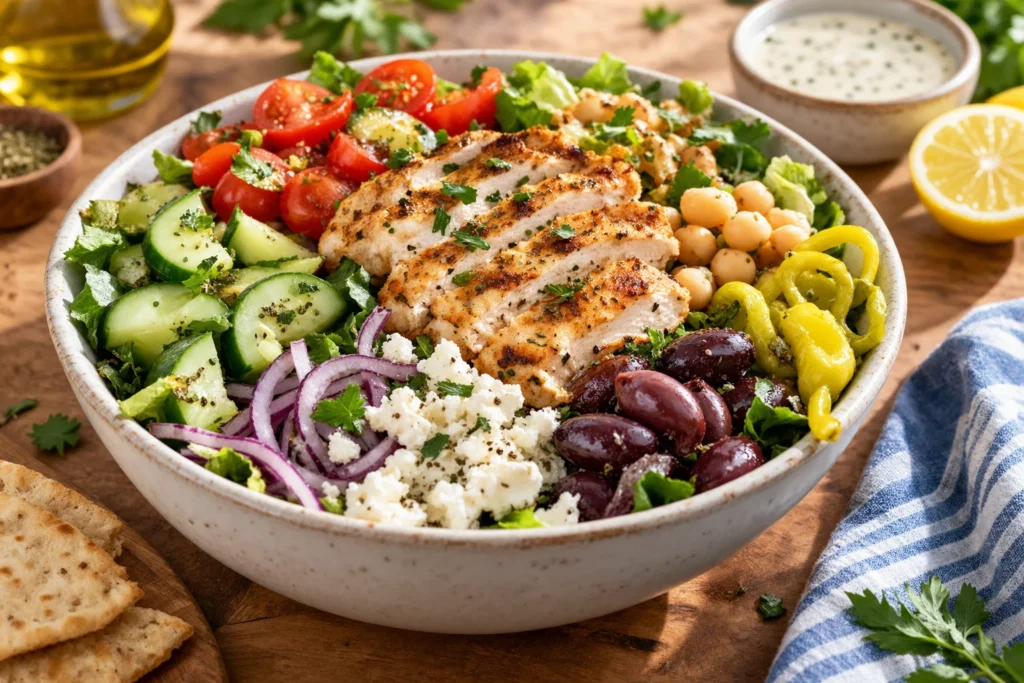
The USDA's chicken chart lists boneless breast halves of about 4 ounces at 6 to 8 minutes per side on a grill, and a thermometer should read 165°F in the thickest part. To use that timing, cut 1.5 pounds of chicken breast into six 4-ounce cutlets, marinate them in lemon juice, oregano, garlic, and olive oil, and grill until done. Slice the chicken over chopped romaine with tomato, cucumber, red onion, olives, and a cup of crumbled feta, and keep the lemon-oregano dressing in a small jar. Assembled this way, a bowl holds up for the next day or two without turning soggy.
The nutrition: Each bowl comes to about 42g of protein, almost all of it from the chicken and the feta.
Buying feta in a block and crumbling it yourself usually costs less than buying crumbles. Cook a double batch of the chicken if you like, since plain cooked cutlets can go in the freezer for Thursday. Keep the lettuce in a separate bag until lunch so the bowl doesn't wilt.
Chicken Cucumber Tomato Salad Plate
How long should chicken poach? Published methods put medium breasts at about 12 to 15 minutes, while the USDA's chart lists 25 to 30 minutes for 4-ounce boneless halves simmered, so the thermometer, not the clock, decides when the chicken is done at 165°F. Simmer 1.25 pounds of breasts gently, cool and shred them, and toss with cucumber, tomato, and a dressing of half a cup of Greek yogurt, lemon, and dill. Four hard-cooked eggs, halved and set on top, add protein and finish the plate.
Because this plate is built like a chicken salad, it falls under the 3 to 4 day salad rule, so eat it by Wednesday at the latest. Hard-cooked eggs themselves keep up to a week, per the FDA, but once they're mixed into a salad the shorter clock applies. Keep the cucumber and tomato in a separate container if you want a plate that stays crisp.
The nutrition: A plate gives you about 40g of protein, with the chicken, the yogurt dressing, and the eggs each contributing.
Grilled Chicken Romaine Salad Plate
The most common mistake with a chicken salad lunch is dressing it too early. Romaine is sturdy, but it still goes limp after a few hours with dressing on it, so pack the dressing separately and pour it on at your desk. Grill 1.25 pounds of chicken breast cut into 4-ounce cutlets for about 6 to 8 minutes a side to 165°F, slice, and lay it over romaine with shredded carrot and cherry tomatoes. A quarter cup of grated Parmesan and a dressing made from a quarter cup of plain yogurt with lemon, and garlic keep it creamy without much fat.
Why this works: Greek yogurt in the dressing adds protein and clings to the leaves, so you need less dressing than you would with a bottled one.
The nutrition: You get about 34g of protein per plate, split between the chicken, the Parmesan, and the yogurt in the dressing.
Let the cutlets rest for a few minutes before slicing so the juices stay in the meat. Slice against the grain for tenderness, and pack the slices in a flat layer so they chill faster. A double batch of cutlets freezes well for Thursday, which takes pressure off the end of the week.
Roasted Chicken and Greens Bowl
A 4-pound chicken is the cheapest way to get several bowls from one cook. FoodSafety.gov lists a whole chicken of 3 to 4 pounds at 350°F for about 1.25 to 1.5 hours, until a thermometer reads 165°F in the innermost part of the thigh and wing and the thickest part of the breast. Rub the bird with olive oil, salt, pepper, and thyme, roast it, rest it for 15 minutes, and carve it. Because bones make the weight hard to estimate, the protein below is for a 5-ounce portion of cooked meat.
Slice the breast and thigh meat over a bed of arugula and spinach with a lemon and olive oil vinaigrette, shaved Parmesan if you like, and sliced pears or apple for contrast. A store-bought rotisserie chicken works the same way, and the USDA says it should be refrigerated within 2 hours and eaten within 3 to 4 days. Pull the meat off the bones soon after cooking so it chills faster.
The nutrition: A 5-ounce portion of cooked chicken carries about 41g of protein, going by USDA data for roasted chicken meat.
Mediterranean Grilled Chicken Plate
Swap the rice for an olive salad and this plate becomes a different lunch. Grill a pound and a half of chicken breast in 4-ounce cutlets until they read 165°F, slice them, and arrange them with chopped olives, tomato, cucumber, and red onion dressed in olive oil and red wine vinegar. Add three-quarters of a cup of feta and half a cup of hummus for a creamy side. The olive salad can be made a day ahead, because the vinegar keeps it bright.
The nutrition: Expect about 43g of protein per plate, with the chicken supplying most of it and the feta and hummus adding the rest.
Warm pita is optional, but it adds fullness to a plate that is mostly protein and vegetables. Keep the chicken and the hummus cold until lunch, because both are perishable. Pack the olive salad in its own container so its vinegar doesn't soften the chicken.
Greek Chicken Feta Plate
Twenty to thirty minutes in a 350°F oven is what the USDA's chart lists for boneless breast halves of about 4 ounces, which makes this the easiest plate of the week if you'd rather not grill. Coat 1.5 pounds of chicken in lemon, oregano, and olive oil, bake until the thickest part reads 165°F, and slice. Serve over greens with one cup of feta, crumbled and a tzatziki made from 0.5 cup of Greek yogurt, grated cucumber, and garlic.
Why this works: Baking the cutlets at a moderate temperature cooks them evenly, which keeps lean breast from drying at the edges before the center is done.
Lean breast dries out quickly once it passes 165°F, so pull the pan as soon as the thermometer reads that number. Rest the chicken for a few minutes before slicing, which keeps more of the juice in the meat. Cooked breast that's cooled promptly keeps 3 to 4 days in the refrigerator, per the USDA, so this plate can be built on Sunday for Monday.
The nutrition: This plate delivers about 45g of protein from the chicken, the feta, and the tzatziki.
Don't Miss the Next Recipe
Get fresh recipes, meal prep systems, and high-protein meal ideas delivered to your inbox every week.
No spam. Unsubscribe anytime.
Tuesday: Fish and Tuna Bowls
The myth: tuna salad and cooked fish keep as long as chicken does. The current USDA chart gives cooked fish 3 to 4 days and chicken, tuna, and egg salads 3 to 4 days as well, while older charts say 3 to 5 days for salads, so the shorter number is the safer one to plan around. Fish has a stronger smell when it's reheated, which is why these bowls are served cold and eaten early in the week. Cook fish as late as you can on Sunday, and let it chill quickly in a shallow container before it goes in the refrigerator.
Tuna comes with its own limit. The FDA and EPA list canned light tuna as a "Best Choice" at 2 to 3 servings a week, using a 4-ounce serving, and albacore as a "Good Choice" at 1 serving a week. A single recipe here can use up one or two of those servings, so count the week and not the bowl.
Salmon Quinoa Plate
Salmon is the first food on this list that comes with a stopwatch. The Alaska Seafood Marketing Institute's rule is about 10 minutes per inch of thickness in a 400°F oven, so a 1-inch fillet is done in around 10 minutes, and the USDA's safe minimum is 145°F. Bake 1.5 pounds of salmon, chill it, and flake it over 3 cups of cooked quinoa with cucumber, scallions, and a dressing of lemon juice, olive oil, and dill. Quinoa follows the standard 1 part quinoa to 2 parts water ratio and simmers covered for 15 to 20 minutes.
America's Test Kitchen reports that many cooks prefer salmon cooked below the USDA's 145°F, but this recipe uses the USDA number. If you have pregnant guests, young children, or anyone with a weakened immune system, the lower temperature isn't a good idea. For more fish ideas, see our omega-3 rich dinners.
The nutrition: Each plate holds about 41g of protein, with the salmon (weighed raw) supplying most of it and the quinoa contributing the rest.
Why this works: Flaking cold salmon over quinoa keeps the fish moist, and the lemon dressing cuts through its richness.
Pesto Salmon Quinoa Plate
Fold a few tablespoons of basil pesto through the quinoa before you add the fish, because that way the pesto coats the grains and the salmon stays clean on top. Bake 1.25 pounds of salmon at 400°F for about 10 minutes per inch of thickness until it reaches 145°F, then flake it on three cups of cooked quinoa and add a cup of cooked shelled edamame. Cherry tomatoes, cut in half, and a squeeze of lemon finish the plate. Edamame raises the protein without adding another animal protein to the week.
The nutrition: The salmon, quinoa, and edamame together give about 40g of protein per plate.
Why this works: Pesto adds fat and flavor to quinoa, which is otherwise mild, so the plate tastes richer than the ingredient list suggests.
Packing the pesto quinoa and the salmon in separate containers makes lunch easier. You can warm the quinoa without warming the fish, and the salmon stays cold and firm. If you'd rather eat the whole plate cold, that works too, since everything in it is already cooked.
Salmon Chickpea Salad Plate
Chickpeas and salmon are a better match than you'd expect, since the chickpeas bring body and the salmon brings richness. Bake a pound of salmon at 400°F, about 10 minutes per inch, to 145°F, cool it, and flake it into two rinsed cans of chickpeas with lemon, red onion, parsley, and half about a cup of feta crumbles. The mixture is a cold salad, so the 3 to 4 day salad rule applies and it's best eaten on Tuesday or Wednesday.
Rinse and drain the chickpeas well, because the canning liquid dilutes the dressing. A drained 15-ounce can of chickpeas holds about 18 grams of protein by USDA data. Serve it over greens or with a slice of whole-grain bread.
The nutrition: One plate comes to about 35g of protein, from the salmon, the two cans of chickpeas, and the feta.
Tuna Spinach Tomato Plate
Canned tuna is already cooked, which makes this the quickest plate in the week. Drain four 5-ounce cans of light tuna and a can of white beans, then toss with baby spinach, cherry tomatoes cut in half, olive oil, and lemon juice. The white beans add about 18 grams of protein across the batch and make the tuna go further. Light tuna has less mercury than albacore, so it's the better choice if you eat tuna more than once a week.
Why this works: White beans stretch the tuna and add fiber, so the same four cans make a fuller plate.
The nutrition: Each plate provides about 26g of protein, nearly all of it from the tuna and the white beans.
If you plan to eat tuna again on Friday, remember the FDA's 2 to 3 servings a week for canned light tuna, with a 4-ounce serving. Four cans make four servings here, so you'd be at your limit with one more tuna meal. Keep the plate cold and eat it within 3 to 4 days.
Wednesday: The Last Fridge Day for Cooked Chicken
The myth: warm is hot enough when you reheat leftovers. The USDA says cooked leftovers should be reheated to 165°F, and a microwave heats unevenly, so cover the food, stir it, and rotate the dish partway through. Rice has its own rule, since cooked rice shouldn't sit out and should be refrigerated within about an hour, according to university extension guidance. Wednesday is the last comfortable day for fridge-stored cooked chicken, so these five bowls are the ones that reheat well.
Each of them uses a grain base that holds moisture through reheating. Cool the rice or quinoa quickly in a shallow container and refrigerate it within an hour of cooking. When you reheat, check the center of the bowl with a thermometer.
Grilled Chicken and Rice Plate
Cook 1.5 cups of dry long-grain rice with 3 cups of water, covered, for about 18 minutes, then spread it on a sheet pan to cool quickly. Grill 24 ounces of chicken breast cut into 4-ounce cutlets for 6 to 8 minutes on each side until they reach 165°F, and slice. Divide the rice among four containers, top with the chicken and a spoonful of roasted vegetables, and add a sauce of your choice on the side.
The nutrition: The chicken and rice together give about 41g of protein per plate.
The rice is the riskiest part of this plate, so refrigerate the containers within an hour of cooking. Reheat the whole plate until the center reads 165°F, stirring partway through. A splash of water over the rice before covering the container keeps it from drying out in the microwave.
Chicken Thigh and Broccoli Bowl
The USDA lists chicken legs or thighs of 4 to 8 ounces at 350°F for 40 to 50 minutes, so bone-in thighs need longer than breast cutlets. Roast 4 to 6 thighs with garlic powder, paprika, and oil until a thermometer reads 165°F near the bone. Meanwhile, roast broccoli florets at 425°F, since extension charts list crucifers at 15 to 25 minutes at that temperature, and serve both over a cup of rice per bowl.
Thighs reheat better than breasts because they stay moister, which is why they suit a Wednesday lunch. Dark meat is often cooked a little past 165°F for a softer texture, though 165°F is the USDA's safe minimum. Pull the meat from the bones after roasting, because the pieces cool faster and the bones stay out of your lunch.
Why this works: Bone-in thighs release fat and juice as they roast, which keeps the meat tender even after reheating.
The nutrition: A bowl made with a 5-ounce portion of cooked thigh meat and a cup of rice comes to about 39g of protein.
Grilled Chicken Quinoa Plate
Roasted vegetables give this plate its character. Extension charts list root vegetables such as carrots and sweet potatoes at 30 to 45 minutes at 425°F, so cut them into even pieces and roast them while the grill heats. Grill 1.5 pounds of chicken breast in 4-ounce cutlets, 6 to 8 minutes for each side, to 165°F, then serve over 3 cups of cooked quinoa with the vegetables and a lemon-tahini or yogurt sauce.
The nutrition: Chicken and quinoa together provide about 43g of protein per plate, with the roasted vegetables left uncounted.
Make the sauce on Sunday and keep it in a separate jar, because it ages like the other cooked foods and shouldn't sit out. The quinoa reheats without drying if you add a splash of water before covering the container. Roast a few extra vegetables, since they taste good cold in a salad later in the week.
Chicken and Chickpea Bowl
The chickpeas go on the sheet pan with the chicken, and they pick up the chicken's drippings as it roasts. Toss bone-in thighs with red onion, smoked paprika, and oil on a sheet pan at 350°F, and roast for 40 to 50 minutes, adding 2 cans of chickpeas, rinsed for the last 20 minutes. The thighs are done at 165°F near the bone. Serve with a quarter cup of garlic-yogurt sauce per bowl.
Why this works: Chickpeas added late roast in the chicken's drippings without drying out, which gives the bowl its flavor.
The nutrition: Expect about 50g of protein, roughly 35g of it from a 5-ounce portion of thigh meat and the rest from the chickpeas and the yogurt sauce.
This bowl has the highest protein count in the plan, and it reheats well on Wednesday. Because it's built on a sheet pan, cleanup is one pan and a bowl. For another low-effort pan idea, our one-pot dinners with real protein work the same way.
Grilled Chicken Pineapple Plate
Sweet potatoes roast alongside the pineapple and give this plate its sweet and savory balance. Cube two sweet potatoes and roast them at 425°F for 30 to 45 minutes, the range extension charts give for root vegetables. Grill 1.5 pounds of skinless chicken breast cutlets, roughly 6 to 8 minutes per turn, to 165°F, grill pineapple slices for a few minutes until they mark, and serve over 4 cups of cooked rice divided among four containers.
Keep the pineapple in a separate container if you can, because its juice makes rice soggy. Reheat everything except the pineapple, and add it back cold so it keeps its bite. Sweet potatoes hold up well to reheating, so the plate tastes much the same afterward.
The nutrition: The plate gives about 41g of protein, mostly from the chicken with a little from the rice.
Thursday: Bowls From the Freezer
The myth: frozen meal prep is unsafe or ruined by the freezer. FoodSafety.gov says food kept continuously at 0°F is safe indefinitely, and the storage times it publishes are about quality only, with cooked meat and poultry leftovers keeping their best texture for 2 to 6 months. The USDA lists refrigerator thawing as one of the safe ways to thaw food, so move a frozen portion to the refrigerator on Wednesday night. Mixed chicken, tuna, and egg salads are the exception, because the same chart says they don't freeze well.
These five bowls are built from cooked meats and grains, which do freeze well. Freeze them in single portions in containers you can reheat in, and label each with the date. Reheat to 165°F, covered and stirred.
Pulled Pork and Rice Plate
A Mississippi State University Extension recipe cooks pork shoulder in a slow cooker for 8 hours on low or 4 to 5 hours on high, and calls the pork ready at 145°F, though shredding usually takes longer. Rub a 2-pound boneless shoulder with smoked paprika, garlic powder, and salt, set it over a sliced onion with half a cup of broth, and cook on low until it pulls apart. Shred it, stir in a little barbecue sauce, and divide it over 4 cups of cooked rice, with coleslaw mix on the side for crunch.
The nutrition: Pulled pork over rice comes to about 41g of protein per plate, using USDA data for cooked pork shoulder.
Pork shoulder is among the cheaper cuts at the meat counter, which fits the thinking in our cheap high-protein dinners to feed six. A 2-pound shoulder makes four generous bowls with room to spare. Freeze the shredded pork flat in a zip-top bag in single portions so it thaws quickly.
Why this works: Long, low cooking breaks down the connective tissue in pork shoulder, which is what lets it shred.
Shredded Chicken Bowl
The slow cooker does the work here. Put 1.5 pounds of boneless chicken breasts, a cup of salsa, and a teaspoon of cumin in the cooker, and cook on high for 4 to 6 hours or on low for 6 to 8 until the chicken reads 165°F, then shred it. The USDA says to thaw chicken before it goes into a slow cooker, since frozen meat can stay in the danger zone too long. Divide the chicken over rice and black beans.
Freeze the shredded chicken flat in a zip-top bag, so it thaws quickly and evenly in the refrigerator. The beans and rice can go in the same container or a separate one. Label each portion with the date, because freezer times are about quality and a label keeps you from guessing.
The nutrition: This bowl provides about 44g of protein from the chicken, the black beans, and the rice.
Beef and Rice Bowl
Brown 1.5 pounds of 90% lean ground beef with onion and garlic until it reaches 160°F, the USDA's number for ground beef. Stir in soy sauce, a spoonful of brown sugar, and a pinch of ginger, and simmer for a few minutes so the sauce clings. Spoon it over 4 cups of cooked rice, add steamed broccoli or shredded carrot, and pack it into freezer containers. If you like skillet cooking, our high-protein skillet dinners have more.
Why this works: Browning the beef first builds flavor that a quick simmer in sauce can't create on its own.
The nutrition: Each bowl has about 38g of protein, from the cooked ground beef and the rice.
Ground beef freezes well once it's cooked, and it reheats quickly in a covered container. Cook it in a wide pan so it browns instead of steaming, and drain the fat before adding the sauce. Rice should go into the freezer in the same flat layer as the beef so both thaw at the same pace.
Chicken Shawarma Plate
Rub 1.5 pounds of boneless chicken breast with cumin, coriander, paprika, turmeric, garlic, and lemon, then roast it at 350°F for 20 to 30 minutes, the USDA's range for boneless halves of about 4 ounces, until it reads 165°F. Slice it thin and divide it over 3 cups of cooked rice with a sauce of 0.75 cup of Greek yogurt, lemon, and garlic. Add cucumber and tomato at lunch rather than freezing them.
The nutrition: A shawarma plate delivers about 45g of protein, from the chicken, the yogurt sauce, and the rice.
Freeze the sliced chicken and rice together, and keep the yogurt sauce in the refrigerator instead of the freezer. For a bigger plate, our 50g protein dinners show how to push the numbers higher. Add cucumber and tomato at lunch so they stay crisp.
Deconstructed Chicken Burrito Plate
Poach or grill 24 ounces of breast meat to 165°F, slice or shred it, and pile it across 3 cups of cooked rice with a can of pinto beans, pico de gallo, and half a cup of shredded cheddar. Dropping the tortilla doesn't cost you any protein, since the chicken and beans supply nearly all of it. Season the chicken with cumin, chili powder, and lime before it goes in the container.
Freeze the chicken, rice, and beans together, and add the pico and the cheese after reheating. Fresh toppings keep the plate from tasting like a leftover. Label the container with the date so you know when it has reached the end of its best-quality window.
Why this works: Skipping the tortilla keeps every bite loaded with chicken and beans, and the rice does the job of the wrap.
The nutrition: The burrito plate comes to about 48g of protein, with the chicken, pinto beans, cheddar, and rice all contributing.
Friday: Pantry Bowls
The myth: a lunch bowl without cooked meat can't have real protein. A drained 15-ounce can of beans holds roughly 15 to 20 grams of protein by USDA data, depending on the bean, and chickpeas land near 18 grams, so a pantry bowl with beans, cheese, and a second source easily reaches 20 grams or more. The seven bowls below range from about 18 to 26 grams per serving. The bigger advantage is that unopened cans and jars have no 3 to 4 day clock, so Friday's lunch doesn't depend on anything left over from Sunday.
Rinse canned beans to cut some of the sodium, and keep the dressing separate until you eat. Once a can is opened and the contents are mixed with fresh vegetables, treat the bowl like any other leftover and finish it within 3 to 4 days. Hummus and cheese go back in the refrigerator right away.
Mediterranean Chickpea Bowl
Two rinsed cans of chickpeas, diced cucumber, tomato, red onion, three-quarters of a cup of crumbled feta, and a dressing of half a cup of Greek yogurt blended with lemon juice, and oregano make the base of this bowl. Spoon it over 2 cups of cooked quinoa, which simmers for 15 to 20 minutes with 4 cups of water, or on top of a leafy base. This one needs no cooking beyond the quinoa, and the quinoa can be cooked early in the week and frozen in portions.
The nutrition: A chickpea bowl on quinoa gives about 20g of protein, with the chickpeas, feta, and yogurt dressing sharing the load.
If you want more protein, add a hard-cooked egg or a few ounces of leftover chicken. Keep the dressing in a separate jar and add it at lunch. Cook the quinoa ahead and keep it in the refrigerator within the 3 to 4 day window.
Greek Chickpea and Olive Bowl
Briny olives and salty feta are what make chickpeas taste like more than a pantry staple. Combine two cans of rinsed chickpeas with a generous cup of feta, a cup of sliced olives, diced tomato, and red onion, then add a cup of cooked shelled edamame for extra protein. Dress with olive oil, red wine vinegar, and oregano, and serve over greens.
Frozen edamame cooks per the package in a few minutes and cools quickly under cold water. The bowl is meat-free, so it suits anyone at the table who doesn't eat chicken or fish. Keep the greens separate until lunch so the olives and vinegar don't wilt them.
The nutrition: Between the chickpeas, the feta, and the edamame, each bowl reaches about 19g of protein.
Chickpea Feta Pesto Bowl
Hard-cooked eggs are what move this bowl past the 15-gram mark. Stir two rinsed cans of chickpeas through three tablespoons of basil pesto, add sliced cucumber and three-quarters of one cup crumbled feta, and top with four halved hard-cooked eggs. The FDA says hard-cooked eggs should be used within a week, so a batch boiled on Sunday is still fine on Friday.
Why this works: Pesto coats the chickpeas, which are otherwise mild, and the eggs add protein without more cooking.
The nutrition: The chickpeas, feta, and eggs add up to about 19g of protein per bowl.
Cool the eggs in cold water right after boiling and refrigerate them in their shells until you need them. Peel them just before assembling so they stay moist and the shells don't end up in the bowl. If your eggs have been in the refrigerator longer than a week, replace them.
Tuna White Bean Bowl
Two pantry staples carry this bowl, and neither needs a stove. Drain three 5-ounce cans of light tuna and two cans of white beans, then toss gently with lemon juice, olive oil, parsley, and a handful of arugula. The FDA and EPA suggest 2 to 3 servings a week of canned light tuna, so if you ate the Tuesday tuna plate, treat this as the second or third serving of the week.
The nutrition: Tuna and white beans give about 26g of protein per bowl.
Why this works: Beans and tuna bring different textures, soft and flaky, so a two-ingredient bowl doesn't feel plain.
If you're eating tuna several times a week, switch one of those meals to a chickpea bowl. Albacore is a "Good Choice" at only 1 serving a week, so stick with light tuna for these bowls. Rinse the white beans well so the dressing doesn't turn cloudy.
Mediterranean Veggie Grain Bowl
This is the lightest bowl in the plan. Layer 3 cups cooked quinoa with a cup of hummus, a can of chickpeas, half a cup of crumbled feta, and chopped cucumber, tomato, and olives. Hummus adds flavor and body, but at about 8 grams of protein per 100 grams it's modest, so the chickpeas and feta contribute more than the hummus does.
Add a hard-cooked egg or a scoop of cottage cheese if you want the bowl to reach 25 grams. Cut the vegetables small enough to fit on a fork. Keep the hummus in a separate container until lunch so the quinoa doesn't absorb it.
The nutrition: This is the lightest bowl in the plan, at about 18g of protein from the quinoa, hummus, chickpeas, and feta.
Collard, Beans and Couscous Plate
Remove the stems from a bunch of collard greens, slice the leaves into thin ribbons, and cook them covered with garlic and chile flakes. Published recipes put young collards at about 10 to 15 minutes, and Purdue Extension notes that mature leaves can take much longer, so taste them to check. Stir in two cans of white beans, and spoon over 3 cups of couscous, which cooks in about 5 minutes per the package. Finish with a quarter cup of shaved Parmesan and 4 fried eggs, cooked until the yolks are firm.
Why this works: Thin ribbons cook through quickly, and the beans soak up the garlic, which makes the plate taste like more than its parts.
The FDA says eggs should be cooked until the yolk and white are firm, and dishes with eggs should reach 160°F. Serve the plate hot, or cold without the eggs if you're packing it. Add the Parmesan at lunch so it doesn't clump in the container.
The nutrition: The beans, couscous, Parmesan, and fried eggs provide about 22g of protein per plate.
Turkey Hummus Protein Plate
Deli turkey is the one cooked meat on Friday's list, and the USDA says opened lunch meat keeps 3 to 5 days, so open the package no earlier than Tuesday. Arrange 12 ounces of sliced turkey with a cup of hummus, a cup and a half of cooked shelled edamame, cucumber, and a handful of greens. If anyone is pregnant, 65 or older, or has a weakened immune system, the CDC advises heating deli meat to steaming hot, 165°F, before eating it.
The nutrition: Turkey, hummus, and edamame together give about 24g of protein per plate.
Edamame, hummus, and greens work with or without the turkey, so you can swap in leftover roasted chicken from earlier in the week. Keep the hummus cold and the turkey in its original container until lunch. The plate needs no cooking, which makes it the fastest bowl in the plan.
Putting the Week Together
Here is the full plan in one place. Cook on Sunday, keep what's due early in the refrigerator, and freeze what's due late. The plan works even if you only make one bowl from each day.
- Monday: one of the six fresh-greens bowls, dressing packed separately.
- Tuesday: a fish or tuna bowl, served cold.
- Wednesday: a reheat-friendly grain bowl, heated to 165°F.
- Thursday: a frozen portion, thawed overnight in the refrigerator and reheated to 165°F.
- Friday: a pantry bowl, built fresh from cans and the refrigerator.
Many people cook one chicken batch and one grain on Sunday, a second batch of pork or beef for the freezer, and leave Friday to the pantry. If your week looks different, shift the days but keep the order: the foods with the shortest clocks come first, the freezer covers the middle, and the pantry covers the end. The one rule that doesn't bend is the 3 to 4 day limit for cooked meat, poultry, and fish.
Never Miss a Recipe
Fresh high-protein recipes, meal prep ideas, and kitchen tips, straight to your inbox every week. No spam, just good food.
No spam. Unsubscribe anytime.
Carrying Bowls to Work
The USDA advises packing perishable food in an insulated bag with at least two cold sources, such as gel packs or frozen water bottles, and not letting perishable food sit out more than 2 hours. That rule applies at a desk as much as in a backpack, so a bowl that sits on a desk from 9 to noon needs to be in the refrigerator or a cooler. If your office has a refrigerator, use it and keep the dressings in a separate container.
When you reheat, cover the bowl, stir it partway through, and check that the center reaches 165°F, because microwaves leave cold spots in dense foods like rice and shredded meat. Bowls eaten cold, such as the salads and pantry bowls, should stay cold until you're ready to eat them. If you can't keep a bowl cold, pack something else.
How We Counted Protein
Protein is calculated from USDA nutrient data for the exact quantities on each recipe card, and each recipe makes four servings. Where a recipe uses chicken, we assumed that 75 percent of the raw weight remains after cooking, and for pulled pork we assumed 70 percent, since USDA data lists protein for cooked meat. For bone-in cuts, we state the protein for a 5-ounce portion of cooked meat, because the weight of the bones can't be estimated reliably. Salmon and tuna are measured as raw or drained, as listed on each card.
Vegetables, dressings, and sauces aren't counted unless they contain a meaningful amount of protein, such as Greek yogurt or hummus. Beans use USDA values for drained canned beans. These numbers are close approximations, not lab measurements, and they'll vary with the brand and how you portion the bowl.
Questions About Lunch Bowl Meal Prep
How long does cooked chicken last for meal prep?
Cooked meat and poultry leftovers keep 3 to 4 days in a refrigerator at 40°F or below, according to the USDA. A batch cooked on Sunday is therefore at its limit by Wednesday or Thursday. For anything beyond that, freeze it in single portions.
Can I freeze lunch bowls?
Yes, if they're built from cooked meats and grains. Food kept frozen at 0°F is safe indefinitely, and the freezer times published by FoodSafety.gov are about quality. Chicken, tuna, and egg salads don't freeze well, so leave those in the refrigerator plan.
How long do tuna and chicken salads keep?
The current FoodSafety.gov chart lists chicken, tuna, and egg salads at 3 to 4 days. Some older charts, including an FDA version, list 3 to 5 days. This article plans around the shorter number, since it's the more cautious one.
How hot should I reheat a bowl?
Reheat leftovers to 165°F in the center, per the USDA. Cover the bowl, stir it partway through, and rotate it in the microwave so the heat spreads evenly. Check dense foods like rice and shredded meat with a thermometer, since those hold cold spots.
How should I handle cooked rice?
Refrigerate cooked rice within about an hour of cooking, according to university extension guidance. Spread it in a shallow container so it cools quickly instead of staying warm in the middle. Reheat it until it's steaming hot before you eat it.
Which bowls have the most protein?
The chicken and chickpea bowl leads at about 50g, followed by the deconstructed burrito plate at about 48g. The Greek chicken feta plate and the chicken shawarma plate each reach about 45g. The lightest bowls, built on beans and hummus, run from about 18 to 26g.
How much canned tuna is safe to eat?
The FDA and EPA recommend 2 to 3 servings a week of canned light tuna, using a 4-ounce serving. Albacore is a "Good Choice" at 1 serving a week. Count the whole week, since a single recipe here can use more than one serving.
Are pantry bowls high enough in protein?
Yes. A drained can of beans holds about 15 to 20 grams of protein by USDA data. The Friday bowls range from about 18 to 26 grams per serving when you add feta, eggs, edamame, or tuna. Unopened cans also have no 3 to 4 day clock, which is why Friday relies on them.
1. Greek Chicken Salad Bowl
Approx. 42g ProteinIngredients: 1 1/2 lb boneless skinless chicken breasts (cut into six 4-oz cutlets), 1 tbsp olive oil, juice of 1 lemon, 1 tsp oregano, 2 cloves garlic, 6 cups chopped romaine, 2 tomatoes, 1 cucumber, 1/2 red onion, 1/2 cup olives, 1 cup crumbled feta. Dressing: 3 tbsp olive oil, juice of 1 lemon, 1 tsp oregano.
Step 1: Marinate the cutlets in the oil, lemon, oregano, and garlic. Grill 6 to 8 minutes per side until a thermometer reads 165°F.
Step 2: Slice the chicken and chill it. Whisk the dressing and keep it in a separate jar.
Step 3: Divide the romaine, vegetables, olives, feta, and chicken among four containers.
2. Chicken Cucumber Tomato Salad Plate
Approx. 40g ProteinIngredients: 1 1/4 lb boneless skinless chicken breasts, 1 cucumber, 2 tomatoes, 4 hard-cooked eggs (halved). Dressing: 1/2 cup plain Greek yogurt, juice of 1 lemon, 1 tbsp dill.
Step 1: Simmer the chicken gently until a thermometer reads 165°F (published poaching methods say about 12 to 15 minutes; the USDA chart lists 25 to 30 minutes for 4-oz halves, so go by the thermometer).
Step 2: Cool and shred the chicken. Stir the dressing.
Step 3: Toss the chicken with the dressing and divide among four containers with the cucumber, tomato, and eggs. Eat within 3 to 4 days.
3. Grilled Chicken Romaine Salad Plate
Approx. 34g ProteinIngredients: 1 1/4 lb boneless skinless chicken breasts (cut into 4-oz cutlets), 1 tbsp oil, salt and pepper, 6 cups romaine, 1 carrot (shredded), 1 cup cherry tomatoes, 1/4 cup grated Parmesan. Dressing: 1/4 cup plain Greek yogurt, juice of 1/2 lemon, 1 clove garlic.
Step 1: Grill the cutlets about 6 to 8 minutes a side until a thermometer reads 165°F. Rest, then slice against the grain.
Step 2: Whisk the dressing and keep it separate.
Step 3: Divide the romaine, carrot, tomatoes, Parmesan, and chicken among four containers.
4. Roasted Chicken and Greens Bowl
Approx. 41g ProteinIngredients: One 4 lb whole chicken, 2 tbsp olive oil, 2 tsp kosher salt, 1 tsp pepper, 1 tbsp thyme, 6 cups arugula and spinach, 1 pear (sliced). Vinaigrette: 3 tbsp olive oil, 2 tbsp lemon juice, 1 tsp Dijon mustard.
Step 1: Preheat the oven to 350°F. Rub the chicken with the oil, salt, pepper, and thyme and roast 1 1/4 to 1 1/2 hours until a thermometer reads 165°F in the innermost thigh and wing and the thickest breast.
Step 2: Rest 15 minutes, carve, and chill the meat promptly.
Step 3: Serve 5 oz of cooked meat per bowl over the greens and pear with the vinaigrette.
5. Mediterranean Grilled Chicken Plate
Approx. 43g ProteinIngredients: 1 1/2 lb boneless skinless chicken breasts (4-oz cutlets), 1 tbsp oil, 1 tsp salt, 3/4 cup crumbled feta, 1/2 cup hummus. Olive salad: 1/2 cup chopped olives, 1 tomato, 1 cucumber, 1/4 red onion, 2 tbsp olive oil, 1 tbsp red wine vinegar.
Step 1: Grill the cutlets 6 to 8 minutes per side to 165°F and slice.
Step 2: Mix the olive salad ingredients.
Step 3: Arrange the chicken, olive salad, feta, and hummus on four plates.
6. Greek Chicken Feta Plate
Approx. 45g ProteinIngredients: 1 1/2 lb boneless skinless chicken breasts (4-oz halves), 2 tbsp olive oil, juice of 1 lemon, 1 tsp oregano, 1 cup crumbled feta, 6 cups greens. Tzatziki: 1/2 cup plain Greek yogurt, 1/2 cucumber (grated), 1 clove garlic.
Step 1: Preheat the oven to 350°F. Coat the chicken in the oil, lemon, and oregano and bake 20 to 30 minutes until the thickest part reads 165°F.
Step 2: Mix the tzatziki.
Step 3: Slice the chicken and serve over greens with the feta and tzatziki.
7. Salmon Quinoa Plate
Approx. 41g ProteinIngredients: 1 1/2 lb salmon fillets (about 1 inch thick), 1 tbsp olive oil, 1 cup dry quinoa (3 cups cooked), 2 cups water, 1 cucumber, 3 scallions. Dressing: 3 tbsp olive oil, juice of 1 lemon, 1 tbsp dill.
Step 1: Simmer the quinoa covered in the water 15 to 20 minutes. Cool.
Step 2: Brush the salmon with the oil and bake at 400°F about 10 minutes per inch of thickness until it reaches 145°F. Chill and flake.
Step 3: Serve the salmon over the quinoa with the cucumber, scallions, and dressing.
8. Pesto Salmon Quinoa Plate
Approx. 40g ProteinIngredients: 1 1/4 lb salmon fillets, 1 tbsp oil, 1 cup dry quinoa (3 cups cooked), 2 cups water, 3 tbsp basil pesto, 1 cup cooked shelled edamame, 1 cup cherry tomatoes (halved), lemon.
Step 1: Cook the quinoa as above and stir in the pesto.
Step 2: Bake the salmon at 400°F about 10 minutes per inch of thickness to 145°F, chill, and flake.
Step 3: Divide the quinoa, edamame, tomatoes, and salmon among four containers and finish with lemon.
9. Salmon Chickpea Salad Plate
Approx. 35g ProteinIngredients: 1 lb salmon fillets, 1 tbsp oil, two 15-oz cans chickpeas (rinsed), 1/2 cup crumbled feta, 1/4 red onion, 1/4 cup chopped parsley, juice of 1 lemon, 2 tbsp olive oil.
Step 1: Bake the salmon at 400°F about 10 minutes per inch of thickness to 145°F and cool.
Step 2: Flake it into the chickpeas with the feta, onion, parsley, lemon juice, and oil.
Step 3: Keep cold and eat within 3 to 4 days.
10. Tuna Spinach Tomato Plate
Approx. 26g ProteinIngredients: Four 5-oz cans light tuna (drained), one 15-oz can white beans (drained), 5 oz baby spinach, 1 cup cherry tomatoes (halved), 3 tbsp olive oil, juice of 1 lemon.
Step 1: Toss the tuna and beans with the olive oil and lemon juice.
Step 2: Divide the spinach and tomatoes among four containers and top with the tuna mixture.
Step 3: Keep cold and eat within 3 to 4 days.
11. Grilled Chicken and Rice Plate
Approx. 41g ProteinIngredients: 1 1/2 lb boneless skinless chicken breasts (4-oz cutlets), 1 tbsp oil, 1 1/2 cups dry long-grain rice, 3 cups water, roasted vegetables.
Step 1: Simmer the rice covered in the water about 18 minutes and spread it on a sheet pan to cool; refrigerate within an hour.
Step 2: Grill the cutlets about 6 to 8 minutes a side to 165°F and slice.
Step 3: Divide the rice, chicken, and vegetables among four containers. Reheat to 165°F.
12. Chicken Thigh and Broccoli Bowl
Approx. 39g ProteinIngredients: 4 to 6 bone-in chicken thighs (4 to 8 oz each), 1 tbsp oil, 1 tsp garlic powder, 1 tsp paprika, 4 cups broccoli florets, 4 cups cooked rice.
Step 1: Preheat the oven to 350°F. Roast the thighs with the oil and seasonings 40 to 50 minutes until a thermometer reads 165°F near the bone.
Step 2: Roast the broccoli at 425°F for 15 to 25 minutes.
Step 3: Serve 5 oz of cooked meat per bowl with a cup of rice and the broccoli.
13. Grilled Chicken Quinoa Plate
Approx. 43g ProteinIngredients: 1 1/2 lb boneless skinless chicken breasts (4-oz cutlets), 1 tbsp oil, 1 cup dry quinoa (3 cups cooked), 2 cups water, 1 lb carrots and sweet potatoes (cut evenly). Sauce: 1/4 cup tahini or yogurt, juice of 1 lemon.
Step 1: Roast the vegetables at 425°F for 30 to 45 minutes while the quinoa simmers covered 15 to 20 minutes.
Step 2: Grill the cutlets 6 to 8 minutes on each side to 165°F and slice.
Step 3: Divide the quinoa, vegetables, and chicken among four containers and keep the sauce separate.
14. Chicken and Chickpea Bowl
Approx. 50g ProteinIngredients: 4 bone-in chicken thighs (4 to 8 oz each), 1 red onion (wedges), 1 tbsp smoked paprika, 2 tbsp oil, two 15-oz cans chickpeas (rinsed). Sauce: 1 cup plain Greek yogurt, juice of 1 lemon, chopped herbs.
Step 1: Preheat the oven to 350°F. Toss the thighs and onion with the paprika and oil on a sheet pan.
Step 2: Roast 40 to 50 minutes, adding the chickpeas for the last 20, until the chicken reads 165°F near the bone.
Step 3: Stir the sauce and serve 5 oz of cooked meat per bowl with half a can of chickpeas and 1/4 cup of sauce.
15. Grilled Chicken Pineapple Plate
Approx. 41g ProteinIngredients: 1 1/2 lb boneless skinless chicken breasts (4-oz cutlets), 1 tbsp oil, 2 sweet potatoes (cubed), 4 pineapple slices, 4 cups cooked rice.
Step 1: Roast the sweet potatoes at 425°F for 30 to 45 minutes.
Step 2: Grill the cutlets 6 to 8 minutes per side to 165°F and grill the pineapple a few minutes until marked.
Step 3: Divide the rice, chicken, and sweet potatoes among four containers and keep the pineapple separate.
16. Pulled Pork and Rice Plate
Approx. 41g ProteinIngredients: 2 lb boneless pork shoulder, 1 tbsp smoked paprika, 2 tsp garlic powder, 1 tsp salt, 1 onion (sliced), 1/2 cup broth, 1/4 cup barbecue sauce, 4 cups cooked rice, coleslaw mix.
Step 1: Rub the pork with the paprika, garlic powder, and salt and set it over the onion in a slow cooker with the broth.
Step 2: Cook on low about 8 hours (or high 4 to 5) until it reaches 145°F and shreds easily.
Step 3: Shred, stir in the sauce, and divide over the rice with the slaw.
17. Shredded Chicken Bowl
Approx. 44g ProteinIngredients: 1 1/2 lb boneless skinless chicken breasts (thawed), 1 cup salsa, 1 tsp cumin, one 15-oz can black beans (drained), 3 cups cooked rice.
Step 1: Put the chicken, salsa, and cumin in a slow cooker.
Step 2: Cook on high 4 to 6 hours or low 6 to 8 until the chicken reads 165°F, then shred.
Step 3: Divide over the rice and beans.
18. Beef and Rice Bowl
Approx. 38g ProteinIngredients: 1 1/2 lb 90 percent lean ground beef, 1 onion, 2 cloves garlic, 3 tbsp soy sauce, 1 tbsp brown sugar, 1/2 tsp ginger, 4 cups cooked rice, broccoli or shredded carrot.
Step 1: Brown the beef with the onion and garlic until it reaches 160°F and drain the fat.
Step 2: Stir in the soy sauce, sugar, and ginger and simmer a few minutes.
Step 3: Spoon over the rice with the vegetable.
19. Chicken Shawarma Plate
Approx. 45g ProteinIngredients: 1 1/2 lb boneless skinless chicken breasts (4-oz halves), 1 tsp each cumin, coriander, paprika, and turmeric, 2 cloves garlic, juice of 1 lemon, 2 tbsp oil, 3 cups cooked rice. Sauce: 3/4 cup plain Greek yogurt, juice of 1 lemon, 1 clove garlic.
Step 1: Preheat the oven to 350°F. Rub the chicken with the spices, garlic, lemon, and oil.
Step 2: Roast 20 to 30 minutes until the thickest part reads 165°F and slice thin.
Step 3: Divide the chicken over the rice and serve with the sauce.
20. Deconstructed Chicken Burrito Plate
Approx. 48g ProteinIngredients: 1 1/2 lb boneless skinless chicken breasts, 1 tsp cumin, 1 tsp chili powder, juice of 1 lime, one 15-oz can pinto beans (drained), 3 cups cooked rice, 1/2 cup shredded cheddar, pico de gallo.
Step 1: Season the chicken and simmer or grill it until a thermometer reads 165°F, then slice or shred.
Step 2: Divide the rice, beans, and chicken among four containers.
Step 3: Add the cheddar and pico after reheating.
21. Mediterranean Chickpea Bowl
Approx. 20g ProteinIngredients: Two 15-oz cans chickpeas (rinsed), 1 cucumber, 2 tomatoes, 1/2 red onion, 3/4 cup crumbled feta, 2 cups cooked quinoa. Dressing: 1/2 cup plain Greek yogurt, juice of 1 lemon, 1 tsp oregano.
Step 1: Simmer the quinoa covered 15 to 20 minutes and cool.
Step 2: Mix the chickpeas, vegetables, and feta and whisk the dressing.
Step 3: Divide the quinoa and chickpea mixture among four containers and keep the dressing separate.
22. Greek Chickpea and Olive Bowl
Approx. 19g ProteinIngredients: Two 15-oz cans chickpeas (rinsed), 1 cup crumbled feta, 1 cup sliced olives, 1 tomato, 1/4 red onion, 1 cup cooked shelled edamame, 3 tbsp olive oil, 1 tbsp red wine vinegar, 1 tsp oregano.
Step 1: Cook the edamame per the package and cool.
Step 2: Combine the chickpeas, feta, olives, tomato, onion, and edamame.
Step 3: Dress with the oil, vinegar, and oregano and serve over greens.
23. Chickpea Feta Pesto Bowl
Approx. 19g ProteinIngredients: Two 15-oz cans chickpeas (rinsed), 3 tbsp basil pesto, 1 cucumber (sliced), 3/4 cup crumbled feta, 4 hard-cooked eggs (halved).
Step 1: Boil the eggs 10 to 12 minutes, cool in cold water, and refrigerate in their shells.
Step 2: Stir the chickpeas through the pesto and add the cucumber and feta.
Step 3: Peel and halve the eggs and set on top.
24. Tuna White Bean Bowl
Approx. 26g ProteinIngredients: Three 5-oz cans light tuna (drained), two 15-oz cans white beans (rinsed and drained), juice of 1 lemon, 3 tbsp olive oil, 1/4 cup parsley, 2 cups arugula.
Step 1: Toss the tuna and beans gently with the lemon juice, oil, and parsley.
Step 2: Serve over the arugula and keep cold.
25. Mediterranean Veggie Grain Bowl
Approx. 18g ProteinIngredients: 1 cup dry quinoa (3 cups cooked), 2 cups water, 1 cup hummus, one 15-oz can chickpeas (rinsed), 1/2 cup crumbled feta, 1 cucumber, 2 tomatoes, 1/2 cup olives.
Step 1: Simmer the quinoa covered 15 to 20 minutes and cool.
Step 2: Divide the quinoa among four containers.
Step 3: Top with the chickpeas, feta, vegetables, and olives and keep the hummus separate.
26. Collard, Beans and Couscous Plate
Approx. 22g ProteinIngredients: 1 bunch collard greens (stems removed, thin ribbons), 3 cloves garlic, 1/4 tsp chile flakes, 1/2 cup water, two 15-oz cans white beans (drained), 1 1/2 cups dry couscous (3 cups cooked), 1/4 cup shaved Parmesan, 4 large eggs.
Step 1: Cook the collards, garlic, chile flakes, and water covered 10 to 15 minutes (longer for mature leaves) until tender.
Step 2: Fold in the beans and warm through. Cook the couscous per the package.
Step 3: Fry the eggs until the yolks are firm and serve over the couscous with the greens and Parmesan.
27. Turkey Hummus Protein Plate
Approx. 24g ProteinIngredients: 12 oz sliced deli turkey, 1 cup hummus, 1 1/2 cups cooked shelled edamame, cucumber, greens.
Step 1: Cook the edamame per the package and cool.
Step 2: Arrange the turkey, hummus, edamame, cucumber, and greens on four plates.
Step 3: Keep cold; heat the turkey to 165°F first for anyone pregnant, 65 or older, or with a weakened immune system.
Get Fresh Recipes Every Week
Join readers getting fresh recipes, meal prep systems, and high-protein meal ideas delivered to your inbox every week.
No spam. Unsubscribe anytime.