
See all 25 recipes
Table of Contents
Every breakfast recipe has a hidden cost that never shows up in the ingredient list, and it's the stack of dishes waiting in the sink. A bowl of yogurt asks almost nothing of you, while a baked egg dish asks for a ramekin, a saucepan, a baking sheet, and a spoon. This article sorts 25 high-protein bowls and plates by how many dishes they leave behind: nine that use only a bowl or a blender, ten that need one pan, three that need two pots, and three that bake in a single dish. Each recipe lists its protein per serving, calculated from USDA nutrient data for the exact quantities on its card.
Eggs carry most of the protein in this list, and that comes with a rule worth knowing before you start. The FDA's egg safety guidance says to cook eggs until both the yolk and the white are firm, and to cook casseroles and other dishes that contain eggs to 160°F. Several popular breakfast plates, including poached eggs on polenta and soft eggs over potatoes, are normally served runny, so the recipes below are written with the firm-yolk version first and a note on what changes if you choose otherwise. You can read the agency's full guidance in its egg safety guide.
The rest of the protein comes from Greek yogurt and cottage cheese, which carry the no-cook bowls, and from a few foods that need a safety note of their own, such as bacon, smoked salmon, and cinnamon roll dough. The FDA says hard-cooked eggs keep up to a week, so a batch boiled on a quiet evening can cover several mornings. Where a recipe depends on a number or a time, we say where it comes from, and where two sources differ, we say that too. For a bigger protein target later in the day, our high-protein dinners with 30g of protein use the same math.
Cooking times and temperatures come from the FDA, the USDA, a major cancer center's published recipe, and university extension recipes. Protein numbers use USDA values for the exact amounts on each card, and we've been upfront wherever a number rests on an assumption or on a label we couldn't see. Nothing here replaces advice from a doctor or dietitian if you have a medical reason to watch your eggs, dairy, or sodium.
Our Take
The FDA advises cooking eggs until both the yolk and the white are firm, and cooking casseroles and other dishes that contain eggs to 160°F.
Pick Your Morning
Start with the question that matters most on a weekday: how much cleanup can you stand? If you want nothing hot and almost nothing to wash, begin with the first section, where every recipe is a bowl, a blender, or a pot of eggs boiled ahead of time. If you can spare one skillet, the second section holds ten plates that cook in a single pan. If it's a weekend and you're feeding other people, the last two sections cover recipes that bake in a dish or use two pots.
- Two minutes, no stove: the nine no-cook bowls and plates.
- One pan, ten minutes: omelets, scrambles, crepes, toast, and bowls.
- Two pots, a slower morning: polenta, potato puree, and an egg dip.
- One baking dish, feeds a table: baked eggs and two egg bakes.
One Bowl, No Stove
Nine recipes need only a bowl, a spoon, and in two cases a blender. Greek yogurt and cottage cheese do the heavy lifting, and one plate uses eggs you boiled ahead of time. They suit mornings when you want to eat within two minutes and wash almost nothing afterward.
Don't Miss the Next Recipe
Get fresh recipes, meal prep systems, and high-protein meal ideas delivered to your inbox every week.
No spam. Unsubscribe anytime.
Greek Yogurt Power Bowl
What turns a bowl of yogurt into breakfast is the amount. Spoon three-quarters of a cup of plain Greek yogurt into each bowl rather than the half cup that most single-serve cups hold, then add a few chopped pecans, a spoonful of roasted pumpkin seeds, and a handful of berries. Plain Greek yogurt holds about 10 grams of protein by USDA data, so a generous scoop does most of the work.
The nutrition: Each bowl delivers about 22g of protein, nearly all of it from the yogurt, with the pecans and pumpkin seeds adding a little more.
Buy plain yogurt in a large tub and sweeten it with fruit, which gives you control over the sugar. Granola is optional, and because brands vary so widely we haven't counted it. Add the toppings just before eating so the nuts stay crisp.
Smoothie Bowl
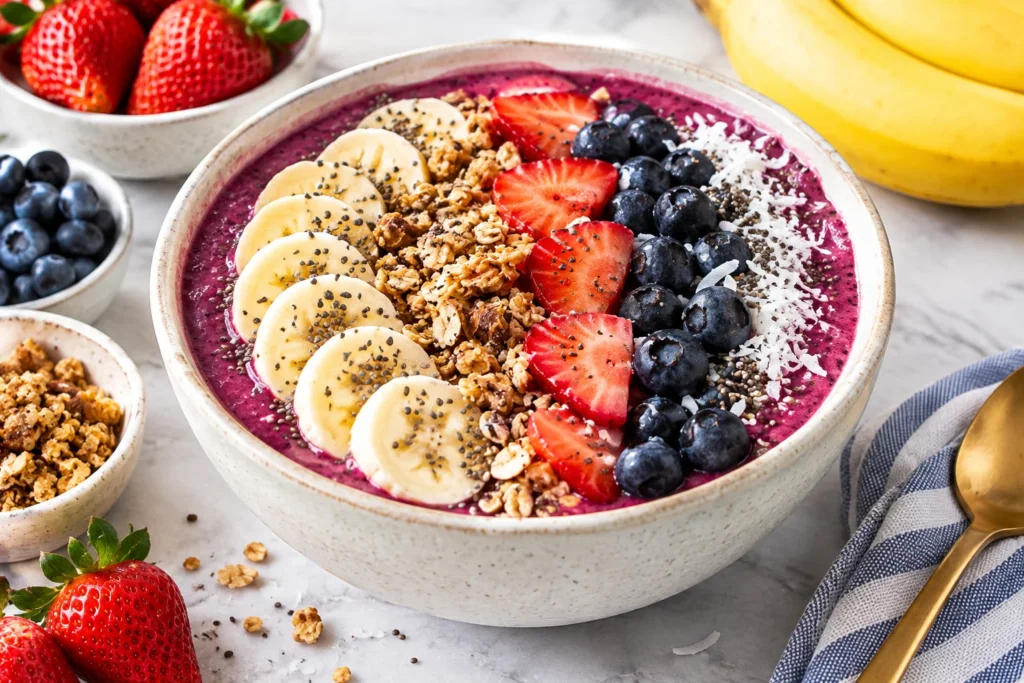
A smoothie bowl is mostly frozen fruit, which means the protein has to come from somewhere else. Blend a cup of plain Greek yogurt and half a cup of cottage cheese with half a cup of milk and about two cups of frozen berries or banana until the mixture is thick enough to hold a spoon. Cottage cheese blends smooth, and it supplies roughly 11 grams for every 100 grams without changing the flavor much.
Protein powder is a common addition, but products vary so much that we've left it out of the numbers. If you use one, check its label for protein per scoop and add that figure yourself. Pour the blend into two bowls, top with seeds and sliced fruit, and rinse the blender jar right away.
The nutrition: Expect about 21g of protein per bowl, from the yogurt, cottage cheese, and milk; the fruit and toppings aren't counted.
Cottage Cheese Breakfast Bowl
Cottage cheese is the quiet high performer of the dairy case, at about 11 grams of protein by USDA data. Spoon 0.75 cup into each bowl, then add sliced fruit, a few chopped pecans, and a drizzle of honey or maple syrup if you like. Because it needs no cooking at all, this is among the fastest bowls in the article.
Why this works: Cottage cheese has a mild, salty flavor that pairs well with sweet fruit, so the bowl tastes balanced without much added sugar.
The nutrition: A bowl gives you about 20g of protein, almost all from the cottage cheese.
If you don't like the curds, blend the cottage cheese for a few seconds until it's smooth. Small-curd cottage cheese is an easy place to start for people who are new to it. A pinch of cinnamon or a little lemon zest changes the flavor without adding sugar.
Yogurt Granola Berry Bowl
Layering matters more than quantity in a yogurt bowl. Put a third of the yogurt in the bottom, add a handful of berries, spoon in more yogurt, and finish with granola on top so it doesn't soften. Use 1.5 cups of plain Greek yogurt for two bowls, which is where all of the counted protein in this bowl comes from.
Granola is sold in so many versions, with anywhere from a few grams to double digits of protein per serving, that we haven't counted it. Check the label if protein is the goal, and choose one with less added sugar. Frozen berries thaw into a light syrup in the bowl, which means you can skip the sweetener.
The nutrition: This bowl comes to about 19g of protein from the yogurt alone; granola and berries aren't counted.
Protein Smoothie Bowl
A spoonable protein smoothie has to be thicker than a drinkable one, and the thickness comes from less liquid and more frozen fruit. Blend 1 cup of cottage cheese, half a cup of Greek yogurt, half a cup of milk, and about two cups of frozen fruit, pulsing and scraping the jar until it's smooth. Pour it into two bowls and scatter a couple of tablespoons of pumpkin seeds on top.
The nutrition: Each bowl provides about 22g of protein, from the cottage cheese, yogurt, milk, and pumpkin seeds.
This version is higher in protein than the first smoothie bowl because it leans on both dairy foods instead of one. If you'd prefer a drinkable version, add more milk until it pours. The blender is the only appliance involved, and the jar needs only a quick rinse.
Yogurt Parfait Bowl
A parfait is a bowl you build in stripes. Alternate a scant cup of plain Greek yogurt with a spoonful of rolled oats and a layer of fruit, and end with fruit on top. Raw rolled oats soften in the yogurt over a few minutes, and dry oats hold roughly 17 grams of protein in each 100 grams, by USDA data.
Why this works: The oats absorb a little of the yogurt's moisture and turn from crunchy to chewy, which gives the parfait a texture that granola can't.
Make it in a jar the night before and it becomes an overnight version that's thicker and chewier. Keep the jar covered and cold until you eat it. Add the fruit in the morning if you don't want it to bleed into the yogurt.
The nutrition: A parfait bowl provides about 21g of protein, with the yogurt supplying most of it and the oats adding a few grams.
Hard-Boiled Egg Protein Plate
Boil a batch of eggs once and breakfast is settled for several days. Lower six eggs into simmering water, cook them for 10 to 12 minutes, cool them in cold water, and refrigerate them in their shells. The FDA says hard-cooked eggs, in the shell or peeled, should be used within a week of cooking.
For each plate, peel three eggs and serve them with an ounce of sliced cheddar and a slice or two of whole-grain toast. A pinch of salt, pepper, or paprika is all they need. The plate takes under five minutes once the eggs are boiled, and the pot is the only dish you'll wash. Eggs are also one of the cheapest proteins you can buy, which is why they show up in our high-protein meal prep ideas on a budget.
The nutrition: Three eggs, an ounce of cheddar, and the toast add up to about 31g of protein per plate.
Why this works: Chilling the eggs quickly in cold water stops the cooking, which keeps the yolks tender instead of chalky.
Berry Yogurt Crunch Bowl
Crunch is the point of this bowl, so the toppings go on at the last second. Spoon three-quarters of a cup of Greek yogurt into each bowl, then top with toasted pecans, a spoonful of pumpkin seeds, and a handful of fresh or thawed berries. The seeds hold about 19 grams of protein for every 100 grams, which is more than most people expect from a topping.
The nutrition: Every bowl delivers roughly 23g of protein, from the yogurt, pumpkin seeds, and pecans.
Toasting the nuts in a dry pan for a few minutes brings out their flavor, though it adds a pan to wash. If you want to stay at zero pans, use them raw. Keep the berries in a separate container if you're packing the bowl to eat later.
Smoked Salmon Breakfast Plate
Smoked salmon deserves a safety note before the recipe. The refrigerated kind sold as lox, nova, or cold-smoked salmon isn't cooked, and FoodSafety.gov advises pregnant women, adults 65 and older, and people with weakened immune systems to avoid it unless it has been heated to 165°F or is sold canned or shelf-stable. For everyone else it's a normal choice, and it's the most brunch-like plate on the list. For more fish-forward meals later in the day, see our omega-3 rich dinners.
To build the plate, spread two tablespoons of cream cheese on each slice of toast, lay on about three ounces of salmon per plate, and add cucumber slices, capers, and lemon. If you need the heated version, warm the salmon in a skillet until it's steaming hot throughout and serve it on the toast. We used the USDA's value for salmon of about 20 grams in every 100 grams, which is conservative because brands of smoked salmon vary.
The nutrition: Each plate gives about 24g of protein, from the salmon, cream cheese, and toast.
Eggs, Doneness, and Who Is at the Table
This is the section to read before you cook any of the plates that follow. The FDA says a lightly cooked egg with a runny white or yolk poses a greater risk than a thoroughly cooked one, and that lightly cooked whites and yolks have both been linked to Salmonella outbreaks. The people most at risk of serious illness are pregnant women, young children, older adults, and people with weakened immune systems. That's why every recipe here cooks the eggs until the whites and yolks are firm.
If you do want a runny yolk, the safer route is pasteurized eggs. In-shell pasteurized eggs are heated to destroy Salmonella without cooking the egg, and the USDA says they can be used in recipes that call for raw or lightly cooked eggs. Pasteurized liquid egg products, including the cartons of egg whites, are also an option. A Memorial Sloan Kettering baked egg recipe takes a middle path by baking until the yolks register 160°F, which leaves them set but still slightly soft.
Handling matters as much as doneness. Cooked eggs and egg dishes shouldn't sit out of the refrigerator for more than 2 hours, according to the FDA. Leftover egg dishes keep 3 to 4 days in the refrigerator, hard-cooked eggs keep up to a week, and casseroles should reach 160°F in the center. Keep eggs refrigerated at 40°F or below until you use them.
One Pan
Ten plates cook in a single skillet or griddle, with a toaster at most. Have the pan hot before the eggs go in, and keep the heat at medium so they set evenly. If you cook this way often, our high-protein skillet dinners use the same one-pan approach for dinner.
Veggie Omelet Plate
An omelet is forgiving as long as you control the heat. Whisk six eggs with a splash of milk, cook half at a time in a lightly oiled nonstick skillet over medium heat, scatter spinach and feta over the surface, and fold when the eggs are set. The FDA says eggs should be cooked until both yolk and white are firm, so give the omelet another minute after the center stops looking wet.
Why this works: Making two small omelets instead of one large one keeps the layer thin, so the center cooks through before the outside turns rubbery.
The nutrition: An omelet with two slices of toast comes to about 29g of protein, and the eggs and feta supply most of it.
Serve each omelet with a slice or two of whole-grain toast and some fruit. Sauté watery vegetables such as mushrooms or tomatoes before they go in, so they don't thin the eggs. One skillet and a toaster are all the equipment you need.
Egg and Bacon Bowl
Bacon is an easy way to add protein, but the number depends on whether you count raw or cooked weight. We counted 6 ounces of raw bacon, which is about 13 grams of protein per 100 grams by the raw USDA value. Cook it in a cold skillet over medium heat until crisp, drain it on paper towels, pour off most of the fat, and cook six eggs in the same pan until the whites and yolks are firm.
The nutrition: Count on about 35g of protein per serving, with the eggs and the raw-weight bacon doing most of the work.
Why this works: Cooking the eggs in the same skillet picks up the bacon's browned bits, so there's flavor without any sauce.
Divide the eggs and bacon between two bowls over toast or a cup of cooked rice, and add halved cherry tomatoes. Portion control matters with bacon, since it's high in sodium, and a few slices go a long way. One skillet covers the whole meal.
Scrambled Egg Breakfast Plate
Scrambled eggs go wrong in two ways: they're cooked too fast, or they're taken off the heat while still wet. The FDA is specific that scrambled eggs shouldn't be runny, so keep the heat at medium-low, stir gently, and cook until the eggs are fully set and no liquid remains. Whisk six eggs with a splash of milk, stir in half a cup of shredded cheddar near the end, and serve.
Pair the eggs with two slices of whole-grain toast and sliced fruit or tomatoes. Leftover scrambled eggs count as an egg dish, which the FDA says to refrigerate and use within 3 to 4 days. Reheat them until they're steaming hot.
The nutrition: The eggs, cheddar, and toast together give each plate about 31g of protein.
Never Miss a Recipe
Fresh high-protein recipes, meal prep ideas, and kitchen tips, straight to your inbox every week. No spam, just good food.
No spam. Unsubscribe anytime.
Egg Crepe Plate
An egg crepe is just a thin omelet that you roll instead of fold. Whisk six eggs with a pinch of salt, pour a quarter of the mixture into a lightly oiled nonstick skillet, tilt the pan to spread it thin, and cook until the top is set. Sprinkle on cheddar and spinach, roll it up, and repeat to make four crepes.
The nutrition: Two crepes per plate deliver about 26g of protein; the eggs make up the bulk and the cheddar adds the rest.
Because the layers are thin, the eggs set quickly and don't turn rubbery as long as the pan isn't too hot. Slice the rolls into pinwheels for a different look on the plate. Serve with fruit or a small salad, and refrigerate leftovers within 2 hours.
Egg White Veggie Bowl
Liquid egg whites sold in a carton are pasteurized egg products, which is a safety advantage if you like softer scrambles. Pour 1.5 cups into a hot, lightly oiled skillet with sautéed spinach and peppers, stir gently until the whites are fully opaque and firm, and fold in a quarter cup of shredded cheddar. USDA data lists raw egg whites at about 11 grams of protein per 100 grams.
Serve the eggs over a cup of cooked quinoa shared between the bowls, and top with avocado slices if you like. Avocado has very little protein, about 2 grams per 100 grams, so it adds creaminess and not much else. Egg whites cook faster than whole eggs, so watch the pan.
Why this works: Egg whites are almost pure protein and cook to a tender set, so the quinoa and the cheese supply the flavor and body.
The nutrition: Egg whites, quinoa, and cheddar give each bowl about 27g of protein.
Savory Egg and Veggie Bowl
Chickpeas are the swap that makes a vegetable bowl high in protein. Sauté onion, peppers, and zucchini in a skillet, add half a can of rinsed chickpeas, then make wells and cook four eggs right in the pan, covered, until the whites and yolks are firm. A lid traps steam and sets the eggs without flipping.
The nutrition: Eggs lead the protein in this bowl, with chickpeas, feta, and rice bringing it to about 22g.
Spoon the mixture over a cup of cooked rice shared between the bowls, and crumble a quarter cup of feta on top. This bowl is a good way to use up vegetables that are getting soft. Whatever vegetables you have will work as long as they're cut small enough to cook evenly.
Breakfast Burrito Bowl
Skip the tortilla and the burrito becomes a bowl with more room for protein. Scramble four eggs until they're set and no longer runny, then pile them over a cup of cooked rice shared between two bowls, with a rinsed can of black beans, warmed, and a quarter cup of shredded cheddar. A drained can of black beans holds about 15 grams of protein by USDA data, which is why this bowl stays filling without meat.
Warm the beans in the same skillet after the eggs come out, so you only use one pan. Cooked rice kept in the refrigerator should be cooled within about an hour of cooking, according to university extension guidance, and reheated until steaming hot. A microwave pouch of rice is a convenient shortcut that skips the cooling step.
The nutrition: Four eggs, a can of black beans, and a little rice and cheddar bring each bowl to about 26g of protein.
Avocado Toast with Egg
The usual mistake with avocado toast is treating the egg as a garnish and the toast as the main event. Toast four slices of whole-grain bread, mash an avocado with lemon and salt, and spread it on, then top each slice with a fried egg cooked until the yolk and white are firm. The FDA says to cook eggs until both are firm, and a soft yolk carries more risk for children, older adults, pregnant women, and people with weakened immune systems.
Why this works: Mashed avocado gives the toast a creamy base, so the egg can be cooked through without the plate feeling dry.
The nutrition: Two slices with two eggs give about 24g of protein per serving, and avocado adds very little at about 2 grams per 100 grams.
If you want a runny yolk, look for pasteurized in-shell eggs, which the USDA says can be used safely without cooking, or for pasteurized egg products. Fry the eggs in a lightly oiled pan over medium heat and cover the pan briefly to set the white. A toaster and one skillet are the only equipment, so it fits a rushed morning as easily as the plans in our quick high-protein dinners for busy school nights.
Loaded Avocado Toast Plate
Loaded means the toast carries more than avocado and an egg. Spread half a cup of cottage cheese under the avocado, add a fried egg with a firm yolk, and sprinkle on two tablespoons of pumpkin seeds. The cottage cheese adds about 12 grams of protein to the plate, which is nearly as much as the eggs do.
The nutrition: A plate of two loaded toasts brings about 32g of protein, shared among the bread, eggs, cottage cheese, and pumpkin seeds.
Spread the cottage cheese thickly, then add the mashed avocado on top so the toast stays crisp underneath. Cut each slice in half to make it easier to eat, and serve with fruit. Toast the bread well, since the toppings are creamy.
Why this works: Cottage cheese acts as a protein-rich spread that holds the avocado in place and keeps the bread from going soggy.
Protein Pancake Plate
Protein pancakes work best when you skip the powder and use foods that already have protein in them. Blend a cup of rolled oats, four eggs, and half one cup of cottage cheese with a ripe banana until the batter is smooth, then let it rest a few minutes so the oats absorb liquid. Cook small pancakes on a lightly oiled griddle over medium heat until the edges are set and the center is firm, because the batter contains raw eggs.
Top each stack with Greek yogurt and fruit in place of syrup, which adds protein and cuts the sugar. Cooked pancakes keep in the refrigerator, and since they contain eggs, the FDA's 3 to 4 day rule for egg dishes applies. Reheat them in a toaster or a skillet.
The nutrition: A plate of pancakes with yogurt on top lands near 32g of protein, with oats, eggs, cottage cheese, and yogurt each pitching in.
Two Pots
Three plates that need a second pot or pan, and they're the ones that feel most like a restaurant breakfast. They're also the three that are usually served with the softest eggs, so each one has a note on cooking the eggs through. Plan on a slower weekend morning for these, and for one-pot cooking at other meals, see our one-pot dinners with real protein.
Poached Egg and Polenta Bowl
Poached eggs need more time than most people give them if the goal is a firm yolk. The FDA and USDA say poached eggs should be cooked until both white and yolk are firm, so simmer them gently in barely bubbling water until the yolk no longer moves when you nudge it with a spoon. Cook the polenta in a separate pot according to the package, since cooking times vary by grind.
Why this works: A pot of polenta gives the eggs a creamy bed that stands in for the runny yolk, so you don't miss the sauce.
Stir a quarter cup of grated Parmesan into the polenta, and top each bowl with two poached eggs and crumbled bacon. Crisp the bacon in a wide skillet first, pour off the fat, then add water and poach the eggs there, so your two pots are the polenta and the skillet. If you want the traditional runny yolk, use pasteurized in-shell eggs.
The nutrition: Eggs, polenta, raw-weight bacon, and Parmesan combine for about 26g of protein per bowl.
Eggslut-Style Egg Bowl
This bowl copies a famous cafe dish: a smooth potato puree under soft eggs, served with toast for scooping. Boil a pound of peeled, cubed potatoes until tender, mash them with a quarter cup of milk and a pinch of salt, and keep them warm. Scramble six eggs gently over low heat until they're set but still creamy, and make sure no liquid egg remains, since the FDA says scrambled eggs shouldn't be runny.
The nutrition: A bowl of potato puree under eggs delivers about 37g of protein, and the eggs account for most of it.
Spoon the eggs over the potato puree, sprinkle on half a cup of cheddar, and serve with two slices of toast. The original dish uses very soft eggs, but the safer version is cooked fully set, or made with pasteurized egg products if you want it softer. Potatoes are low in protein, about 2 grams per 100 grams, so the eggs carry the bowl.
Egg Dip Crostini Plate
An egg dip is basically egg salad that you spread. Chop six hard-cooked eggs, mix them with half a cup of Greek yogurt, mustard, chives, salt, and pepper, and spread the mixture on toasted baguette slices. USDA guidance puts egg dishes such as egg salad at 3 to 4 days in the refrigerator, so make the dip no more than a couple of days ahead.
Toast 12 baguette slices and keep them separate from the dip until you serve, so they stay crisp. Set the dip on the plate with cucumber slices and cherry tomatoes. The plate is shareable, which makes it a good choice for a weekend breakfast with company.
The nutrition: Eggs, yogurt, and baguette slices bring each plate to about 34g of protein.
Why this works: Greek yogurt replaces most of the mayonnaise, so the dip stays creamy while adding protein.
One Baking Dish
Three recipes that let the oven do the work. Because they contain eggs, each one should reach 160°F in the center, per the FDA, and the thermometer is more reliable than the clock. The last two also feed a crowd and keep for several mornings, which suits the same planning as our cheap high-protein dinners to feed six.
Baked Eggs with Toast
A Memorial Sloan Kettering recipe for baked eggs with tomatoes and mozzarella gives a useful temperature. It bakes the ramekins at 350°F for about 15 minutes, until the whites are opaque and the yolks register 160°F or higher on an instant-read thermometer, which leaves them set but still slightly soft. Simmer a 28-ounce can of crushed tomatoes with onion and garlic first, divide the sauce among four ramekins with mozzarella, and crack two eggs into each.
The nutrition: Two eggs with mozzarella and a slice of toast give each serving about 24g of protein.
Serve each ramekin with a slice of toast for dipping. The sauce can be made a day ahead, which makes the morning bake quick. A yolk that reaches 160°F meets the temperature the FDA lists for egg dishes.
Egg Bake Plate
An egg bake feeds a crowd from one dish. Several extension recipes bake a 9 by 13-inch pan at 350°F for about 35 to 45 minutes, and the center needs to reach 160°F, per the FDA's rule for casseroles and other egg dishes. Whisk 12 eggs with a cup of milk, stir in 1.5 cups of shredded cheddar, 8 ounces of diced ham, and vegetables, and pour into a greased dish.
Assemble it the night before and refrigerate it, then add a few minutes to the bake if it goes in cold. Cut it into eight squares and serve each with fruit or toast. Leftover squares keep 3 to 4 days in the refrigerator, which makes this a good make-ahead choice for a busy week, as in our healthy meal prep dinner ideas.
The nutrition: Each square carries about 20g of protein, mostly from the eggs, with ham and cheddar contributing the rest.
Cinnamon Roll Egg Bake Plate
Canned cinnamon roll dough turns an egg bake into dessert for breakfast, but it also means the dish contains raw dough. Cut the rolls into pieces, set them in a greased 9 by 13-inch dish, and pour over a custard of eight eggs, a cup of milk, and a cup of cottage cheese blended smooth. One published version bakes at 350°F for 40 to 45 minutes, and the center should reach 160°F per the FDA, so check with a thermometer instead of the clock.
Why this works: Blending cottage cheese into the custard adds protein without adding a noticeable flavor, so the bake still tastes like a cinnamon roll.
The nutrition: A square plus a quarter cup of yogurt on the side provides about 17g of protein; the eggs, cottage cheese, milk, and yogurt supply it, and the dough and icing aren't counted.
Serve each square warm with plain Greek yogurt and fruit in place of the full icing. The icing packet that comes with the rolls is mostly sugar, so use only a little. Assemble the dish the night before and bake it in the morning, adding a few minutes if it goes in cold.
How We Counted Protein
Protein is calculated from USDA nutrient data for the exact quantities on each recipe card. A serving is one bowl or plate for the first 22 recipes, as stated on each card, and the baked eggs, the egg bake, and the cinnamon roll bake are divided into 4, 8, and 8 servings. Eggs are counted at about 6.3 grams each, plain Greek yogurt at 10.3 grams per 100 grams, cottage cheese at 11 grams, and raw egg whites at 10.9 grams.
Some items aren't counted because their protein varies by brand: granola, protein powder, cinnamon roll dough and icing, and most vegetables and fruit. Bacon is weighed raw. The smoked salmon plate uses the USDA's lower value for salmon, about 20 grams per 100 grams, and the real figure depends on the product you buy. These numbers are close approximations, not lab measurements, and they'll shift with portion size and brand.
Questions About High-Protein Breakfast Bowls
How long do hard-cooked eggs keep?
The FDA says hard-cooked eggs, in the shell or peeled, should be used within a week of cooking. Egg salads and other cooked egg dishes keep 3 to 4 days in the refrigerator. Cooked eggs shouldn't sit out for more than 2 hours.
Is a runny yolk safe?
The FDA advises cooking eggs until both the white and the yolk are firm, and says a runny egg poses a greater risk. That risk is highest for pregnant women, young children, older adults, and people with weakened immune systems. Pasteurized in-shell eggs or egg products are the safer way to get a softer result.
What temperature should an egg bake reach?
The FDA says casseroles and other dishes containing eggs should reach 160°F in the center. Check with an instant-read thermometer, because color and wobble aren't reliable. Most 9 by 13-inch egg bakes take roughly 35 to 45 minutes at 350°F.
Can pregnant women eat smoked salmon?
FoodSafety.gov advises pregnant women, adults 65 and older, and people with weakened immune systems to avoid refrigerated smoked salmon unless it's heated to 165°F. Canned or shelf-stable smoked salmon is a lower-risk choice. For everyone else, cold-smoked salmon is an ordinary food.
Are carton egg whites pasteurized?
Liquid egg products sold in cartons are pasteurized, according to the FDA and USDA descriptions of egg products. That makes them a good choice for softer scrambles, though they should still be cooked until firm. Raw egg whites hold about 10.9 grams of protein by USDA data.
Do I need protein powder?
None of the recipes here require it. Protein powders vary widely and aren't included in the numbers, so check the label if you add one. Greek yogurt and cottage cheese bring the protein in the blended bowls.
Which breakfast has the most protein?
The Eggslut-style egg bowl leads at about 37g per bowl, followed by the egg and bacon bowl at about 35g and the egg dip crostini plate at about 34g. The lightest are the cinnamon roll egg bake at about 17g and the yogurt granola berry bowl at about 19g. Granola and dough aren't counted, so the real numbers for those two may be a little higher.
Can I make these ahead?
Several keep well. Hard-cooked eggs last a week, egg bake squares keep 3 to 4 days, and the egg dip and pancakes follow the same 3 to 4 day rule. The yogurt and cottage cheese bowls are best assembled fresh so the toppings stay crisp.
1. Greek Yogurt Power Bowl
Approx. 22g ProteinIngredients: 1 1/2 cups plain Greek yogurt, 1/4 cup chopped pecans, 2 tbsp roasted pumpkin seeds, 1 cup berries, granola (optional).
Step 1: Spoon 3/4 cup yogurt into each bowl.
Step 2: Top with the pecans, pumpkin seeds, and berries just before eating.
2. Smoothie Bowl
Approx. 21g ProteinIngredients: 1 cup plain Greek yogurt, 1/2 cup cottage cheese, 1/2 cup milk, about 2 cups frozen berries or banana, toppings of your choice.
Step 1: Blend the yogurt, cottage cheese, milk, and frozen fruit until thick enough to hold a spoon.
Step 2: Pour into two bowls and add toppings.
3. Cottage Cheese Breakfast Bowl
Approx. 20g ProteinIngredients: 1 1/2 cups cottage cheese, 1/4 cup chopped pecans, sliced fruit, honey or maple syrup (optional).
Step 1: Spoon 3/4 cup cottage cheese into each bowl.
Step 2: Add the fruit and pecans and drizzle with honey or syrup if you like.
4. Yogurt Granola Berry Bowl
Approx. 19g ProteinIngredients: 1 1/2 cups plain Greek yogurt, 1 cup berries, 1/2 cup granola.
Step 1: Layer yogurt, berries, and more yogurt in each bowl.
Step 2: Finish with the granola on top.
5. Protein Smoothie Bowl
Approx. 22g ProteinIngredients: 1 cup cottage cheese, 1/2 cup plain Greek yogurt, 1/2 cup milk, about 2 cups frozen fruit, 2 tbsp pumpkin seeds.
Step 1: Blend the cottage cheese, yogurt, milk, and fruit until smooth, scraping the jar as needed.
Step 2: Pour into two bowls and top with the pumpkin seeds.
6. Yogurt Parfait Bowl
Approx. 21g ProteinIngredients: 1 1/2 cups plain Greek yogurt, 1/3 cup rolled oats, 1 cup fruit.
Step 1: Alternate yogurt, oats, and fruit in two bowls or jars.
Step 2: Let stand a few minutes so the oats soften.
7. Hard-Boiled Egg Protein Plate
Approx. 31g ProteinIngredients: 6 large eggs, 2 oz sliced cheddar, 2 slices whole-grain toast, salt, pepper, paprika.
Step 1: Simmer the eggs 10 to 12 minutes, cool in cold water, and refrigerate in the shell (use within 1 week).
Step 2: Peel 3 eggs per plate and serve with 1 oz cheddar and a slice of toast.
8. Berry Yogurt Crunch Bowl
Approx. 23g ProteinIngredients: 1 1/2 cups plain Greek yogurt, 1/4 cup roasted pumpkin seeds, 1/4 cup pecans, 1 cup berries.
Step 1: Spoon the yogurt into two bowls.
Step 2: Top with the pecans, pumpkin seeds, and berries just before eating.
9. Smoked Salmon Breakfast Plate
Approx. 24g ProteinIngredients: 6 oz smoked salmon, 4 tbsp cream cheese, 2 slices whole-grain toast, cucumber slices, capers, lemon. Note: heat the salmon to 165°F first for anyone pregnant, 65 or older, or with a weakened immune system.
Step 1: Spread the cream cheese on the toast.
Step 2: Top with the salmon, cucumber, and capers and finish with lemon.
10. Veggie Omelet Plate
Approx. 29g ProteinIngredients: 6 large eggs, 2 tbsp milk, 2 cups baby spinach, 1/2 cup crumbled feta, 1 tbsp oil, 2 slices whole-grain toast.
Step 1: Whisk the eggs and milk.
Step 2: Cook half the eggs at a time in the oiled skillet over medium heat, adding the spinach and feta, until firm, and fold.
Step 3: Serve with the toast.
11. Egg and Bacon Bowl
Approx. 35g ProteinIngredients: 6 large eggs, 6 oz bacon, 2 slices toast (or 1 cup cooked rice), halved cherry tomatoes.
Step 1: Cook the bacon in a cold skillet over medium heat until crisp and drain.
Step 2: Pour off most of the fat and cook the eggs in the pan until the whites and yolks are firm.
Step 3: Divide over the toast with the bacon and tomatoes.
12. Scrambled Egg Breakfast Plate
Approx. 31g ProteinIngredients: 6 large eggs, 2 tbsp milk, 1/2 cup shredded cheddar, 2 slices whole-grain toast, fruit.
Step 1: Whisk the eggs and milk and cook over medium-low heat, stirring gently, until fully set and no liquid remains.
Step 2: Stir in the cheddar at the end.
Step 3: Serve with the toast and fruit.
13. Egg Crepe Plate
Approx. 26g ProteinIngredients: 6 large eggs, 1/2 cup shredded cheddar, 1 cup baby spinach, 1 tbsp oil, salt.
Step 1: Whisk the eggs with the salt and cook a quarter of the mixture at a time in an oiled nonstick skillet, spread thin, until set.
Step 2: Add the cheddar and spinach, roll up, and repeat to make four crepes.
14. Egg White Veggie Bowl
Approx. 27g ProteinIngredients: 1 1/2 cups liquid egg whites (pasteurized), 1/4 cup shredded cheddar, 1 cup spinach, 1/2 bell pepper, 1 cup cooked quinoa, 1 avocado (sliced).
Step 1: Sauté the spinach and pepper in a lightly oiled skillet.
Step 2: Add the egg whites and stir gently until fully opaque and firm. Fold in the cheddar.
Step 3: Serve over the quinoa with the avocado.
15. Savory Egg and Veggie Bowl
Approx. 22g ProteinIngredients: 4 large eggs, 1/2 can chickpeas (rinsed), 1/4 cup crumbled feta, 1 cup cooked rice, 1/2 onion, 1/2 bell pepper, 1 small zucchini.
Step 1: Sauté the vegetables in a skillet and add the chickpeas.
Step 2: Make four wells, crack in the eggs, cover, and cook until the whites and yolks are firm.
Step 3: Serve over the rice with the feta.
16. Breakfast Burrito Bowl
Approx. 26g ProteinIngredients: 4 large eggs, one 15-oz can black beans (rinsed), 1 cup cooked rice, 1/4 cup shredded cheddar, salsa.
Step 1: Scramble the eggs until set and no longer runny. Remove.
Step 2: Warm the beans in the same skillet.
Step 3: Divide the rice, beans, eggs, and cheddar between two bowls and top with salsa.
17. Avocado Toast with Egg
Approx. 24g ProteinIngredients: 4 slices whole-grain bread, 1 avocado, juice of 1/2 lemon, 4 large eggs, 1 tbsp oil, salt.
Step 1: Toast the bread and mash the avocado with the lemon and salt.
Step 2: Fry the eggs, covered briefly, until the whites and yolks are firm.
Step 3: Spread the avocado on the toast and top with the eggs.
18. Loaded Avocado Toast Plate
Approx. 32g ProteinIngredients: 4 slices whole-grain bread, 1 avocado, 4 large eggs, 1/2 cup cottage cheese, 2 tbsp pumpkin seeds.
Step 1: Toast the bread and spread with the cottage cheese.
Step 2: Mash the avocado on top and add the fried eggs (yolks firm).
Step 3: Sprinkle with the pumpkin seeds.
19. Protein Pancake Plate
Approx. 32g ProteinIngredients: 1 cup rolled oats, 4 large eggs, 1/2 cup cottage cheese, 1 ripe banana, 1/2 cup plain Greek yogurt, fruit, oil for the griddle.
Step 1: Blend the oats, eggs, cottage cheese, and banana until smooth and rest 5 minutes.
Step 2: Cook small pancakes on an oiled griddle over medium heat until the edges are set and the center is firm.
Step 3: Top with the yogurt and fruit.
20. Poached Egg and Polenta Bowl
Approx. 26g ProteinIngredients: 4 large eggs, 1/2 cup dry polenta, 4 oz bacon, 1/4 cup grated Parmesan, water for poaching.
Step 1: Cook the polenta per the package and stir in the Parmesan.
Step 2: Crisp the bacon in a wide skillet, pour off the fat, add water, and poach the eggs gently until the whites and yolks are firm.
Step 3: Serve the eggs over the polenta with the bacon.
21. Eggslut-Style Egg Bowl
Approx. 37g ProteinIngredients: 6 large eggs, 1 lb potatoes (peeled and cubed), 1/4 cup milk, 1/2 cup shredded cheddar, 2 slices toast, salt.
Step 1: Boil the potatoes until tender and mash with the milk and salt.
Step 2: Scramble the eggs gently over low heat until set and no liquid remains.
Step 3: Spoon over the potato with the cheddar and serve with toast.
22. Egg Dip Crostini Plate
Approx. 34g ProteinIngredients: 6 hard-cooked eggs (chopped), 1/2 cup plain Greek yogurt, 1 tsp mustard, 2 tbsp chives, 12 baguette slices (toasted), cucumber and cherry tomatoes.
Step 1: Mix the eggs, yogurt, mustard, chives, salt, and pepper.
Step 2: Spread on the toasted baguette slices just before serving.
Step 3: Serve with the cucumber and tomatoes. Use within 3 to 4 days.
23. Baked Eggs with Toast
Approx. 24g ProteinIngredients: One 28-oz can crushed tomatoes, 1/2 onion, 2 cloves garlic, 2 tbsp olive oil, 4 oz mozzarella, 8 large eggs, 4 slices toast.
Step 1: Preheat the oven to 350°F. Simmer the tomatoes with the onion, garlic, and oil until thick.
Step 2: Divide the sauce and mozzarella among four ramekins and crack two eggs into each.
Step 3: Bake about 15 minutes until the whites are opaque and the yolks register 160°F or higher. Serve with the toast.
24. Egg Bake Plate
Approx. 20g ProteinIngredients: 12 large eggs, 1 cup milk, 1 1/2 cups shredded cheddar, 8 oz diced cooked ham, 2 cups chopped vegetables, salt and pepper.
Step 1: Preheat the oven to 350°F and grease a 9 by 13-inch dish.
Step 2: Whisk the eggs and milk, stir in the cheddar, ham, and vegetables, and pour into the dish.
Step 3: Bake 35 to 45 minutes until the center reaches 160°F. Cut into eight squares.
25. Cinnamon Roll Egg Bake Plate
Approx. 17g ProteinIngredients: Canned cinnamon roll dough (cut into pieces), 8 large eggs, 1 cup milk, 1 cup cottage cheese (blended smooth), 2 cups plain Greek yogurt for serving, fruit.
Step 1: Preheat the oven to 350°F. Set the dough pieces in a greased 9 by 13-inch dish.
Step 2: Blend the eggs, milk, and cottage cheese and pour over the dough.
Step 3: Bake 40 to 45 minutes until the center reaches 160°F. Serve each square with 1/4 cup yogurt and fruit.
Get Fresh Recipes Every Week
Join readers getting fresh recipes, meal prep systems, and high-protein meal ideas delivered to your inbox every week.
No spam. Unsubscribe anytime.