
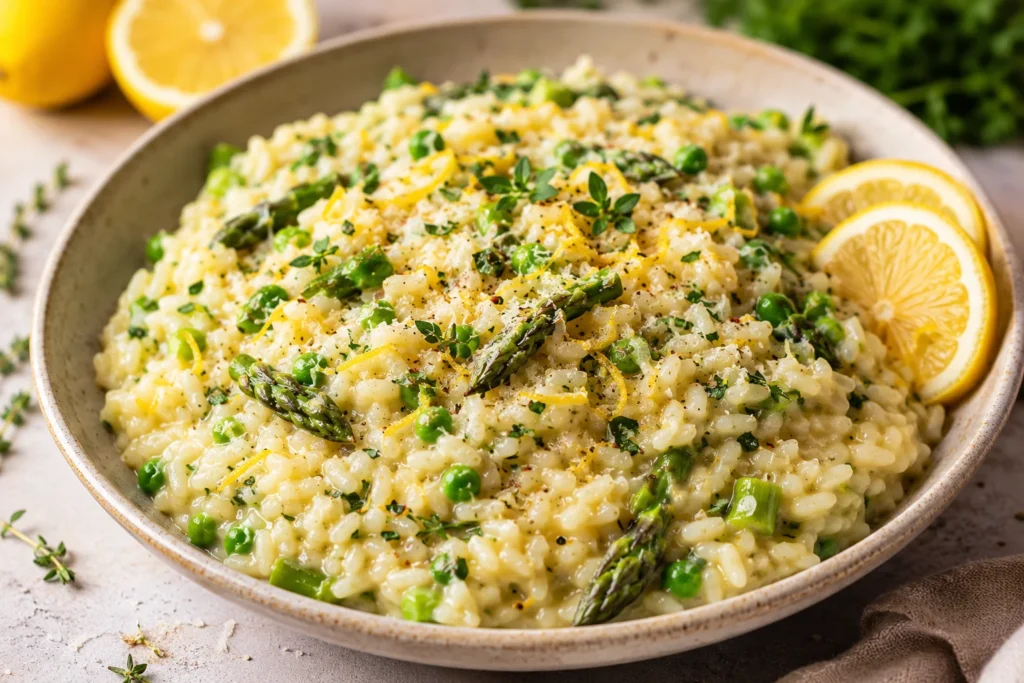
I make this the moment asparagus and peas show up at the market, it’s genuinely the dish that convinces me winter is actually over. Creamy arborio rice, bright lemon, and fresh spring vegetables come together into something that feels indulgent but is honestly pretty simple once you get the rhythm of it. I’ve rebuilt it here with a real protein path built in, not just an afterthought stirred in at the end.
Quick Summary
What it is: Creamy arborio rice slow-cooked with warm broth, finished with spring vegetables, lemon, and Parmesan.
Why it works: Arborio rice releases starch gradually as you stir in broth a ladle at a time, which builds a naturally creamy texture without any actual cream.
Timing: About 40 minutes total, mostly hands-on stirring, so it’s not a walk-away dish.
Flavor profile: Rich and comforting from the rice and Parmesan, but the lemon zest and fresh thyme keep it from ever feeling heavy.
Key move: Warm your broth before adding it. Cold broth shocks the rice and stalls the whole cooking process.
Why This Works
Risotto has a reputation for being finicky, but it’s really just one technique repeated patiently: add broth, stir, wait, repeat. The starch on the outside of arborio rice dissolves slowly into the liquid, thickening it around each grain while the inside of the rice stays just barely firm, that’s the texture you’re chasing.
The lemon zest and thyme go in at the very end, off the heat, so their brightness stays sharp instead of cooking away. If you’ve made my garlic parmesan roasted potatoes, this uses the same principle of building real flavor slowly rather than rushing the process, just with a completely different technique.
Never Miss a Recipe
Fresh high-protein recipes, meal prep ideas, and kitchen tips, straight to your inbox every week. No spam, just good food.
No spam. Unsubscribe anytime.
Ingredients (Serves 4)
- 2 tbsp olive oil
- 1 small onion, finely chopped
- 2 cloves garlic, minced
- 1.5 cups arborio rice the starch here is what makes risotto risotto, regular long-grain rice won’t give you the same creaminess
- 1/2 cup dry white wine (optional) adds acidity and depth; skip it and add a splash more broth if you’d rather not cook with wine
- 4 cups vegetable or chicken broth, warmed warm broth keeps the rice cooking evenly; cold broth drops the pan’s temperature and slows everything down unevenly
- 1 cup fresh asparagus, cut into 1-inch pieces
- 1 cup sweet peas, fresh or frozen
- 1 tsp lemon zest
- 1 tbsp fresh thyme leaves
- 1 tbsp butter
- 1/4 cup grated Parmesan, plus more for garnish
- Salt and pepper, to taste
Ingredients (Serves 4)
- 2 tbsp olive oil
- 1 small onion, finely chopped
- 2 cloves garlic, minced
- 1.5 cups arborio rice
- 1/2 cup dry white wine (optional)
- 4 cups vegetable or chicken broth, warmed
- 1 cup fresh asparagus, cut into 1-inch pieces
- 1 cup sweet peas, fresh or frozen
- 1 tsp lemon zest
- 1 tbsp fresh thyme leaves
- 1 tbsp butter
- 1/4 cup grated Parmesan, plus more for garnish
- Salt and pepper, to taste
Instructions
- Warm olive oil in a heavy-bottomed pan over medium heat. Cook onion 3-4 min until translucent. Add garlic, stir 1 min until fragrant.
- Add arborio rice, toast briefly stirring so every grain is coated in oil. Add white wine, let it bubble and reduce almost completely.
- Add warm broth one ladle at a time, stirring slowly and letting the rice absorb each addition before adding more.
- After 15 minutes, add asparagus and peas. Continue adding broth and stirring until rice is creamy but holds a slight bite, about 20 more minutes.
- Off heat, stir in lemon zest, thyme, butter, and Parmesan. Adjust salt and pepper. Serve immediately.
Troubleshooting
- Gummy instead of creamy: Broth added too fast or heat too high. Slow, steady ladles with constant light stirring is the trick.
- Rice stayed hard in center: Broth likely went cold. Keep it at a low simmer the entire time.
- Turned out bland: Risotto needs more salt than expected. Taste before serving and adjust, extra lemon zest also helps.
How I Actually Make It
Equipment: A heavy-bottomed pan, a separate small pot to keep the broth warm, a ladle, and a wooden spoon for stirring. Nothing fancy.
I warm the olive oil in the heavy-bottomed pan over medium heat, then cook the diced onion for 3 to 4 minutes until translucent. I add the garlic and stir for about a minute, just until fragrant, garlic burns fast if I look away too long here.
I add the arborio rice and toast it briefly, stirring so every grain gets coated in the oil. This step matters more than it seems, toasting the rice helps it hold its shape through the long stirring process ahead. I pour in the white wine and let it bubble and reduce almost completely before I start ladling in the warm broth, one ladle at a time, stirring slowly and letting the rice fully absorb each addition before pouring in more.
After about 15 minutes of this rhythm, I add the asparagus and peas. I keep stirring and adding broth until the rice turns creamy but still holds a slight bite at the center, usually another 20 minutes total, tasting a grain here and there to check. Off the heat, I stir in the lemon zest, thyme, butter, and Parmesan, then adjust salt and pepper to taste. I serve it immediately, risotto waits for no one.
Turning This Into a Real Protein Source
As written, this risotto is comfort food first, not a protein-forward meal, a serving runs somewhere around 8 to 10g of protein depending on the broth used.
I'll often stir in 6 oz of grilled shrimp or diced chicken during the last few minutes, which pushes a serving to around 30g of protein without changing the texture or flavor balance at all. White beans work well too for a vegetarian version, a can folded in near the end adds real protein and barely changes that creamy texture people love this dish for. If you want more meals built protein-first from the start rather than added on afterward, my 25 high-protein dinners collection follows that same approach throughout.
Variations I've Tried
Swap the vegetables by season: Carrots work well when asparagus isn't available, cut them small so they finish cooking in the same window as the peas.
Make it dairy-free: Vegan butter and a plant-based Parmesan alternative both work here without changing the method at all.
Mushroom version: Sautéed mushrooms added with the onion bring a completely different, earthier direction if spring vegetables aren't in season yet.
Add protein directly into the rice: Stir in cooked shrimp, chicken, or white beans during the last 5 minutes so everything finishes warm together, rather than serving cold protein on top of hot risotto.
Troubleshooting
My risotto turned out gummy instead of creamy. Usually the broth was added too fast, or the heat ran too high and cooked the rice unevenly. Slow, steady ladles with constant light stirring is really the whole trick, patience matters more than technique here.
The rice stayed hard in the center even after 30 minutes. Your broth may have gone cold partway through, which stalls the cooking. Keep it at a low simmer in a separate pot the entire time you're making risotto.
It's turned out bland. Risotto needs more salt than people expect since the rice absorbs so much liquid. Taste right before serving and adjust, a little extra lemon zest at the end can also brighten a flat batch.
It seized up and got too thick before I finished. That usually means the broth ran out too early. Keep extra warm broth or even hot water on hand to loosen it back up.
Nutrition and Storage
The base recipe runs roughly 8 to 10g of protein per serving from the Parmesan and broth alone, with moderate calories from the rice and butter. Adding 6 oz of shrimp or chicken brings a serving closer to 30g of protein.
Storage: Risotto is genuinely best fresh since it firms up considerably as it cools, the starch keeps setting even off the heat. Leftovers keep in the fridge for up to 3 days.
Reheating: I add a splash of broth or water and reheat gently on the stovetop over low heat, stirring often to loosen the starch back up. Microwaving works in a pinch but tends to make the texture slightly gluey.
Make-ahead tip: If I know I'm short on time, I'll cook the risotto about 80% of the way, then finish it with the remaining broth, vegetables, and toppings right before serving.
Frequently Asked Questions
Can I make risotto ahead of time?
It's genuinely best fresh, but you can partially cook it (about 80% of the way) and finish it just before serving without losing much texture.
Can I skip the wine?
Yes, just add a small splash of extra broth in its place. You'll lose a bit of acidity, so a little extra lemon at the end helps make up for it.
Why does risotto need constant stirring?
Stirring releases the starch from the rice into the broth gradually, which is what builds that creamy texture. Skipping it leads to unevenly cooked rice and a thinner, less cohesive result.
How accurate is the protein estimate?
The base recipe's protein comes mostly from the Parmesan and broth, roughly 8 to 10g per serving. Adding 6 oz of shrimp or chicken brings a serving to about 30g. Our Macro Calculator can help you recalculate based on your exact add-ins.
Risotto has a reputation for being finicky, but the technique really is just patience and attention, nothing more advanced than that. According to the USDA, shrimp is one of the most efficient proteins you can stir into a dish like this, lean, fast-cooking, and it barely changes the texture that makes risotto worth making in the first place. If you're mapping out a full week of meals built around real protein numbers instead of guesswork, my 30-Day Protein Plan tool can help lay that out from the start.
Get Fresh Recipes Every Week
Join readers getting fresh recipes, meal prep systems, and high-protein meal ideas delivered to your inbox every week.
No spam. Unsubscribe anytime.